If it were my personal tractor and I was restoring it to perfection, one thousandth on one bearing would not justify me grinding the crank or buying a new one. That's just me. I say leave it like it is, nobody will notice it for a very very very long time. (And by the way I am a machinist and make things within tenths of one thousandths all the time, one thousandth on one bearing isn't gonna be noticeable on the oil gauge.)

You are using an out of date browser. It may not display this or other websites correctly.
You should upgrade or use an alternative browser.
You should upgrade or use an alternative browser.
R.O.C.K Restoration Project
- Thread starter rockfarmer
- Start date
The right answer!Chipmaker":3vtvag2k said:I say leave it like it is . . .)
If you are that concerned about the clearance there is a simple trick to fix it so the bearings can come out the same, they make .002 undersize bearings, use one .002 bearing shell and the standard for the other half and it will be in spec., I rebuild a lot of these and this was a common practice years ago with old machinists, I have used this method myself to get a crank in spec, realized your crank has all ready been under sized so that method will not work, sorry to confuse you with that
another method is a piece of brass shim stock under the bearing shell to bring it in to spec
another method is a piece of brass shim stock under the bearing shell to bring it in to spec
rockfarmer
501 Club
I was advised by a forum member, while the engine is fine as is, why not reverse the front and rear bearings just to see if the clearance issue moved with the bearing(s). What I found, while doing this, is the front and rear bearing Caps were on backwards....History was made, by a dummy!...because I'm sure this is the first time this has ever happened, ever, in the lifetime of Farmall!
Reversed the caps with one half of the bearing attached and the rear came into spec while the front stayed in spec. :{_}:
Many thanks for all your suggestions, as we continue to restore ol' Rocky.
Reversed the caps with one half of the bearing attached and the rear came into spec while the front stayed in spec. :{_}:
Many thanks for all your suggestions, as we continue to restore ol' Rocky.
rockfarmer
501 Club
My wife and I attended a meeting at ROCK this evening where this years Barn Dance theme was unveiled.

I was asked to present Rocky and our restoration project donation to the board members. I provided a brief history of the CUB and its original target market, thank you A.T.I.S. I also explained that I am by no means an expert in restoring Farmall cubs, but, I do know someone who knows someone who is really good at restoring these tractors. :wink: I told them about y'all and this website. Their excitement was off the chart! I was asked if I could get an expert to the Barn Dance this year to elaborate on the Cub and its capabilities. I told them I would ask.
If anyone considers themselves or another an expert on these tractors, and I know there are many of you out there, and would like to attend this event, my wife and I will provide you and your significant other with round trip airfare and lodging for 2-3 nights in beautiful Georgetown, TX. The bluebonnets should be in full bloom at that time...there, I asked! I can only afford one expert, by the way.
Rocky is going to be the center piece auction item placed on a turn table among-st well over 600 guests. The band, "Asleep at the Wheel" will be performing during the event and hopefully someone with lots of money, and the urge to donate to ROCK, will be in the market for a vintage 1949 garden tractor.
I was asked to present Rocky and our restoration project donation to the board members. I provided a brief history of the CUB and its original target market, thank you A.T.I.S. I also explained that I am by no means an expert in restoring Farmall cubs, but, I do know someone who knows someone who is really good at restoring these tractors. :wink: I told them about y'all and this website. Their excitement was off the chart! I was asked if I could get an expert to the Barn Dance this year to elaborate on the Cub and its capabilities. I told them I would ask.
If anyone considers themselves or another an expert on these tractors, and I know there are many of you out there, and would like to attend this event, my wife and I will provide you and your significant other with round trip airfare and lodging for 2-3 nights in beautiful Georgetown, TX. The bluebonnets should be in full bloom at that time...there, I asked! I can only afford one expert, by the way.
Rocky is going to be the center piece auction item placed on a turn table among-st well over 600 guests. The band, "Asleep at the Wheel" will be performing during the event and hopefully someone with lots of money, and the urge to donate to ROCK, will be in the market for a vintage 1949 garden tractor.
Chipmaker":2rhtk8tr said:I'd like to say thank you for what you and your wife are doing and I know someone will wind up with a great tractor but most importantly what the money is going towards is the awesome part. Thank you both for what y'all are doing.
 ito: I'll second that.
rockfarmer
501 Club
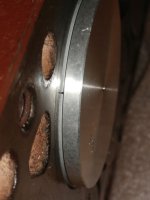
I was encouraged to check the end gap clearances on the rings before assembling the engine, so I purchased a set of feeler gauges. It was pretty easy once I got the first one done. All of them checked in around 0.012". This is in spec for the original iron pistons, according to page 1-5 in service manual. Is there a difference for over sized aluminum pistons?
Here is one of the top ring gaps slightly exposed during installation.
Torqued in and ready to go.
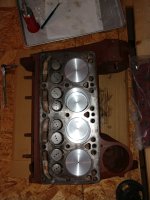
Also checked the side clearances and everything is in spec.
Next steps are;
1. Install Idler gear
2. Install front cover
3. Install crankshaft pulley, which will need it's wear sleeve installed first.
4. Install rear retainer and oil pump.
5. Install valve cover and water inlet pipe.
Here is one of the top ring gaps slightly exposed during installation.
Torqued in and ready to go.
Also checked the side clearances and everything is in spec.
Next steps are;
1. Install Idler gear
2. Install front cover
3. Install crankshaft pulley, which will need it's wear sleeve installed first.
4. Install rear retainer and oil pump.
5. Install valve cover and water inlet pipe.
rockfarmer
501 Club
It's been a while since we provided an update on Rocky's Progress. I'm sorry to say that there has been very little assembly progress in the past month due to work getting in the way, but, Santa Claus stepped up the game yesterday by delivering the last of Rocky's newly painted body! Blessed, is all I can say.
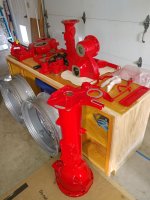
I will most likely be asking lots of questions this week with the first being; Should I prime the areas where the powder coating was not applied? More specifically, should the areas where the cast parts are joined together and perhaps the gasket areas be left as bare steel? I know it is important to keep a good ground through the chassis.
Now, with time off work, we hope to get Rocky reassembled and running before January 1st! Nothing really special about the date, just a milestone target set about 7 months ago. It's going to be extremely cold here this week, 50's and 30's, so I have the heater in the garage and fleece lined work gloves on standby
Since the tractor is totally disassembled, I plan on counting the parts today, just curious, to see how many there are, excluding fasteners and attachments.
I have new head bolts, grade 9, and a nice collection of dot heads to use during reassembly. Permatex Aviation gasket sealer for the bolts and copper spray for the head gasket.
Question 2. How much of the head bolt's thread should be coated with permatex?
I will most likely be asking lots of questions this week with the first being; Should I prime the areas where the powder coating was not applied? More specifically, should the areas where the cast parts are joined together and perhaps the gasket areas be left as bare steel? I know it is important to keep a good ground through the chassis.
Now, with time off work, we hope to get Rocky reassembled and running before January 1st! Nothing really special about the date, just a milestone target set about 7 months ago. It's going to be extremely cold here this week, 50's and 30's, so I have the heater in the garage and fleece lined work gloves on standby
Since the tractor is totally disassembled, I plan on counting the parts today, just curious, to see how many there are, excluding fasteners and attachments.
I have new head bolts, grade 9, and a nice collection of dot heads to use during reassembly. Permatex Aviation gasket sealer for the bolts and copper spray for the head gasket.
Question 2. How much of the head bolt's thread should be coated with permatex?
Hi,
Nice looking parts in the pic.
My opinion, the edges of the slot for the fan, could be painted red.
Where the castings join together should be bare, that's how IH made them. They do need to provide a ground for the electrical system. Where gaskets go should be bare too.
Stir the Aviation Form A Gasket well before using it.
Don't hurry, trying to finish the work by January 1. Take your time and ask questions if you need to.
I don't know how long the threads are on your head bolts. Only the bottom 3/4" needs coating with the sealer.
Before putting them in with the head on, while the head is off, clean all the head bolt threads with a tap, turned in by hand. Then turn each bolt into the threads fully by hand, they all should turn freely in and out by hand.
The rim in the pic, closest to the camera, does not look in too good a shape. Just my opinion.
Nice looking parts in the pic.
My opinion, the edges of the slot for the fan, could be painted red.
Where the castings join together should be bare, that's how IH made them. They do need to provide a ground for the electrical system. Where gaskets go should be bare too.
Stir the Aviation Form A Gasket well before using it.
Don't hurry, trying to finish the work by January 1. Take your time and ask questions if you need to.
I don't know how long the threads are on your head bolts. Only the bottom 3/4" needs coating with the sealer.
Before putting them in with the head on, while the head is off, clean all the head bolt threads with a tap, turned in by hand. Then turn each bolt into the threads fully by hand, they all should turn freely in and out by hand.
The rim in the pic, closest to the camera, does not look in too good a shape. Just my opinion.
rockfarmer
501 Club
Thanks Glen. Jan. 1 was the Eggnog talking this morning. After working all day cleaning up the garage so that I can find everything, I stopped counting painted parts at 58.
Here is a close up of the rim in question.
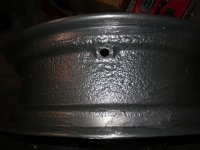
Pretty bad around valve stem and center of rim but not too bad around the lip.
Here is a close up of the rim in question.
Pretty bad around valve stem and center of rim but not too bad around the lip.
staninlowerAL
501 Club
If you decide to use it, this can be reinforced with a couple layers of resin and fiberglass cloth before painting. I would not hesitate to use the rim. After all, it will never see high speed or excess pressure. Install a bushing to fit the modern smaller tube valve stem to the rim's larger hole (available at a tire repair shop). Just my 2 cents worth.
If you had that rim powdercoated I wouldn’t hesitate using it like it is. Like Stan said, it won’t see high speed. It doesn’t hold a lot of weight or have a lot of pressure in it either. I’ve seen some a lot worse than that still pumped up being used on big tractors.
The red looks great! I agree with what Glen said about not painting the areas where they touch other areas other than where the fan will be.
The red looks great! I agree with what Glen said about not painting the areas where they touch other areas other than where the fan will be.
rockfarmer
501 Club
I'm glad you all think the rims are OK, especially now that they are painted. Did not realize they were in that bad of shape.
I decided to go with a black manifold, since it is a high temp coating (1000 degrees F) and the red will not stay red very long.
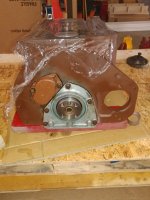
Oil pump and a "new" rear retainer by tst were installed using aviation gasket sealer on both sides of gaskets.
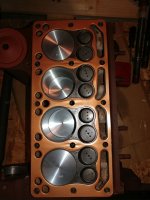
Installed the head using permatex copper sealer on both sides of the head gasket.
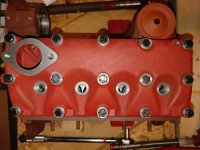
Torqued to 30 then 45 ft-lbs following the service manual's tightening sequence 1-15,
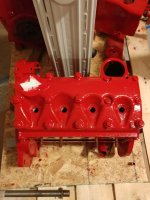
and applied a coat of color matched PU coating.
Next: front cover, governor and pulley installation
I decided to go with a black manifold, since it is a high temp coating (1000 degrees F) and the red will not stay red very long.
Oil pump and a "new" rear retainer by tst were installed using aviation gasket sealer on both sides of gaskets.
Installed the head using permatex copper sealer on both sides of the head gasket.
Torqued to 30 then 45 ft-lbs following the service manual's tightening sequence 1-15,
and applied a coat of color matched PU coating.
Next: front cover, governor and pulley installation
Hi,
Looks good.
I would use some paint thinner on a rag, and remove all the paint on the rear of the engine, around the edge, where the bare surface on the clutch housing meets the engine. It has to be bare so it will ground for the electrical system. That is how they were new.
Also remove the paint from the front of the engine, on the 2 mountings for the front end, and from the front end casting, where it bolts to the engine, if those have paint.
Remove the paint where flat surfaces on castings bolt together.
One suggestion, if you ever do another engine, I would use more gradual steps torquing the head bolts. 20, 30, 40, 45 ft lbs.
Looks good.
I would use some paint thinner on a rag, and remove all the paint on the rear of the engine, around the edge, where the bare surface on the clutch housing meets the engine. It has to be bare so it will ground for the electrical system. That is how they were new.
Also remove the paint from the front of the engine, on the 2 mountings for the front end, and from the front end casting, where it bolts to the engine, if those have paint.
Remove the paint where flat surfaces on castings bolt together.
One suggestion, if you ever do another engine, I would use more gradual steps torquing the head bolts. 20, 30, 40, 45 ft lbs.
staninlowerAL
501 Club
Remember to retorque the head bolts after you run the engine up to operating temperature.
rockfarmer
501 Club
Glen, I did torque the bolts from finger tight to 30, 40, then 45. I will take your advice on the next one and be a little more patient. Also, plan on using a rotary sander to remove the primer/paint between the engine block and torque tube, starter, front bolster, oil pan, water outlet, hydraulic pump and front cover. It's hard for me to look at bare steel w/o wanting to slap some paint on it. Pet Peeve. I will have to say that the metallurgy on these tractors are phenomenal from a corrosion perspective. I have blasted parts laying in my garage for weeks where the humidity has been as high as 90% with no visible flash rust. Great USA made iron!
When should the re-torquing of the head bolts happen? While the engine is still warm or allow it to cool first?
When should the re-torquing of the head bolts happen? While the engine is still warm or allow it to cool first?