
You are using an out of date browser. It may not display this or other websites correctly.
You should upgrade or use an alternative browser.
You should upgrade or use an alternative browser.
R.O.C.K Restoration Project
- Thread starter rockfarmer
- Start date
Shane Nelson":2eik0pqt said:You may could try it in an oven on for a bit. I’ve always used a big cutting torch to heat the ones I’ve done. It is for sure a tight press but will fall right in when heated enough.
We've been known to use both the oven, and a freezer when needed where I work. You just might could try both here
rockfarmer
501 Club
You all ROCK!!!
1 hour in the freezer,

+
15 minutes on the grill,

=


1 hour in the freezer,
+
15 minutes on the grill,
=
That looks like it was a lot easier than using a torch too!
rockfarmer
501 Club
Absolutely! I highly recommend this method! p.s. Wife would not let me use the oven.Bob McCarty":3p98t0jw said:That looks like it was a lot easier than using a torch too!
I got the front hubs put together with pre-packed bearings, and packed as much as i could into the housing and caps,

...and figure, when I get it full of grease, it will exit from the zerk hole installed by a PO,
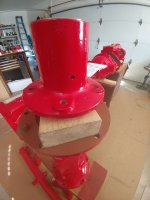
Question: Should I plug this hole, or install a zerk fitting?

Don McCombs
501 Club
Definitely close the hole. Otherwise, it will be an entry point for grit and moisture. A zerk of the appropriate thread size will probably be easier to find than a plug.
rockfarmer
501 Club
I will look for a plug first, so that no one is tempted to attach a grease gun and start pumping away.
rockfarmer
501 Club
Just checked. 1/4-28. Threads are still clean so loctite should work good. This will allow me to finish up the front axle and move on to the finals.
When I purchased the tractor, I noticed several of the implement bolt holes had been over-sized. I thought, no problem, just get them heli-coiled. Well, after getting them soda blasted and painted I discovered some major thread erosion, and half (6) of them have been over-sized to 3/4". The machine shop says they can repair all of them, even the 3/4" holes.


The potential problem is in order to convert the 3/4" holes to 5/8" coils, they need to drill the hole to 7/8". Will that leave enough iron to provide adequate performance?
When I purchased the tractor, I noticed several of the implement bolt holes had been over-sized. I thought, no problem, just get them heli-coiled. Well, after getting them soda blasted and painted I discovered some major thread erosion, and half (6) of them have been over-sized to 3/4". The machine shop says they can repair all of them, even the 3/4" holes.
The potential problem is in order to convert the 3/4" holes to 5/8" coils, they need to drill the hole to 7/8". Will that leave enough iron to provide adequate performance?
rockfarmer
501 Club
I gave the machine shop a green light on installing the coils into the finals. Hopefully I will have them back in a day or two. In the meantime, its back to the front axle.
I packed the bearings and housing with as much grease as I could get in there without making a huge mess. I then installed the small bearing and castle nut with a 9/16 inch washer separating them. I did not see a washer in the installation procedure but without it, the cotter pin hole is on top of the nut and not in one of the castellations. Therefore, I presume it belongs there since it was on when disassembled.
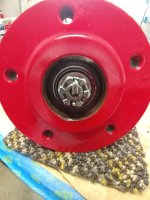
The manual says to rotate the hub while tightening the nut until a slight drag is felt, then back the castle nut off til the next castellation is accessible, and insert cotter pin.
In doing so, the spindle now spins freely and there is very little drag. Edit; I loosened the castle nut and hand tightened only. Inserted the cotter pin and it now it has enough drag that it will not spin freely.
I don't want to ruin the bearings and races by not having it tight enough, at the same time, I don't want to over tighten either.
This happened recently on a tandem trailer I purchased. One hub was not tightened enough by the manufacturer and by the time I put 2,000 miles on it the tire was ruined.
I packed the bearings and housing with as much grease as I could get in there without making a huge mess. I then installed the small bearing and castle nut with a 9/16 inch washer separating them. I did not see a washer in the installation procedure but without it, the cotter pin hole is on top of the nut and not in one of the castellations. Therefore, I presume it belongs there since it was on when disassembled.
The manual says to rotate the hub while tightening the nut until a slight drag is felt, then back the castle nut off til the next castellation is accessible, and insert cotter pin.
In doing so, the spindle now spins freely and there is very little drag. Edit; I loosened the castle nut and hand tightened only. Inserted the cotter pin and it now it has enough drag that it will not spin freely.
I don't want to ruin the bearings and races by not having it tight enough, at the same time, I don't want to over tighten either.
This happened recently on a tandem trailer I purchased. One hub was not tightened enough by the manufacturer and by the time I put 2,000 miles on it the tire was ruined.
staninlowerAL
501 Club
I've always used the "slight drag" technique to tension the bearings, never had a problem with one in the past. Lookin' Good!!
rockfarmer
501 Club
Thanks Stan!
After tightening the castle nut until a "slight drag was felt", I packed the cap with grease and screwed it on. Unscrewed the cap, packed some more grease and repeated 2 more times until grease began coming out of the zerk hole.

Repeated for the other hub. The holes functioned nicely as vent holes while packing and insured the Hub was full of grease.
Temporarily plugged the holes with zerk fittings and installed in the front axle;

It seems like it would be easier to assemble the front axle after it is attached to the front bolster rather than a pre-assembly. I recall it being a bear to put the axle on with 2 dangling, spinning, 10 lb weights attached to each side. Any thoughts?
After tightening the castle nut until a "slight drag was felt", I packed the cap with grease and screwed it on. Unscrewed the cap, packed some more grease and repeated 2 more times until grease began coming out of the zerk hole.
Repeated for the other hub. The holes functioned nicely as vent holes while packing and insured the Hub was full of grease.
Temporarily plugged the holes with zerk fittings and installed in the front axle;
It seems like it would be easier to assemble the front axle after it is attached to the front bolster rather than a pre-assembly. I recall it being a bear to put the axle on with 2 dangling, spinning, 10 lb weights attached to each side. Any thoughts?
Hi,
Below is a page from the 1949 Cub owner's manual with info about greasing the front wheel bearings.
I guess you meant the washer between the nut, and the outer bearing. It is C in the pic.
http://farmallcub.com/rudi_cub/www.clea ... age-16.jpg
Below is a page from the 1949 Cub owner's manual with info about greasing the front wheel bearings.
I guess you meant the washer between the nut, and the outer bearing. It is C in the pic.
http://farmallcub.com/rudi_cub/www.clea ... age-16.jpg
rockfarmer
501 Club
Glad to see the washer in the picture. It looks like it's time to read the owners manual, again. It's been so long since I read it, instead relying on service manuals and previous threads for information. Just goes to show, you can never read too much. Thanks Glen!


rockfarmer
501 Club
#12 yes. I remember those washers well!!! When restoring the '62. I forgot to install them until the wheels were on. I lost my religion for a few hours while getting them back in. Installing them with just the tube will be much easier. Thanks for the tip.
rockfarmer
501 Club
Finals are back from the machine shop with new implement holes!

They did a fine job I must say! Had to write a new program for their machine. I ask them to keep the program.
I noticed there was no casting date on the left final.
They did a fine job I must say! Had to write a new program for their machine. I ask them to keep the program.
I noticed there was no casting date on the left final.
Hi,
The parts look good.
I would scrape all the paint off where the round cap, held on with the 4 bolts, goes on the final drive. Also the other 2 flat places, 1 where the seal on the lower axle shaft bolts on, and the cap at the end of the upper shaft. Also remove the paint where the castings bolt onto the tractor, if there is paint.
I posted at Shane's post about your Touch Control lever.
The parts look good.
I would scrape all the paint off where the round cap, held on with the 4 bolts, goes on the final drive. Also the other 2 flat places, 1 where the seal on the lower axle shaft bolts on, and the cap at the end of the upper shaft. Also remove the paint where the castings bolt onto the tractor, if there is paint.
I posted at Shane's post about your Touch Control lever.