
You are using an out of date browser. It may not display this or other websites correctly.
You should upgrade or use an alternative browser.
You should upgrade or use an alternative browser.
Something wrong with the touch control
- Thread starter NewCubGuy
- Start date

Based on your added information, it doesn't sound like you have added any 80W90 to the Touch-Control unit. You probably need to fill it to get it working. Taking this to the next potential problem, if your Touch-Control has become empty with no obvious leak, it is leaking into the engine at the hydraulic pump. A new shaft o-ring might fix it.
Having Hy-Tran in the transmission is not a problem. There is no need to drain/replace. If it is overfull, drain down to the level plug
Having Hy-Tran in the transmission is not a problem. There is no need to drain/replace. If it is overfull, drain down to the level plug
Thanks for the picture, the Cub looks good.
Too bad the serial number plate is gone.
Below is info about finding the year the castings of the Cub were made.
Cubs have date codes cast on the larger castings of the tractor.
The codes tell the date the parts were made.
The year is a letter code.
Below is info from TM Tractor showing what date codes are.
The page below shows where the date codes are. You may need a good light to see the date codes.
The code on the clutch housing is usually partly behind the clutch pedal.
http://www.tmtractor.com/id/castdate_loc.htm
There should be an engine serial number on the left side of the engine.
The engine serial number will be close the tractor serial number, but not the same, it may be a few hundred, or a few thousand above the tractor serial number, if it is the original engine, sometimes people replace the engine.
Below is a page from the 1955 Cub owner's manual showing where the engine serial number is.
The number is stamped in the block, you may need to clean the area, and use a light to see it.
Too bad the serial number plate is gone.
Below is info about finding the year the castings of the Cub were made.
Cubs have date codes cast on the larger castings of the tractor.
The codes tell the date the parts were made.
The year is a letter code.
Below is info from TM Tractor showing what date codes are.
The page below shows where the date codes are. You may need a good light to see the date codes.
The code on the clutch housing is usually partly behind the clutch pedal.
http://www.tmtractor.com/id/castdate_loc.htm
There should be an engine serial number on the left side of the engine.
The engine serial number will be close the tractor serial number, but not the same, it may be a few hundred, or a few thousand above the tractor serial number, if it is the original engine, sometimes people replace the engine.
Below is a page from the 1955 Cub owner's manual showing where the engine serial number is.
The number is stamped in the block, you may need to clean the area, and use a light to see it.
Right, I did not add any 89/90 to the touch control. I drained the touch control this evening but I’ll have to get some more Hy Tran to fill it. Not sure I got it completely empty. Maybe I should let it drain for a day or so till I get back to it. Boy, am I losing it. This stuff used to be easy! I certainly appreciate everyone’s patience.Based on your added information, it doesn't sound like you have added any 80W90 to the Touch-Control unit. You probably need to fill it to get it working. Taking this to the next potential problem, if your Touch-Control has become empty with no obvious leak, it is leaking into the engine at the hydraulic pump. A new shaft o-ring might fix it.
Having Hy-Tran in the transmission is not a problem. There is no need to drain/replace. If it is overfull, drain down to the level plug
I read somewhere that the casting numbers were not gospel as they might pull a new one off the shelf from a couple of years ago to use when building a tractor, but hey, I’ve already proved my level of knowledge with these tractors. Wouldn’t make much sense to have a part from a 1960 used on a 55 unless it was done during the restore. As mentioned in my original post, I was losing oil out of the rear main. The engine oil never went down so it must have been the touch control that lost it. That make sense?Thanks for the picture, the Cub looks good.
Too bad the serial number plate is gone.
Below is info about finding the year the castings of the Cub were made.
Cubs have date codes cast on the larger castings of the tractor.
The codes tell the date the parts were made.
The year is a letter code.
Below is info from TM Tractor showing what date codes are.
The page below shows where the date codes are. You may need a good light to see the date codes.
The code on the clutch housing is usually partly behind the clutch pedal.
http://www.tmtractor.com/id/castdate_loc.htm
There should be an engine serial number on the left side of the engine.
The engine serial number will be close the tractor serial number, but not the same, it may be a few hundred, or a few thousand above the tractor serial number, if it is the original engine, sometimes people replace the engine.
Below is a page from the 1955 Cub owner's manual showing where the engine serial number is.
The number is stamped in the block, you may need to clean the area, and use a light to see it.
Was the engine oil higher than full on the dipstick?
The reason I asked about the dipstick level is that overfull indicates the pump shaft o-ring is leaking. If you added you won't be able to tell.
staninlowerAL
501 Club
Yup, individual or even multiple parts might have come from a donor. The idea is to check all the major castings and see if they are the same year. Month and day might vary and even year if the part came from a donor. In your first post, replacing the rear main should have solved the leak there. There is no connection between the TC and the engine oil sump (oil pan), that's why Bob asked the question. If the engine oil rises without adding any oil, it's highly likely that the TC pump is leaking into the oil up by the front engine cover. JMHO StanI read somewhere that the casting numbers were not gospel as they might pull a new one off the shelf from a couple of years ago to use when building a tractor, but hey, I’ve already proved my level of knowledge with these tractors. Wouldn’t make much sense to have a part from a 1960 used on a 55 unless it was done during the restore. As mentioned in my original post, I was losing oil out of the rear main. The engine oil never went down so it must have been the touch control that lost it. That make sense?
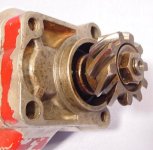
The Touch Control pump is gear driven by the engine timing gears. That's why the Touch Control is supposed to work whenever the engine is running.
You can see where the pump is in the page I posted showing the parts of the system.
The front of the pump is into where the engine oil is.
Below is a picture from TM Tractor Parts of the front of the pump, and the gear.
You can see where the pump is in the page I posted showing the parts of the system.
The front of the pump is into where the engine oil is.
Below is a picture from TM Tractor Parts of the front of the pump, and the gear.
Attachments
The idea that wide differences in date codes could come from the factory is one of those stories that can't be proven one way or another. Anything could happen. But with a foundry on-site and a tractor built by the thousands, a stray old part finding it's way to a new tractor is very unlikely. The idea of huge date variations from the factory has certainly been promoted by owners of pieced together tractors that are trying to present them as "factory original".I read somewhere that the casting numbers were not gospel as they might pull a new one off the shelf from a couple of years ago to use when building a tractor, . . .
I've had my suspicions that this tractor was somewhat pieced together since I brought it home. It doesn't really matter to me as it works well (usually) and looks great. I would just like to nail down the year. The easiest thing to say is 1955 because of the grill (although I guess is could be a 56?). That's what most people will look at and, who knows, it may have started life as a 55. I'll deal with that if I ever go to sell it I guess.
Right now it's sitting back there waiting for Hy Tran which I am picking up tonight. Other than that, it's ready to go. I'll report back (hope to be a good report) whenever it's done. I don't know when I've ever been on a forum that is so friendly and helpful. I sure do appreciate everybodys input.
Right now it's sitting back there waiting for Hy Tran which I am picking up tonight. Other than that, it's ready to go. I'll report back (hope to be a good report) whenever it's done. I don't know when I've ever been on a forum that is so friendly and helpful. I sure do appreciate everybodys input.
You will have an engine number STAMPED into the engine block. It is now your most important number as it is the only positive ID for the tractor. The year of the engine can be determined by that number. You can check date codes on various castings to see it they are near the engine date. They will be strong indicators of whether it was pieced together. Whether pieced together or not, you have a nice-looking tractor.
Thank you, and thankfully it runs as good as it looks.Whether pieced together or not, you have a nice-looking tractor.
The dual rear wheels are not often seen on here. I've wondered how they grip in soil, if they grip differently than single rear wheels.
I see in your picture the Cub has the deluxe seat. They came out in about 1957, or 1958. But some people put them on Cubs made before then, I think I have seen on here.
It looks like it is on top of the regular seat spring, there is no bracket on the left side of it that I can see in the picture.
The originals are mounted solidly to the Cub with 2 brackets, they don't use the spring.
They are also lower, so IH used a bent shift lever to clear the seat.
Below are pages from the 1965 Cub and LoBoy operator's manual showing the gear shift lever, and the seat from the rear.
https://farmallcub.club/rudi/farmal... Lo-Boy Operator's Manual 7-29-65/Page-04.jpg
https://farmallcub.club/rudi/farmal... Lo-Boy Operator's Manual 7-29-65/Page-15.jpg
If someone has made a bracket, or brackets for the seat that have welds, I would check the welds carefully, you don't need the seat breaking off from the base when using the Cub.
I see in your picture the Cub has the deluxe seat. They came out in about 1957, or 1958. But some people put them on Cubs made before then, I think I have seen on here.
It looks like it is on top of the regular seat spring, there is no bracket on the left side of it that I can see in the picture.
The originals are mounted solidly to the Cub with 2 brackets, they don't use the spring.
They are also lower, so IH used a bent shift lever to clear the seat.
Below are pages from the 1965 Cub and LoBoy operator's manual showing the gear shift lever, and the seat from the rear.
https://farmallcub.club/rudi/farmal... Lo-Boy Operator's Manual 7-29-65/Page-04.jpg
https://farmallcub.club/rudi/farmal... Lo-Boy Operator's Manual 7-29-65/Page-15.jpg
If someone has made a bracket, or brackets for the seat that have welds, I would check the welds carefully, you don't need the seat breaking off from the base when using the Cub.
RunningRed
Well-known member
I rebuilt my touch control and it was still jerky when raising it or lowering it. I just think that's how these Cubs are. Good looking cub though. The guys on here know more about cubs and anywhere else on the web. Don't forget to look at the manuals on here aswell. Tons of knowledgeable guys, got a question just ask.
I’ve tried plowing with one dual and without. Not a very fair comparison though as I was in corn stubble once and clean ground the other. Didn’t really noticed any difference other than the cool factor. I did plow with one dual in very wet ground and ended up taking around 300 pounds of mud home with me.The dual rear wheels are not often seen on here. I've wondered how they grip in soil, if they grip differently than single rear wheels.
I see in your picture the Cub has the deluxe seat. They came out in about 1957, or 1958. But some people put them on Cubs made before then, I think I have seen on here.
It looks like it is on top of the regular seat spring, there is no bracket on the left side of it that I can see in the picture.
The originals are mounted solidly to the Cub with 2 brackets, they don't use the spring.
They are also lower, so IH used a bent shift lever to clear the seat.
Below are pages from the 1965 Cub and LoBoy operator's manual showing the gear shift lever, and the seat from the rear.
https://farmallcub.club/rudi/farmallcub.com/rudi_cub/www.cleancomputes.com/Cub/Cub Owner's Manuals/International Cub & Lo-Boy Operator's Manual 7-29-65/Page-04.jpg
https://farmallcub.club/rudi/farmallcub.com/rudi_cub/www.cleancomputes.com/Cub/Cub Owner's Manuals/International Cub & Lo-Boy Operator's Manual 7-29-65/Page-15.jpg
If someone has made a bracket, or brackets for the seat that have welds, I would check the welds carefully, you don't need the seat breaking off from the base when using the Cub.