Nosparkplug
Active member
Short stroke or long stroke, long duration or short duration. It doesn’t take mass or the human factor out of the equation. I didn’t mean to ruffle any feathers. If I did please forgive me.


First let me say this equipment is typically not cheap, but you can cut some corners and save money. The automotive shops that do this type testing have pretty sophisticated equipment and analyzers with on screen capability for viewing the oscilloscope tracing in real time. I believe most folks that have their own personal equipment typically use what is called an automotive pico-scope. I have my own equipment which I have owned for about fifteen years and until now only used it for work related activities. So I really cannot comment on the pico-scope and how well they perform. I think they can be purchased for about $250 if you only need a couple of channel inputs.phill_mi":6j2p8foi said:I find this discussion very interesting. At some point can you share specs and source for the tools so someone with interest can duplicate the tests?
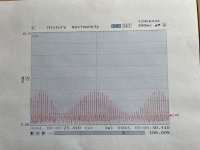
The engine was idling, no load. Under these conditions, even if idling at 1,800 rpm, the throttle is mostly closed to keep the engine from over-reving. This puts the intake manifold at high vacuum and limits the amount of air/fuel taken in at each intake stroke. The lower amount taken in reduces the compression reading accordingly. If you were to attach the engine to a full load so the throttle was wide open, you would see higher compression readings.inairam":2npoi4xh said:I wonder if the heat of the engine and from compression is somehow compromising the seal of the transducer and the mechanical gauge to the spark plug hole only allowing you to build up to 45 psi. ??
Jim Becker":13iwm0f1 said:During the test, was the engine speed being controlled by the governor? If so, it may have been cycling the throttle. I am guessing it could be moving the throttle enough to show up in the readings even if so slight that there was no audible speed variation. If this seems like a possibility and you want to chase it any more, there are a couple things you could try:
1) Move your sensor to the intake manifold and see if there is a cycle in the vacuum with the engine running at the previous test speed.
or
2) Repeat the running test setting the idle adjust screw to obtain the test speed, keeping the governor control at the slow idle position. This would take the governor out of the picture.
inairam":16x8hrwl said:Spark or not the fuel will be warm from the warm engine intake and the heat of compression will raise the temp in the cylinder and should vaporize most of the fuel as in a normal cycle even if the cylinder is not quite as hot from no spark/ignition burn from the previous cycle. The question would be during the expansion stroke if the fuel stays in vapor form or condenses before it is exhausted.
inairam":16x8hrwl said:I wonder if the heat of the engine and from compression is somehow compromising the seal of the transducer and the mechanical gauge to the spark plug hole only allowing you to build up to 45 psi. ??
SamsFarm":3szti5xv said:Not trying to beat you up about it.
Just curious, but what is the reason for all this?
What is the goal?