Wood splitter?

Rudi, Its does seem you are on the right track. I was also thinking of a unit that would be lighter without the tank. The 3x18 cylinder is a good start as it will be lighter and use less oil. BTW... I have a gauge on mine and most wood will split below 500psi pressure and most of that will barely move the gauge. Like you said, if you encounter a tough one you can deal with it another way. With the smaller cylinder comes a possibly smaller beam. I really like the wedge on the ram. If you get one stuck in the wood it can self retract out when the cylinder is reversed back through the gate. Have you thought about picking both forward and rear sets on mounting holes in the finals? That would have to greatly encrease the strength.
MERRY CHRISTMAS
 
Rudi. Before you jump into this let's do some calculations.

If the Cub's hydraulic pump puts out 1500 PSI then with the 3" cylinder you only get just over 10,600 lbs pressure. Probably not enough to split a knotted, twisted log or old oak. The Cub's high pressure safety valve is set between 1100 and 1500 PSI. So the actual pressure could be considerably less.

How many gallons per minute the pump puts out? Unknown
How big the hydraulic reservoir is?. 4.25 pints

It takes .55 gallon(4.40 pints) of hydraulic fluid to fill the cylinder 3"x18".
Then we need to figure in the cylinder shaft diameter. A 1.5" diameter shaft X 18" will displace 1.1 pints. The bare minimum capacity for the reservoir to operate a 3 x 18 would be 3.3 pints.

The Cub's hydraulic system would be the bare minimum to operate the log splitter. If the system were operated for very long it would more than likely over heat the hydraulic oil.

And then the Cub's hydraulic system system is closed - not vented. This is another problem area.
 
Yep what Eugene says. The tank also cools the fluid. The 3inch Ramis underdoing it a bit. No sense building a splitter and playing shoulda coulda.
 
WKPoor":3aqmp31k said:
Rudi, Its does seem you are on the right track. I was also thinking of a unit that would be lighter without the tank. The 3x18 cylinder is a good start as it will be lighter and use less oil. BTW... I have a gauge on mine and most wood will split below 500psi pressure and most of that will barely move the gauge. Like you said, if you encounter a tough one you can deal with it another way. With the smaller cylinder comes a possibly smaller beam. I really like the wedge on the ram. If you get one stuck in the wood it can self retract out when the cylinder is reversed back through the gate. Have you thought about picking both forward and rear sets on mounting holes in the finals? That would have to greatly encrease the strength.
MERRY CHRISTMAS

Bill:

Yup, :big smile:

Exactly. I was thinking on using both the for and aft mounting pads to increase the strength and the stability of the unit. And you are right, it has been my experience that most wood in my yard will split with very little pressure. Usually what would get split by smacking it with a maul.

The wedge on the ram is a good idea for my mind precisely because it will extricate itself from a stubborn or gnarly piece of pine or maple. A small cylinder means that less fluid is needed and what the hoses will hold will be more than enough.

Granted, I am not a metal fabricator, but to my mind much of the principles would be the same. Where I need the help is in the actual design, or maybe to vette my design with. I was figuring probably 2"x1" rectangular tubing for the support frame with welded mounting pads or something similar. I guess I really need to sketch something up.

Eugene, Bill:......

To my mind, be that what it may... I am not looking to build the penultimate wood splitter. I am looking for something that will negate the need for me to split with a maul. With my chest wired the way it is, a maul is less than the ideal tool to be splitting with. And as I said before, I am not interested in super sturdy, lets rip into a 3 foot chunk of gnarly maple that would take a 20 ton splitter to make toothpicks out of. I am looking to simply split birch, some maple, poplar, pine and fir. This is what I harvest, this is what I need to split. And as far as getting the Cubs hydraulics hot enough to damage something.. well that would mean I would have to be lifting something pretty heavy -- and that ain't gonna happen, not with my chest. :roll: :oops: :roll: :wink: :D :!:

If and when I need to split really stubborn stuff.. save it up for a weekend when I gots help, and I can go rent a splitter for $75.00 for the weekend if need be. Aside from that, Ellie will be more than enough pump for me to handle :shock: 8) :lol:
 
Rudi":1g61pd4c said:
Eugene, Bill:...To my mind, be that what it may... I am not looking to build the penultimate wood splitter. I am looking for something that will negate the need for me to split with a maul.

Aside from that, Ellie will be more than enough pump for me to handle.
Rudi. The pump size is not what you have to worry about. Most hydraulic pumps will put out about 1500 PSI. The really big difference in pumps is gallons per minute. The Cub's hydraulic pump will operate a wood splitter. Perhaps not very fast. It's the reservoir capacity that is limited - severly limited.

My previous calculations were based on the 3" X 18" cylinder. Most log splitters use 4" or larger cylinders. The Cub's reservoir is not large enough to handle cylinders that large.

Hydraulic oil will get heated just circulating through the pump.

My opinion. Over build the log splitter rather than under build it.

Look around for old hydraulic operated equipment. Last place I worked they had to have the junk man haul away (free) for old fork lifts. Old combines.

And another idea/thought. A screw driven wood splitter.
 
Before I graduated to the sofisticated world of hydraulics I had one of those corksrew splitters. It was called a Stickler- very simple- looked like a giant wood screw that bolted to a drive wheel axle. Still see them at swap meets. I ran mine off a Sears Suburban 12 h.p. garden tractor. You split the wood from the side, not the end. Worked very well -nothing to break. If you got into a really gnarly piece it would lift the tractor right off the jack. BTW Im still trying to master picture posting of my splitter pics. Got everything into Photobucket but now Im stuck. Frank
 
Frank - Photobucket makes it easy for you. The image tag links are there with the tags already imbeded. Just click on the one that starts with img and paste the whole link directly into your post. All the hard work has already been done for you by photobucket.
 
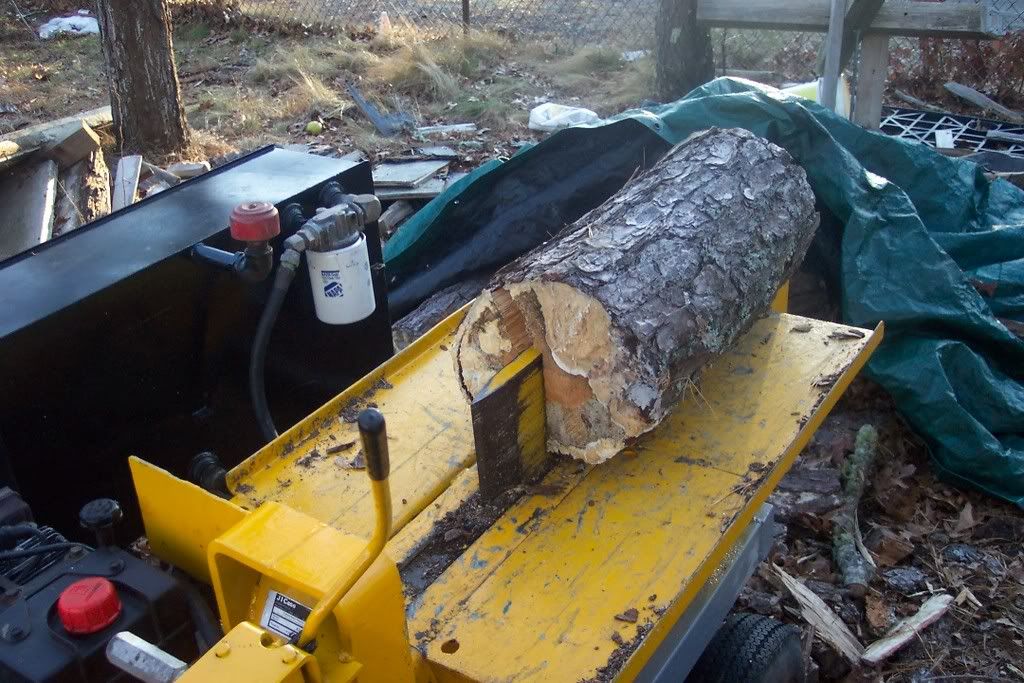
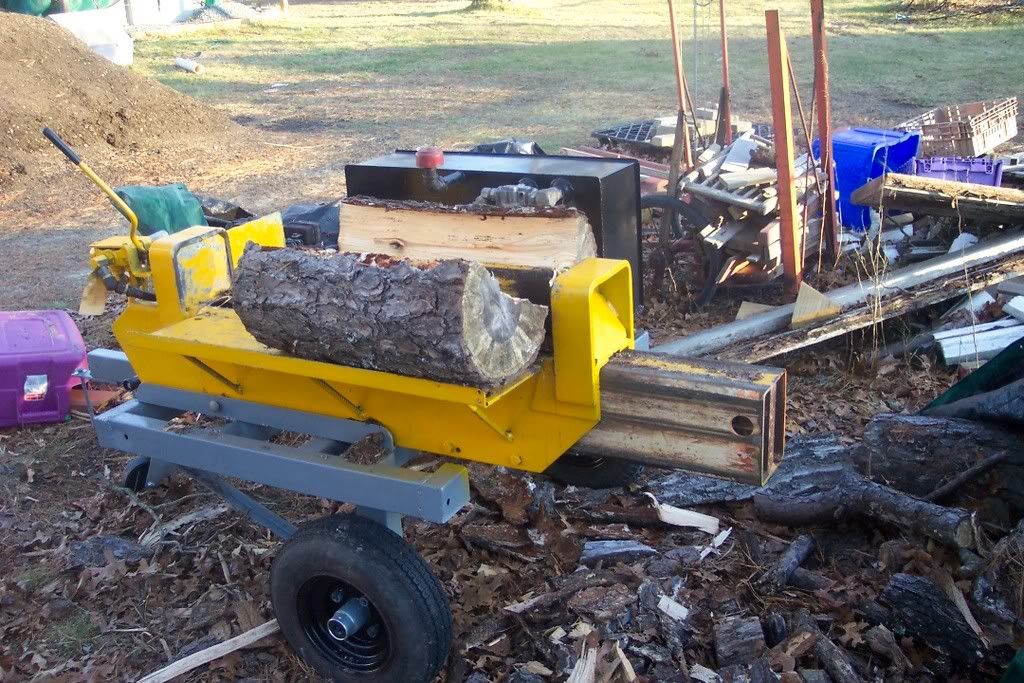
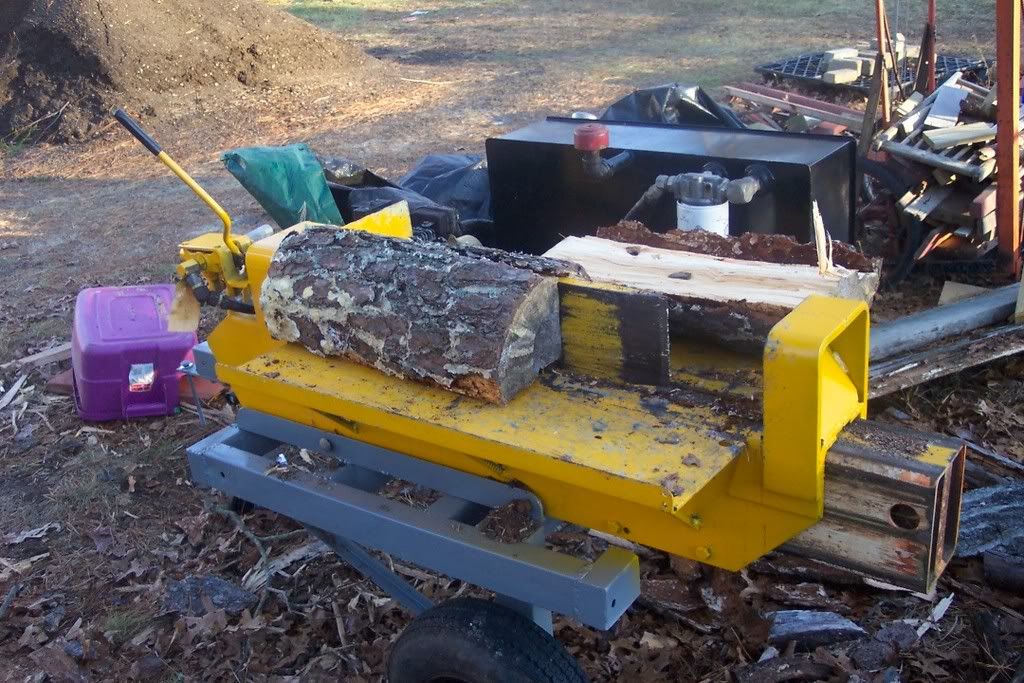
If all goes well, here are the pics of my splitter project.
WOODSPLITTER002.jpg

WOODSPLITTER003.jpg

WOODSPLITTER004.jpg

WOODSPLITTER005.jpg
 
I did a little editing to get them to show up. Click on the edit button in the upper right corner of your post to see what I did.
 
Frank:

Very nice splitter, well built. I guess not much is gonna stop that. Not even the gnarliest maple .... :shock: Well done.
 
Frank that is absolutely ingenious. Splits 1 way and then splits on the way back.
Then to add to it there is the shelf to hold the split for the second split. Though i do have two thoughts on the shelf. You have to pitch each piece off. Of course you could toss it into a trailer or on to the pile. That is a plus. Yet on the other hand mine fall off and after a while i have a shelf of split pieces that I use as a ramp to roll big pieces up to be split. As the pile gets bigger the split piece hits the pile and pushes the splitter back a bit to make more room.
I am really impressed with your splitter.
 
I have 2 screens open so I can look at the splitter and type at the same time. From what I see the box beam with the wedge in it moves and the yellow shelves don't move. Is the cylinder inside the box beam? Do you have any wear plates?
My Lickety Splitter has brass wear plates. I replaced them once but they are shot again and I understand the company is out of business.
I am enthralled with your splitter.
 
The splitterhas no wear plates that I can find. The inner carriage just moves along inside the beam. I have not seen any wear in any part. The cylinder is attached pretty solid, and it seems to function like a beam sliding inside another beam, The yellow part is factory made J.I.Case model 34, originally driven off the hydraulic P.T.O. of a Case 446 garden tractor. As near as Anyone can figure the original pump delivered in the neighborhood of 7.5 g.p.m. It really takes 2 people to operate this thing to its full potential. One loading and one unloading, plus operating the lever. We never timed it but it will make a cord of wood dissappear mighty fast. Thanks Again to Bigdog. Frank
 
That splits in both directions thats a great idea. I'm in the process of planning my new log splitter. My last one I built lasted for over 25+ years that i built. I wore out the I beam. I have a choice of I & H beams now. I was thinking of using a 5" bore X 24" stroke with a 2" shaft cylinder and a 22gpm pump with a double detent valve so i have more hands free time. I want to add a loader arm too for the bigger stuff because i'm not getting any younger plus my sons will help too.

My problem is now which tractor to hook it up too. I was thinking of trailering it with a cub cadet and mounting the hydraulic pump on the cadet flywheel pulley. I will keep it hooked up to this tractor.

The 22gpm two stage pump is the key to speed. The ram in free movement moves at 500psi @ 22gpm thats really quick. Then i believe when the second stage kicks in when splitting its 3gpm @ 3,000psi. Some of these pumps do differ on the second stage.

My first log splitter would actually cut a 8" log in half on the knife thats the key to how good your splitter is working.

I believe i need at least a 14hp engine with the 22gpm pump. I know its going to cost more this time but i want speed and more splitting power over my last one.
 
Bill Just for comparison my splitter thats pictured previously has an 11g.p.m. 2 stage pump with a 5 horse motor, that never goes above 1/2 throttle and I cut a pine log in half during the initial testing. Mashed would be a more appropriate term. Frank
 
Im trying to build a splitter also
I just want a plain ole one way splitter
Whats a good ram size for a 11gpm pump and a 5 hp engine
I am concerned about the length and where to put the cutting blade
How long should cylinder be and how close to the wedge should it stop at wide open cylinder
Thanks
 
Back
Top