
You are using an out of date browser. It may not display this or other websites correctly.
You should upgrade or use an alternative browser.
You should upgrade or use an alternative browser.
Wiring a 6V Generator
- Thread starter Stanton
- Start date
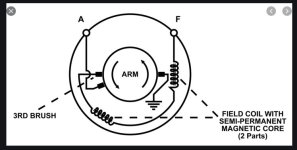
Two possibilities, either it is incorrect or just poorly drawn. The main output brush should be 180 degrees from the ground brush. This looks like somebody copied/redrew the drawing on YT.
Jim Becker":1afbenmn said:Two possibilities, either it is incorrect or just poorly drawn. The main output brush should be 180 degrees from the ground brush. This looks like somebody copied/redrew the drawing on YT.
Ok, thanks Jim.
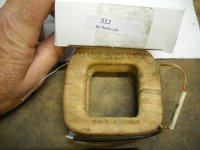
The rebuild kit for this 6V gen came with a field coil set that had a bare wire coming out of one side of field windings and a black wire with terminal coming out of the other side of windings:
Here's a pic of my brushes:
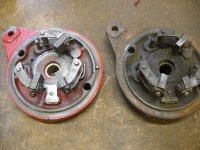
Referring to the picture of the field windings, I soldered the bare wire to the "F" post (ground) and connected the terminal wire to the 3rd brush. I made a jumper and connected the 2nd brush (the one not directly connected to the field windings) to the "A" post.
Unit won't motor at all when power is applied to the "A" and "F" posts.
Is the lower right brush the ground? Would appear so.
I don't know which way is right between the bare and insulated leads on your field coils. I would do it the same way you did. The rest of your wiring is correct, assuming you correctly identified the brushes. The commutator end frame on the right has the brushes labeled A, B, and C. Brush C appears to have a ground strap attached, which it should. Brushes A and B should be insulated from the end frame. You should be able to verify all 3 with an ohmmeter. You can see that brush A, when the brushes are pulled back to operating position, is 180 degrees from the ground brush. This is the brush that should be connected to the A terminal. The remaining brush, B is the "THIRD BRUSH". It is at an odd position relative to the ground brush. It appears that this is an adjustable third brush as it looks like it is attached to a steel ring that can rotate on the end frame. This is the brush the field coil should attach to.
A good generator should motor over if the FRAME is grounded and power is applied to the A terminal. If those connections are maintained and the F terminal is grounded it should slow down. I don't know what to expect if power is applied to the A and F terminals. I don't know where the idea came from that it is some sort of useful test. I never tried it and don't intend to try it with one of my generators.
A good generator should motor over if the FRAME is grounded and power is applied to the A terminal. If those connections are maintained and the F terminal is grounded it should slow down. I don't know what to expect if power is applied to the A and F terminals. I don't know where the idea came from that it is some sort of useful test. I never tried it and don't intend to try it with one of my generators.
Jim Becker":cbekfu85 said:I don't know which way is right between the bare and insulated leads on your field coils. I would do it the same way you did. The rest of your wiring is correct, assuming you correctly identified the brushes. The commutator end frame on the right has the brushes labeled A, B, and C. Brush C appears to have a ground strap attached, which it should. Brushes A and B should be insulated from the end frame. You should be able to verify all 3 with an ohmmeter. You can see that brush A, when the brushes are pulled back to operating position, is 180 degrees from the ground brush. This is the brush that should be connected to the A terminal. The remaining brush, B is the "THIRD BRUSH". It is at an odd position relative to the ground brush. It appears that this is an adjustable third brush as it looks like it is attached to a steel ring that can rotate on the end frame. This is the brush the field coil should attach to.
A good generator should motor over if the FRAME is grounded and power is applied to the A terminal. If those connections are maintained and the F terminal is grounded it should slow down. I don't know what to expect if power is applied to the A and F terminals. I don't know where the idea came from that it is some sort of useful test. I never tried it and don't intend to try it with one of my generators.
Alright, here's the kicker. My assumption was that Brillman had sent me the correct 6V gen kit. When I had to send one of the posts and the field coils back because they didn't fit, you would have thought I'd double-check the armature. Dug the armature box out of the trash can and sure enough, on the end of the box, the label read: "#1455 12V Delco armature". Earlier this morning, I took the gen to a local auto electrical shop and he tested it (frame to pos and "A" post to neg) and it turned over great. Got home and did the same using my 6V battery and nothing. That's when I dug out the box and checked.
So, I've got a 12V armature. Need to call John Brillman and get this thing switched out.
It is nice to know my gen rebuild was a success, even if the wrong voltage.
I'm working on one of these now too. I have two others that work, so I have been cross checking everything. Of the two working ones, each is wired differently. On one the coated field wire goes to the fixed brush and the A terminal goes to the movable (3rd brush). The other working one is just the opposite, with the coated field to the movable (3rd brush) and the A terminal to the fixed brush. All three have the bare wire from the field coils to the field terminal. I now have tried the non working one both ways with almost no change. The generator actually works, but only if I ground the field. With it grounded it puts out a little over ten volts and almost 20 AMPs. This is with the brushes wired with the A terminal to the movable brush. It works almost the same with the two brushes the other way, but a little less voltage and a little fewer AMPs. I guess I should have said this is on a JD 6 volt neg. ground with a cut out, and not on a Cub. I doubt there is any difference though. What I can't figure is why it wont put out enough voltage to energize the cut out unless I ground the field. The way I believe it should work is that when you start the engine the generator starts charging and activates the cut out too allow the voltage too go to the battery and when the engine stops the cut out kicks back off so that the battery doesn't try to motor the generator. So what I'm wondering where does the field wire on the generator get its ground. On this dang MT every thing is hidden behind the pedestal and has the battery hiding it all from the other side. I guess my next step is to tare every thing apart and trace the wire back from the gen. I can only assume that that's were the problem is.
viewtopic.php?p=858991#p858602birddog":asd0h0t1 said:. . . Of the two working ones, each is wired differently. On one the coated field wire goes to the fixed brush and the A terminal goes to the movable (3rd brush). The other working one is just the opposite, with the coated field to the movable (3rd brush) and the A terminal to the fixed brush. . . .
I found my problem. I pulled the battery and every thing else out of the way to get at the switch. When I got the switch out I found the ground was broken to the resistor. After making a new ground wire and reinstalling every thing it charges better then it has in years. At full throttle a little over ten AMPs and on high charge almost twenty AMPs. This is with the generator wired with the A terminal to the movable (3rd) brush, and the coated field wire to the fixed brush. This is the way it is shown in the first picture, except that they have the fixed and movable (3rd) brushes mixed. I have two tractors charging like new now and they are wired different from each other, so I guess it doesn't really matter which brush the A terminal is connected to as long it's not the grounded brush.
For the third time, it does matter and you are doing it wrong. These cut-out systems were designed for 12 or 13 amps maximum. If you keep pulling 20 amps out of it, you will burn something out. Since you have the brush connections backwards, you are putting more voltage into the field coil than you are the battery. The field coil will probably be the first part to burn out.
JohnMihevic
Well-known member
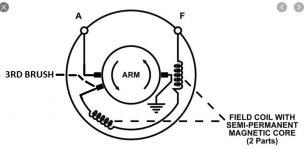
Based on the comment from Jim Becker, I have modified the graphic at the beginning of this thread as shown here. Comments welcome if this looks correct. I like simple schematics.
John M.
John M.
The updated drawing is correct.JohnMihevic":2v3x6en1 said:I have modified the graphic . . .
JohnMihevic":1cxvx1yz said:...I like simple schematics.
John M.
Thanks, John. I do too!