My Super A chassis # 298432 HAS A REPLACEMENT BLOCK BY A PREVIOUS OWNER. iT HAS A DIP STICK AND SOMEWHERE i HEARD THAT THE BLOCKs WITH THE DIPSTICK STARTED LIFE AS POWER FOR OTHER THAN A TRACTOR AND POTENTIALLY FOR A LIFT OF SOME KIND. mY QUESTION IS WOULD IT HAVE THE SMALLER BORE SIZE OF 3 TO 3 3/8 OF THE LARGER OF 3 1/8 TO 3 1/2 INCHES. The chassis number iF it had the original block would be the larger bore as I understand it. Any help much appreciated.

You are using an out of date browser. It may not display this or other websites correctly.
You should upgrade or use an alternative browser.
You should upgrade or use an alternative browser.
what block/bore size do I have?
- Thread starter 49willard
- Start date
Part number 352411R1 was used on early power units. It would have been the small bore. I don't know if there were other small bore part numbers, but I think not. You can also look at the block's date code. The size would have changed somewhere in mid-1951.
Jim,
Thanks for responding. The numbers on the left side of the block are as follows:
1. Large cast #'s are 356318-R1
2. Cast below are 2 2. 29 .X where the last 3 digits are in an oblong circle looking like a tag was in the mold prior to casting
3. Stamped on a flat in the block (done after it was cast) is 24487
DXoes any of this help to better identify the block?
Bill
Thanks for responding. The numbers on the left side of the block are as follows:
1. Large cast #'s are 356318-R1
2. Cast below are 2 2. 29 .X where the last 3 digits are in an oblong circle looking like a tag was in the mold prior to casting
3. Stamped on a flat in the block (done after it was cast) is 24487
DXoes any of this help to better identify the block?
Bill
I'm 99% certain you have a later block with the larger lower sleeve bores. It looks like you have a date code for February 29, 1952 (+2-29-X+). The stamped number, 24487 is the engine serial number. It indicates 1952. With a late enough parts catalog, it would be adequate to confirm the answer to the original question.
staninlowerAL
501 Club
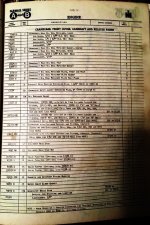
The tractor SN 298432 in your first post indicates a 1950 date and the casting number as Jim said is Feb 29, 1952 which agrees with your post that it is a later model engine. This tractor SN list for A/SA/SAV is probably not going to help much but I'm adding it to the info available FYI. It's from a OEM original parts catalogue that I have. JMHO StanI'm 99% certain you have a later block with the larger lower sleeve bores. It looks like you have a date code for February 29, 1952 (+2-29-X+). The stamped number, 24487 is the engine serial number. It indicates 1952. With a late enough parts catalog, it would be adequate to confirm the answer to the original question.
EDIT: add A&B block info
Attachments

Last edited:
Power units commonly had dip sticks even though tractors didn't, even before the bore size change. The later C-123s in the 140 had a dip stick, not sure about the slightly earlier tractors like the 130. They were on your other left.
Shawn,
Thanks for your offer. As I understand it the 100 was a significantly larger engine than the A/SA. Based on discussion here and what I could gleen from online info I am thinking that the block came from a power unit/U-2A and I have not been able to determine if it is a C113 or C123 block. What I will say it runs well and strong. My original reason to start the thread is that I see evidence of "chocolate milk" on the dipstick and I was going to order a head gasket kit to be ready to pull the head after snow season here in Maine. Other info I have found on the forum makes me suspicious of a condensation problem. I could drain the oil for a better look, however, the only spot where I see the "milk" is in the 1 ft long tube for the dipstick. Dipping the dipstick without the tube in place shows no evidence of the "milk".
Thanks for your offer. As I understand it the 100 was a significantly larger engine than the A/SA. Based on discussion here and what I could gleen from online info I am thinking that the block came from a power unit/U-2A and I have not been able to determine if it is a C113 or C123 block. What I will say it runs well and strong. My original reason to start the thread is that I see evidence of "chocolate milk" on the dipstick and I was going to order a head gasket kit to be ready to pull the head after snow season here in Maine. Other info I have found on the forum makes me suspicious of a condensation problem. I could drain the oil for a better look, however, the only spot where I see the "milk" is in the 1 ft long tube for the dipstick. Dipping the dipstick without the tube in place shows no evidence of the "milk".
Last edited:

ShawnAgne
501 Club
You are correct 123block. I saw 130s and 140s being mentioned and I lost the scope of the original question.
Yeah condensation is going to happen and other than keeping them in a stable temperature year round I'm not sure you can get around it. Even though there are seals it is an open system and moisture will get in them. Yesterday it was mid 70s here in Ohio, very unusual. Well the shop floor was wet with moisture the tractors were all wet on the outside and I'm assuming on the inside also. I know I went out last night at 7pm and took care of the table saw, Bridgeport, and lathe as they had flash rusted.
Yeah condensation is going to happen and other than keeping them in a stable temperature year round I'm not sure you can get around it. Even though there are seals it is an open system and moisture will get in them. Yesterday it was mid 70s here in Ohio, very unusual. Well the shop floor was wet with moisture the tractors were all wet on the outside and I'm assuming on the inside also. I know I went out last night at 7pm and took care of the table saw, Bridgeport, and lathe as they had flash rusted.
The real distinction between blocks for a tractor vs. a power unit is a big notch in right side of the rear flange. The power unit block is notched so a starter can be mounted at the front side of the flywheel. Consequently, one bolt hole for attaching the block to the bell housing is gone. It is pretty obvious. The Super A had a 3" bore for 113 cubic inches. The Super A1, 100, 130, 140 had a 3-1/8" bore for 123 cubic inches. The lower bore in the blocks was increased to allow for the 3-1/8 sleeves in 1951. However, the balance of Super A production used a thicker sleeve with a 3" bore.
The original 123 head gasket had a larger hole at the sleeve flange than did the 113 head gasket. A lot of the 123 gaskets have been used on 113 engines even though they aren't really the right gasket. More important, there are two variations of each gasket for use either with or without a water pump. Most 123 engines had a water pump while most 113 engines did not. So there were 4 variations of the gasket. You need to select the proper gasket depending on the water pump, even if you end up with a 123 gasket in a 113 engine.
The original 123 head gasket had a larger hole at the sleeve flange than did the 113 head gasket. A lot of the 123 gaskets have been used on 113 engines even though they aren't really the right gasket. More important, there are two variations of each gasket for use either with or without a water pump. Most 123 engines had a water pump while most 113 engines did not. So there were 4 variations of the gasket. You need to select the proper gasket depending on the water pump, even if you end up with a 123 gasket in a 113 engine.
Jim,
Thanks, good info. My starter motor mounts back of the flywheel and there is not any notch to mount a starter forward of the flywheel. So in summary it must be a tractor block cast in 1952 but it has cast into the block a boss with a hole to accept a dipstick tube and dipstick located very close to the tapped hole for an oil pressure gage. It does not have a water pump. So I do not know exactly what the block is however the tractor runs great and strong and to my thinking the dipstick is a nice to have instead of just the oil pan high and low petcocks for checking oil like my Model T. I think I will not know the bore unless I pull the head which I will not do just to find out since the initial reason for the post was that I thought that I might have a leak resulting in the famed "chocolate milk" !
Thanks, good info. My starter motor mounts back of the flywheel and there is not any notch to mount a starter forward of the flywheel. So in summary it must be a tractor block cast in 1952 but it has cast into the block a boss with a hole to accept a dipstick tube and dipstick located very close to the tapped hole for an oil pressure gage. It does not have a water pump. So I do not know exactly what the block is however the tractor runs great and strong and to my thinking the dipstick is a nice to have instead of just the oil pan high and low petcocks for checking oil like my Model T. I think I will not know the bore unless I pull the head which I will not do just to find out since the initial reason for the post was that I thought that I might have a leak resulting in the famed "chocolate milk" !
Last edited:

Don McCombs
501 Club
I previously owned a 1951 Super C (same engine) that originally was equipped with the two petcocks in the oil pan for checking the engine oil level. I swapped the original oil pan for the later one without petcocks. I then installed a tube and dipstick in the boss for the convenience.
EDIT: I replaced the original photo with the dipstick that I finally ended up with. It also shows the notch a little better.
EDIT: I replaced the original photo with the dipstick that I finally ended up with. It also shows the notch a little better.
Attachments

Last edited:
The engine in Don's picture is a power unit engine. The big notch can be seen directly below the pressure gauge. I'm sure yours has the same.
Don McCombs
501 Club

It is a power unit block with the bigger lower bore for 3-1/8" sleeves, a C-123.