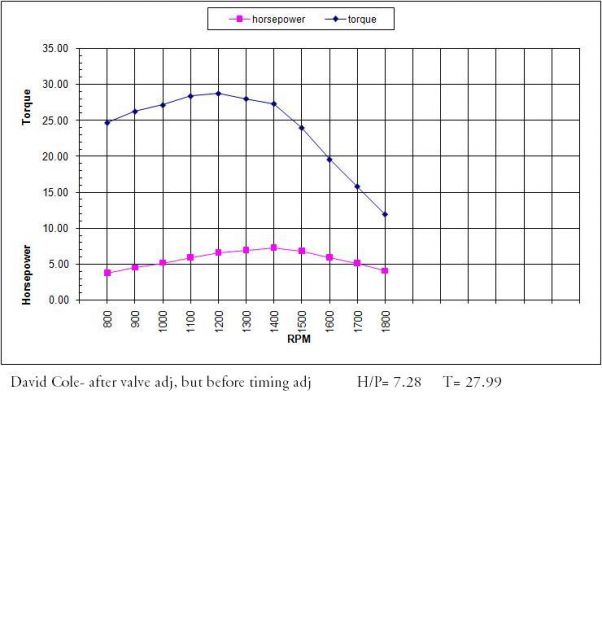
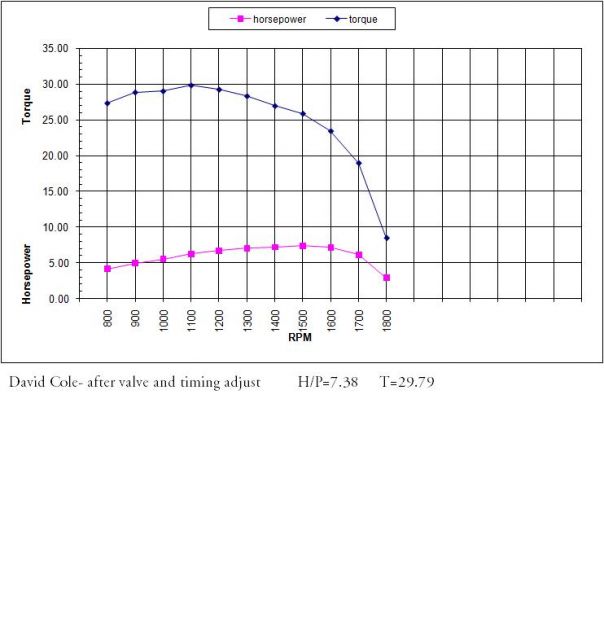
I paid for college as a teenager driving a semi alternating between two road tractors, a R model Mack with a 237 hp maxidyne engine and one with a 220 Cummins. The Mack engine had a broad torque range and had only a 5 speed transmission while the cummins had a narrower range and had a constant shift 13 speed. Both pulled the same but required more work , shifting, with the cummins. The actual torque is not all that important but the range of torque is important.
I expect the 300 hp Mack pulled better because it had 300 hp vs 237 hp of the smaller maxidyne engine. It is hard to compare when you have changes two variables.
I have a cub with a 11 hp Honda clone instead of the original c-60 engine and it will easily cut 3 1/2 foot tall grass in my fields with a 42 inch mower in first gear at normal lawn height of 2 inches. My MTD Lowes tractor with a 15 hp engine will do the same. A cub engine is an old low compression flat head design, bore larger than stroke, there was nothing high torque about it. A slow running engine does not necessary mean high torque, two different things. If you search the internet you can find power curves for older and newer Kohler engines and compare to the cub. The curves for the K series engines are very similar to the newer Kohler engines. Older does not always mean better. If you compare a curve from a larger kohler engine, look at the torque and hp at 2000 rpm and it will be higher than the cub engine. I kept hearing how high torque a gravely engine was so I looked at the power curve and it has lower hp and torque than any kohler is for a 30 cubic inch engine. The gravely just runs slower.
I have a small chipper shredder that has a large flywheel that serves as the plate for the chipper knives. It has a normal 3600 rpm briggs engine. A few years ago I slowed down the engine to see how slow it would run with that large flywheel, I did not measure the rpm but estimate it was running around 500 rpm. A large flywheel does not give more torque, just more inertia that lets the engine run slow. The briggs engine did not magically develop more torque because of the large flywheel it was just able to run slower because of the inertia of the flywheel.
I can take the spark plugs out of a cub engine, put the crank in the front, and easily turn the crank to over 40 ft-lbs of torque. If I mount my 4kw generator on the cub, spin the crank, and see how many light bulbs I could light, I would find the answer was zero, I can generate the torque but I cannot spin the crank fast enough to get the 8 hp needed for the generator. I could then hook up my woods 42 mower and I would be able to turn the crank but not fast enough to give the blade speed needed to cut grass. I can make the torque but not apply the torque with enough speed to be effective. The speed at which you apply torque is the horsepower, comes directly from the equation. Same thing with my Hester disc plow, I cannot move the tractor fast enough to clear a furrow with the plow. The speed at which you apply torque is tremendously important ( horsepower), the actual torque is not. Torque can be changed through gearing to match the requirements but horsepower cannot. Horsepower can substitute for lack of torque but torque cannot ever substitute for lack of horsepower.
Although I normally agree with Lurker Carl: Torque is nice but Horsepower cuts grass. The blades have to travel at a certain speed which is horsepower not torque. However, the range of torque and therefor the range of horsepower is important. A broad range of torque and therefor a broad range of horsepower will get you through the clumps of thick grass without having to stop and shift to a lower gear. . A mack engine vs a cummins.