
You are using an out of date browser. It may not display this or other websites correctly.
You should upgrade or use an alternative browser.
You should upgrade or use an alternative browser.
Tool, what is it ?
- Thread starter Yogie
- Start date
I don't know either but here is another that says it's used for making wooden barrel hoops.
https://www.worthpoint.com/worthopedia/ ... eaver-rare
https://www.worthpoint.com/worthopedia/ ... eaver-rare
One or the other of these guys probably got his information from the other. I find it hard to believe that something intended for splitting wood, even thin strips, wouldn't show some evidence of use with a hammer. Now there are two of them without hammer marks. The three-sidedness of the working end also seems counter to the idea of turning hunks of wood into something with a rectangular cross section.indy61":3ajoqiej said:I don't know either but here is another that says it's used for making wooden barrel hoops.
I don't know, just saying.
Jim Becker":1klp0tns said:One or the other of these guys probably got his information from the other. I find it hard to believe that something intended for splitting wood, even thin strips, wouldn't show some evidence of use with a hammer. Now there are two of them without hammer marks. The three-sidedness of the working end also seems counter to the idea of turning hunks of wood into something with a rectangular cross section.indy61":1klp0tns said:I don't know either but here is another that says it's used for making wooden barrel hoops.
I don't know, just saying.
I am not disputing your point, but if I was a barrel maker, I just might be using a wooden mallet. Food for thought!
Note:
I am not a barrel maker (Cooper), and can not see what the above tool would be used for!
Finishing a bung hole with the desired taper, seems more realistic to me!
Rick Spivey
501 Club
I've never made a barrel, but those three tools referenced sure look alike to me, and two of them are identified as useful in barrel making. Both references could be wrong about its use. But I believe I would try and follow up on that lead if I wanted to determine what the tool was and how it was used. Surely there's a site somewhere for barrel making?

Don McCombs
501 Club
Interesting trivia...
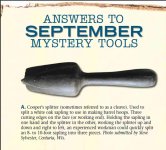
The white oak saplings that were harvested for barrel hoops, were cut to length and called hoop poles. The tool in question was apparently used to split the poles, creating the hoop material. Our house is adjacent to Hoop Pole Ridge and Hoop Pole Run, most of which is now flooded by Deep Creek Lake. See map...

The white oak saplings that were harvested for barrel hoops, were cut to length and called hoop poles. The tool in question was apparently used to split the poles, creating the hoop material. Our house is adjacent to Hoop Pole Ridge and Hoop Pole Run, most of which is now flooded by Deep Creek Lake. See map...
indy61":24bdvtck said:This is from the Nov 2018 issue of Farm Collector magazine, don't know if it's a correct identification.
Untitled.jpg
Great find! I wonder how often one would end up ramming the freshly split ends into their hand or forearm using one of these?

Yogie
501 Club
I agree, I just can't see how you would use this without busting knuckles. Would you drive the other end of the wood into the hard floor for it to split while holding this tool on the other end ? Door Stop ! No, I could see my toes split wide open some night in the dark.Urbish":pk2gspzy said:indy61":pk2gspzy said:This is from the Nov 2018 issue of Farm Collector magazine, don't know if it's a correct identification.
Untitled.jpg
Great find! I wonder how often one would end up ramming the freshly split ends into their hand or forearm using one of these?
Check out how a froe is used for splitting wood. Since the cleave is used for splitting saplings for barrel hoops, should work quite well.Eugene":ucg52ngv said:Froe. For splitting strips of wood.