I purchased a steel fuel line for my 1957 Cub and i thought the ferrules would already be set on the line but they came separate and need installed. The problem I am having is when I tighten it down they still leak. I am worried if I put additional force on them the threads will strip. Does anyone know the proper way to get the ferrules to tighten against the steel line without stripping out the threads in the fuel sediment assembly and carburetor?

You are using an out of date browser. It may not display this or other websites correctly.
You should upgrade or use an alternative browser.
You should upgrade or use an alternative browser.
Steel Fuel Line
- Thread starter mmassery
- Start date

Dale Finch
501 Club
Is this the type of fitting you used?
I've read that some folks have trouble getting it to separate when tightened. Maybe someone will come along who knows more about it than I.
I've read that some folks have trouble getting it to separate when tightened. Maybe someone will come along who knows more about it than I.
Go to a hardware or auto parts store and get a 5/16 female compression fitting (brass). Attach your fuel line to it, tighten it until the ferrule grips the tube. You are unlikely to strip the brass fitting. Then remove the hardware store fitting and connect the fuel line on the tractor. You can use the brass fitting to prep both ends of the fuel line. Then throw it into your pile of special tools
I tried looking for a fitting like I suggested in #3. Didn't have much luck from the usual sources that I had mentioned. Here are a couple eBay items that would do it:
122560707491
263673534728
Searching for the product "Edelmann 123500" seems to find one, along with some oddball mismatches.
122560707491
263673534728
Searching for the product "Edelmann 123500" seems to find one, along with some oddball mismatches.
Below is a listing at TM Tractor Parts for the gas line fitting, it says it is Case IH. You can look at the picture.
When tightened the 1st time, the ring at the end is supposed to tighten onto the tube, and break off from the nut part of the fitting. Maybe you knew already.
https://www.tmtractor.com/new/fl/512fp.htm
The ones I used in the past broke off easily from the fitting. If you have a different brand, they may not break off easily, I don't know.
Be sure the tube is fully through the fitting and ring before tightening it the 1st time.
Below is TM Tractor Parts listing for a new gas line for use with the under axle exhaust system, since your Cub is a 1957, it probably has that. You can look at the pictures of the bends in the gas line.
When tightened the 1st time, the ring at the end is supposed to tighten onto the tube, and break off from the nut part of the fitting. Maybe you knew already.
https://www.tmtractor.com/new/fl/512fp.htm
The ones I used in the past broke off easily from the fitting. If you have a different brand, they may not break off easily, I don't know.
Be sure the tube is fully through the fitting and ring before tightening it the 1st time.
Below is TM Tractor Parts listing for a new gas line for use with the under axle exhaust system, since your Cub is a 1957, it probably has that. You can look at the pictures of the bends in the gas line.
Last edited:
staninlowerAL
501 Club
I've never found a way to successfully flare a steel tubing line. I suppose you could use the factory flared end of a brake line, cut it to the desired length and use a compression nut and ferrule on the other end. The flare and compression fittings that I've found are not 1/2 x 20 straight threads like the OEM carb and sediment bowl threads and require some sort of adapter. JMHO StanI have found that some after-market sediment bowls/fuel shut offs use a flare fitting.............
This is what i was kind of thinking might work. I will give it a try. I did purchase these from Steiner. The line came with two fittings that wouldn't slide on the tubing but I purchased a couple extra that fit fine and had the same part number fyiGo to a hardware or auto parts store and get a 5/16 female compression fitting (brass). Attach your fuel line to it, tighten it until the ferrule grips the tube. You are unlikely to strip the brass fitting. Then remove the hardware store fitting and connect the fuel line on the tractor. You can use the brass fitting to prep both ends of the fuel line. Then throw it into your pile of special tools
yes that is itIs this the type of fitting you used?
I've read that some folks have trouble getting it to separate when tightened. Maybe someone will come along who knows more about it than I.
Dale Finch
501 Club
Then I suggest you follow Jim Becker's advice about buying a "substitute temporary brass fitting" to seat the ferrule and separate it from the male screw-in fitting.yes that is it
The two pieces are designed to break apart, but I think some of them are not scored deeply enough.
JohnMihevic
Well-known member
Instead of steel, use copper for the gas line. Copper will bend easily and you can flare the end at the filter bowl and you can use a compression fitting at the carb. end.
I don't use copper tubing. It can work harden from vibration then crack.

Don McCombs
501 Club
The steel brake line comes in coated and un-coated versions. I have found that the coated version is too large for the fittings. You need the un-coated version.This is what i was kind of thinking might work. I will give it a try. I did purchase these from Steiner. The line came with two fittings that wouldn't slide on the tubing but I purchased a couple extra that fit fine and had the same part number fyi
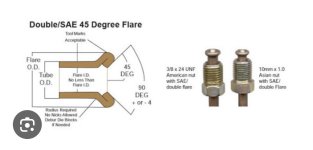
Steel tubiing needs to be double flared, or else it will split with single flare. Not all flare tools will have the mandral to double flare.I've never found a way to successfully flare a steel tubing line. I suppose you could use the factory flared end of a brake line, cut it to the desired length and use a compression nut and ferrule on the other end. The flare and compression fittings that I've found are not 1/2 x 20 straight threads like the OEM carb and sediment bowl threads and require some sort of adapter. JMHO Stan
Steel tubiing needs to be double flared, or else it will split with single flare. Not all flare tools will have the mandral to double flare.
Attachments

I know I am going to get pushback on this, but I have been using a 5/16 ferrule from Parker PN #60PT-5 ( plastic) on both the sediment bowl and the carb for about 4 years. They seal on the first go. Also, I do not feel like I was going to break something or pull threads out like I do when I was working with the one-piece fitting. I can turn the fitting without muscling it. The Delrin (Acetal Copolymer) is rated for flammable liquids. From a search "Acetal copolymer is highly resistant to gasoline and is widely used in automotive fuel system components."
Specs:
Tube Size (Outer Diameter): 5/16 inch
Material: Acetal Copolymer (plastic / Delrin)
Temperature Range: -65°F to 250°F (-54°C to 121°C)
Maximum Pressure: Up to 300 psi (depending on application and tubing)
Standards: Meets SAE J-512 requirements and is UL listed for flammable liquids
Specs:
Tube Size (Outer Diameter): 5/16 inch
Material: Acetal Copolymer (plastic / Delrin)
Temperature Range: -65°F to 250°F (-54°C to 121°C)
Maximum Pressure: Up to 300 psi (depending on application and tubing)
Standards: Meets SAE J-512 requirements and is UL listed for flammable liquids