
Dan England
501 Club
This has been a day to spend inside the home. Dark and gloomy with misting rain much of the day. Still pretty warm but a winter mix is predicted to arrive on Wednesday. While watching the birds at our feeder, I began to think of my favorite birds and have come up with a list of them. Some are year-round residents of this area, some are present only during summer months or perhaps only during the winter season. Others frequently pass through this area during their spring and/or fall migration. And the list contains at least one species which is never a regular resident, perhaps it simply strayed into our area by chance and I, along with other birdwatchers, was fortunate enough to see it.
The largest number of birds on my list are placed there because of their beauty. As a general statement, bright body colors are present only in males. If females have bright vivid colors, they would be easily located, caught and eaten by enemies when nesting. So, the species would have difficulty surviving as most females, their young and their eggs would be destroyed on a regular basis.
MY LIST
1. PAINTED BUNTING-One of the most colorful birds. An extremely rare visitor to our area. I have been a birdwatcher for years and have seen only two specimens.
2. WOODDUCK-I am not a fan of ducks but this is one beautiful bird. Well worth your time and effort to locate one if they are found in your geographical area.
3. RED-HEADED WOODPECKER-A striking bird with red, white and black body colors.
4.AMERICAN GOLDFINCH-Males are very bright black and gold color when in summer plumage.
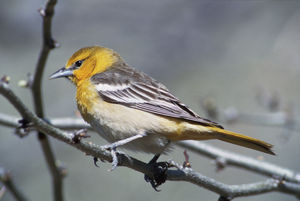
5. BALTIMORE ORIOLE-Pass through our area during spring migration.
6. ROSE-BREASTED GROSBEAK- Another spring migrant. I usually see only one or two flying through our area. A few years ago, we had this species at our feeder for about two weeks. I counted as many as fifteen at one time. They seemed to have little fear and allowed me to approach within a few feet of the feeder before my presence disturbed them.
7. INDIGO BUNTING-Brilliant, vibrant blue colored ground feeders, a very social bird with sometimes a cluster of twenty or more feeding in a yard. I have never seen this species at a bird feeder.
8 CARDINAL- Year round residents in our area and are easily attracted to bird feeding stations.
9. SUMMER TANAGER-Males are all red, slightly smaller and more slender than cardinals. Unlike the cardinal, they lack the top-knot, so the top of the head is smooth.
10. BARN SWALLOW-An elegant bird with long, slender pointed wings and deeply forked tail. Extremely graceful during flight. Back is blue in color with buff or orange throat/belly region.
11. RUBY-THROATED HUMMINGBIRD-The only hummer which is a resident of Arkansas. Extremely competitive, one bird tries to drive off the competitors from feeders. Vince D attracts extremely large numbers of hummers to his feeders. I suspect that he mixes a stress-releiving chemical to his sugar-water mix.(just kidding about the stress-releiving drug, I think that he uses mild hypnosis to make them less competitive)
12. EASTERN BLUEBIRD-Male has bright blue upper body with rust colored breast. Song is soft, melodious warble, very pleasing to the ear.
13. VERMILION FLYCATCHER-Brilliant scarlet body with dark brown back, wings and tail. Range generally restricted to the southern portions of Texas, New Mexico and Arizona. Several years ago, one somehow arrived at the campus of Southern Arkansas University during the Christmas break. It spent a couple of weeks, then disappeared. Sure attracted a lot of attention of birdwatchers in this area. The only time which I have seen this beautiful bird.
14. SCISSOR-TAILED FLYCATCHER-Summer resident only. Gray upper body, black upper wings and tail. Bright pink color on lower wing surface and body. Extremely long, deeply forked tail.
15. BALD EAGLE-A majestic animal, very deserving of its designation as our national bird. A much better choice, I think, than Ben Franklin's preference of the turkey. The bald eagle is probably the only bird on this list which every forum member would recognize by sight.
16. BARN OWL-A very pretty owl but I have a special reason to value this bird. The species feeds on small birds but its main food consists of small mammals. The prey is swallowed whole, the flesh is digested for use as food. The digestive juice is not strong enough to break down fur and bone material. The fur and bones are rolled into moist pellets and disgorged through the birds mouth. I did a lot of small mammal trapping to determine which non-game species were located in southwest Arkansas. But I also collected pellets beneath barn owl roosts, then carefully pick the pellets apart to retrieve the skulls. One can then identify the species of mammal from skull structure. There is a species of shrew (desert shrew), common in some of the western states but only two specimens had ever been found in Arkansas. One was caught in a trap, around 1950, in northwest Arkansas. The story on the other specimen is very interesting. An Indian burial had been evacuated near the Fayetteville region and given to the University of Arkansas. This happened, I believe around 1950. Later, someone who was examining the specimen noticed a small mummified mammal on (or in) the Indian's chest region. The resident mammalogist was made aware of the mammal which he identified as a desert shrew. Those were the only two records of desert shrews ever being documented within the state of Arkansas and both occured in the northwest region of the state. Well, during my trapping operation, I captured shrews but never a desert shrew. But, the owl pellets which I was collecting began to supply skulls of desert shrews. That was quite a surprise to me and to other biologist in the state. Altogether, I believe that desert shrew skulls turned up in about twenty-five owl pellets from locations in three different counties in southwest Arkansas. An excellent example of a bird making an important contribution to our body of knowledge on non-game species of mammal in Arkansas.
17. KILDEER-A ground nesting bird with the eggs often being laid on gravel or bare soil without benefit of a nest. I put this one on my list because of a special behavorial trait. When the eggs are approached by a predator, the mother will feign a broken wing and lead the predator away from the nest. When a sufficient distance from the eggs is attained, the bird will calmly fly back to her nesting area leaving the predator behind.
18. ROADRUNNER: This one is definitely not a beauty. On a list of the prettiest birds of Arkansas, this one might well be at the bottom of the list. However, from my earliest memory, I have been fascinated with our American West, anything related to Texas, Longhorns, J.Frank Dobie, branding, trail drives and horned toads (which aren't toads at all). I still read western fiction and probably have somewhere between 100-200 books of western lore. Thus, my placement of the roadrunner on my list. As an interesting comment on this species, I grew up in southcentral Missouri. There were no roadrunners in our area, and none in any part of Missouri. But their range has now extended further north to include the part of Missouri where I once lived.
That is my list. As you can tell, I like birds. While working on this report, I received a message from a forum member stating that my previous posts on birds had restored his interest in birds, that he is now feeding and that he and his family are now enjoying the birds once again. A win-win situation, the family has hours of enjoyment while the birds receive adequate food to survive cold, rainy weather. Remember to feed the birds. They need your help during the severe weather which is approaching. I am interested in seeing the list of your favorite birds. Dan






 h and the great Horned Owl that hoots out back,,,love to get him going with the trurkey calls!!! Kevin :shock: :shock: :shock: :shock:


