servicing starter motor

marshall

Well-known member
1950 Cub
I've charged my battery and cleaned the terminals and connections. There's continuity through the cables and 12 volts on the starter when I pull out the ON/OFF switch on the dashboard. But when I
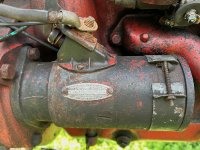
pull back the starter lever, there's absolute silence. So I'm guessing my starter (Delco Remy) shown in the attached pic is in need of service or replacement. I'm not sure I'm up to doing the servicing myself since I'm a little worried some of the screws may be frozen and I may have a hard time getting it all apart and back to working order. I don't have a torch.

From reading another post it sounds like I should remove the starter from the tractor and try to find a shop that will service it. Those kinds of shops are getting hard to find around here. Is there an alternative such as a mail-order service center? I'm not sure what model I'd need to buy to replace this (can anyone provide a link to a good 12 volt replacement?), but I do have to wonder whether a new one might not cost much more than servicing this one. Thoughts about replace vs service? This is not a showpiece tractor; its strictly for work.

Is there any test I should do other than these basic tests about voltage continuity to isolate that the problem is indeed the starter?

Thanks all
 

Attachments

  • IMG_4429.jpeg
    IMG_4429.jpeg
    408.7 KB · Views: 24
Are you sure that is a twelve volt? Did you remove the switch on top of the starter and test it?
 
Symptoms described could be a poor ground or a defective saddle switch. Will the starter "motor" if you remove it from the tractor and power it directly to the "nub" and ground to the housing using jumper cables? Connect to 6v or 12v, the starter does not know the difference. JMHO Stan
 
Are you sure that is a twelve volt? Did you remove the switch on top of the starter and test it?
What switch on top of the starter? Its got 2 wires running to its post: 12 v battery negative and a wire that goes to the ammeter are what's mounted on that post.
If the starter was getting voltage, shouldn't I hear some sound of it attempting to crank? Unless maybe it's shorted out internally?
 
Hi,
Cubs commonly have electrical problems caused by the battery cable ends being corroded, and losing contact with where they are attached.
The cable end area in your picture is rusty, it needs sanding with fine sandpaper so it is clean.
The battery ground cable commonly loses contact, sand both ends of it.
Sand all 4 battery cable ends, and where they attach to. Start with doing that.
Wipe off all sanding with a clean rag.
Disconnect the ground cable first, and connect it last, to avoid shorting the system.

What switch on top of the starter?
The part with the push button moved by the lever and rod is a switch.
The battery cable is connected to the top of the switch. It has moving parts inside it, they can burn from use and not make contact.
Below is a listing for it at TM Tractor Parts, you can look at the pictures.
https://www.tmtractor.com/new/el/2543fp.htm

They have said on here the starter can lose contact where it mounts to the engine. The surfaces on the starter, and engine block may need sanding where they touch together, so the starter can ground.
The starter in your picture is a 6 volt Cub starter.
The 12 volt Cub starters are a slightly bigger diameter than the 6 volt starters. They have said on here IH changed the shape of the engine block at the starter so there is more room for the bigger diameter 12 volt starter. A 12 volt starter may not fit in the room for a 6 volt starter on a Cub engine made before 1964. The 12 volt starter uses a different switch, and different battery cables.
The brushes and bushings in the starter could be worn and need replacing.
You can remove the band from the starter, and use a light to inspect the brushes. They wear down from use. When they wear down enough, the starter won't work.
Below is a picture of new brushes and bushings, you can see the length of the brushes in the picture.
The ends of the band are originally at the bottom of the starter.
The starter is held together by 2 long bolts going through it. The small heads for them are on the end of the starter. The big screws on the sides of it don't hold it together, and aren't removed to take it apart.
I would have the starter rebuilt if it needs it. :)
 

Attachments

  • Cub starter brushes.jpg
    Cub starter brushes.jpg
    9.5 KB · Views: 5
Last edited:
The above tests and information will determine if the starter will produce any movement. Another possibility is the starter armature has a fault that can only be determined by testing. Often referred to as "open", the starter will not produce any movement, but sometimes if the armature is rotated slightly so the brushes touch the communtator at a different spot it MIGHT produce some movement. A shop can test this for you. There are aftermarket starters for the Cub tractor available, typically you will expect to get a warranty of maybe 1 year on a reman starter. JMHO Stan
 
The above tests and information will determine if the starter will produce any movement. Another possibility is the starter armature has a fault that can only be determined by testing. Often referred to as "open", the starter will not produce any movement, but sometimes if the armature is rotated slightly so the brushes touch the communtator at a different spot it MIGHT produce some movement. A shop can test this for you. There are aftermarket starters for the Cub tractor available, typically you will expect to get a warranty of maybe 1 year on a reman starter. JMHO Stan
Also more detailed info is in the GSS 1310 service manual starting on page 25.
 

Attachments

  • battery ign starter circuit.jpg
    battery ign starter circuit.jpg
    248.7 KB · Views: 17
Hi,
Cubs commonly have electrical problems caused by the battery cable ends being corroded, and losing contact with where they are attached.
The cable end area in your picture is rusty, it needs sanding with fine sandpaper so it is clean.
The battery ground cable commonly loses contact, sand both ends of it.
Sand all 4 battery cable ends, and where they attach to. Start with doing that.
Wipe off all sanding with a clean rag.
Disconnect the ground cable first, and connect it last, to avoid shorting the system.


The part with the push button moved by the lever and rod is a switch.
The battery cable is connected to the top of the switch. It has moving parts inside it, they can burn from use and not make contact.
Below is a listing for it at TM Tractor Parts, you can look at the pictures.
https://www.tmtractor.com/new/el/2543fp.htm

They have said on here the starter can lose contact where it mounts to the engine. The surfaces on the starter, and engine block may need sanding where they touch together, so the starter can ground.
The starter in your picture is a 6 volt Cub starter.
The 12 volt Cub starters are a slightly bigger diameter than the 6 volt starters. They have said on here IH changed the shape of the engine block at the starter so there is more room for the bigger diameter 12 volt starter. A 12 volt starter may not fit in the room for a 6 volt starter on a Cub engine made before 1964. The 12 volt starter uses a different switch, and different battery cables.
The brushes and bushings in the starter could be worn and need replacing.
You can remove the band from the starter, and use a light to inspect the brushes. They wear down from use. When they wear down enough, the starter won't work.
Below is a picture of new brushes and bushings, you can see the length of the brushes in the picture.
The ends of the band are originally at the bottom of the starter.
The starter is held together by 2 long bolts going through it. The small heads for them are on the end of the starter. The big screws on the sides of it don't hold it together, and aren't removed to take it apart.
I would have the starter rebuilt if it needs it. :)
Hi Glen. As always, thanks for your detailed reply. I have removed the cables and filed down all the ends so that its shiny copper no sign of activity in the starter. The next move will be to remove the starter from the body and sand it down so I know that it is connected to ground. Once its off the tractor, I guess I might as well take apart the starter to see if the switch seems like its not in good shape or if the brushes are worn out. I've seen mixed statements about a 12volt system with a 6volt starter but its been on there a while and took this long to wear out so trying to fit a 12 volt starter as a replacement won't be the direction I try to go.
 
I would remove the switch, they are often the reason the starter won't work. Sand the contacts in it, and wipe off all sanding with a clean rag. If it is burned lots, it needs a new switch.
There should be 2 thin insulations inside the switch, 1 at each side. They have to be there or the switch can short.
I sent you a message, you get to it near the top of the page.
 
The part with the push button moved by the lever and rod is a switch.
The battery cable is connected to the top of the switch. It has moving parts inside it, they can burn from use and not make contact.
Below is a listing for it at TM Tractor Parts, you can look at the pictures.
https://www.tmtractor.com/new/el/2543fp.htm
I removed the switch from the starter and detected that something dropped into the grass below. Search was fruitless (or course).
On looking at the nub on the starter and the switch I'm guessing what dropped was a chunk of copper. You can see in the picture the angled off nub and
similar inside the switch. So I'm wondering if this is the likely cause of why the starter isn't doing anything. Looks pretty cheap to buy a new switch but I'm a little worried
about that angled off nub on the starter. If that broke off too, will a new switch be enough so that contact is correctly made?
 

Attachments

  • IMG_4431.jpeg
    IMG_4431.jpeg
    305 KB · Views: 33
What fell might have been the insulation pieces that fit on either side of the copper piece inside that switch. Without those insulation pieces The switch can easily short out.

My suggestion would be to buy a new saddle switch and gently even out the rough arced area on the nub on your starter. Try not to remove too much material, but a file or some sandpaper should be able to smooth that out pretty well.

That nub on the starter cannot be easily replaced without opening the starter up and unsoldering it. So don't try to turn it.
 
That nub is supposed to be angled. Do not try to file any part of it or you might damage it.
If anything I would just wire brush it clean. Put the starter in a vice and connect a battery to the nub and a.good ground spot on the starter body. If it spins good, then you probably have a bad switch or bad connection.
 
That nub on the starter cannot be easily replaced without opening the starter up and unsoldering it. So don't try to turn it.
Yup, Dale's right on with that. I've had an old time starter repair shop do it before and also had one that I replaced the nub with a more modern type brass bolt so I could use a separate electrical solenoid for starting. JMHO Stan
 
After looking at one of my rebuilt starters. I notice that the nub is very slightly angled. Yours is likely worn down enough that it does not make contact with the switch. If so, then your only recourse is to have a shop install a new nub.

1756309494048.png
 
I found in the grass 2 small pieces of plastic. insulators for the switch. they fit inside on the sides. I'll try the 12 volts direct to the starter in the basement and see if I get some spinning.
 
Last edited:
I found in the grass 2 small pieces of plastic. insulators for the switch. they fit inside on the sides. I'll try the 12 volts direct to the starter in the basement and see if I get some spinning.
If your insulator pieces are in poor condition a piece of cardboard like stencil board or plastic from a 1 gallon jug makes a good replacement material. Just need a marker pen and a good pair of scissors. JMHO Stan
 
My bench test of the starter was positive. Spins nicely when I connect directly to the battery so I guess its safe to assume it must be the switch that is failing and that a new one from TM will restore starting. I'm assuming its not worth taking apart the starter to check on brushes or other things unless the new switch doesn't do the job
 
My bench test of the starter was positive. Spins nicely when I connect directly to the battery so I guess its safe to assume it must be the switch that is failing and that a new one from TM will restore starting. I'm assuming its not worth taking apart the starter to check on brushes or other things unless the new switch doesn't do the job
Well, that depends on what the objective is, IMO. A starter on a 75 y/o tractor will probably benefit from some PM as described in the service manual that was referenced in the above posts. The brushes wear out, bearings/bushings get worn to the point that it causes problems with the fields, insulation on the fields breaks down/degrades over time. dust and carbon builds up inside, etc. so PM addresses these kinds of problems before they begin to cause actual performance problems. JMHO Stan
 
Back
Top