
You are using an out of date browser. It may not display this or other websites correctly.
You should upgrade or use an alternative browser.
You should upgrade or use an alternative browser.
Paint removal
- Thread starter bw1982
- Start date

ricky racer
501 Club
A good heavy duty wire cup brush on an angle grinder is what I used on most of my Cub. Yes, lead in the paint is a reality and a good dust mask should be worn when creating the dust you will make with the wire brush. Also keep that in mind when you are sweeping up the paint dust and debris from the floor too. Remember to take "before" pictures of your Cub and "in process" pictures too! If you don't you'll wish you had... :wink: Oh, post pictures here so we can watch along with you and see the progress you make. We like pictures!! :{_}:
I'm stripping my 1956 Cub, and I'm a big fan of an electrolysis tank for paint (and rust) removal.
After a day in the tank, the majority of paint on any part will be bubbled off in large sheets. The WIND from the angle grinder will actually blow off a lot of the paint before the wire wheel even touches the part! I usually scrape the paint off into a trash bag first and seal it up. No dust.
Anyway, removing the paint in large sheets means very little toxic lead dust. If you simply go at a part with the wheel, ALL of the paint is converted to lead dust. Not good.
I also like how the e-tank works 24/7 on stripping parts, when I can't. Here's a photo of my wheel centers, one of which has been in the tank for about 36 hours. Pretty easy getting the old paint off!
Lots of posts here about setting up an electrolysis tank. If you need any info, I'm happy to help.

After a day in the tank, the majority of paint on any part will be bubbled off in large sheets. The WIND from the angle grinder will actually blow off a lot of the paint before the wire wheel even touches the part! I usually scrape the paint off into a trash bag first and seal it up. No dust.
Anyway, removing the paint in large sheets means very little toxic lead dust. If you simply go at a part with the wheel, ALL of the paint is converted to lead dust. Not good.
I also like how the e-tank works 24/7 on stripping parts, when I can't. Here's a photo of my wheel centers, one of which has been in the tank for about 36 hours. Pretty easy getting the old paint off!
Lots of posts here about setting up an electrolysis tank. If you need any info, I'm happy to help.
I agree 100 percent with the previous post about electrolysis. An electrolysis tank and a pressure washer are two tools I couldn’t imagine being without when restoring old equipment. With a 55 gallon tank I can do any part of a cub. Even a fuel tank/hood or a torque tube can be done by immersing half of it at a time. I’m restoring my fourth cub now and I would have quit after the first one if not for my electrolysis tank and pressure washer

Stevetractor
Well-known member
Wow Floater. That’s impressive paint and rust removal on those wheel centres. Please post a picture of your electrolysis tank and solution mixture. What’s your power supply? I experimented with a smaller tank with variable results. Want to build a larger and obviously more effective one by the looks of those centres. Great job.
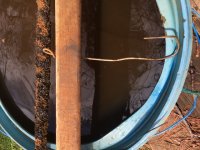
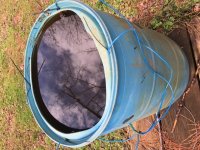
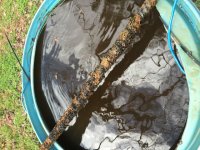 My results are just like floaters. I’ve included some pictures. Power supply is just an old battery charger. You can see in one of the pictures what a used anode looks like. My electrolyte solution is about a half box of washing soda in a 55 gallon drum of water. My tank has 4 rebar anodes in it. The 2x4 with the hook thru it is what I hang parts from. With small parts I’ll hang more than one part in the tank at the time. I use welding rods with the flux knocked off to bend hooks out of that are like large s hooks. Parts hang on one end and the other end just hangs off the 2x4 and I jumper all the hooks together with wire with alligator hooks on the end. I have found that cleaning the anodes with a pressure washer when they start looking like the one in the picture helps the process
Attachments
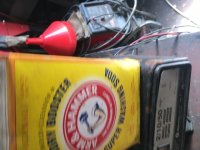
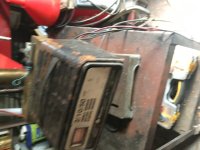
Anything you can do to protect your self from the dust and lead paint exposure is a good idea.
Perhaps equally or even more important is protection from the hazards of applying the new paint.
Any paint or primer that has a catalyst in it to help with drying or to add to the gloss, contains chemicals that can damage your body way worse than lead paint dust.
Charcoal filters offer very little if any protection from these hazards, and that is what most of us use, because that all we have.
I do all may painting out in the drive way anymore, so as to limit my exposure. I do paint the hoods and fuel tanks, fenders and things that really show inside, to keep the dirt down.
When I was in auto body school close to 40 years ago, our instructor used to raise hell with us for now wearing gloves when cleaning paint guns, and wiping panels off with lacquer thinner. He said it only takes 15 seconds for lacquer thinner to go through your skin and to your liver.
Pretty unsettling. When I got out of school I went into a safer line of work, but continue to paint a little once in a while.
Have not done an over all paint job on a car in 15 years or longer, and will never do another one. Exposure is too long, and I will let guys with the proper equipment to it for me.
Thats just my thoughts.. Your mileage may vary.
Perhaps equally or even more important is protection from the hazards of applying the new paint.
Any paint or primer that has a catalyst in it to help with drying or to add to the gloss, contains chemicals that can damage your body way worse than lead paint dust.
Charcoal filters offer very little if any protection from these hazards, and that is what most of us use, because that all we have.
I do all may painting out in the drive way anymore, so as to limit my exposure. I do paint the hoods and fuel tanks, fenders and things that really show inside, to keep the dirt down.
When I was in auto body school close to 40 years ago, our instructor used to raise hell with us for now wearing gloves when cleaning paint guns, and wiping panels off with lacquer thinner. He said it only takes 15 seconds for lacquer thinner to go through your skin and to your liver.
Pretty unsettling. When I got out of school I went into a safer line of work, but continue to paint a little once in a while.
Have not done an over all paint job on a car in 15 years or longer, and will never do another one. Exposure is too long, and I will let guys with the proper equipment to it for me.
Thats just my thoughts.. Your mileage may vary.
My electrolysis tank is pretty simple, and on a much smaller scale than Mht's. I bought a plastic tub for $15. I drilled a couple of holes near the ends of a wooden stake to hold my anode(s), and screwed a (conductive) hook through the center to hang or wire the cathode.
The cathode is the NEGATIVE, the anode is the POSITIVE. My anodes are rebar. My power supply began as a 12V smart charger. You can see the charger leads hooked up to the hook (Neg) and the rebar (Pos) in this first photo, but the smart charger tried to out-smart me - it faulted after about ten minutes when hooked up to the e-tank directly.

So to get around the charger fault, I put a 12V battery between the charger and the e-tank (charger to battery, and jumper cables from the battery to the cathode/anode). I use 2-3 heaping cups of Washing Soda to make the water conductive (same as Mht). I put the washing soda in a jug, fill the jug with hot water and shake vigorously to make sure the washing soda is completely dissolved. That's why the water in the first photo looks so cloudy. The part submerged in the photo is a final drive, sitting on the bottom of the tub and a piece of mechanic's wire wiring it to the hook. The anode (rebar) should never touch the part being "cooked". Also - a member here (Rudi) is a fervent believer in adding TSP (trisodium phosphate) to the water to prevent flash rust after the part is removed from the tank. I added a cup of TSP to my water, and I think it definitely helps. Thanks Rudi!

The second photo shows the jumper cables from the battery (green leads). I made a little "Faraday Cage" and tried some rusty bolts in with the final drive. Not so great on straight rust, but really good results blowing off paint.
One final important tip - the CLEANER the anode, the better the reaction. And by clean I mean bare metal. I use only one rebar anode at a time, and switch it for a clean rebar about every 12 hours. I rinse off the old rebar (the sludge which forms during electrolysis rinses right off), let the rebar dry and the WIRE WHEEL the REBAR, back down to bare metal. This is very important.
Another thing I do is run the tank using just the battery during the day (with a fresh anode). Then in the evening, replace the anode again and plug in the charger (to recharge the battery overnight). This seems to work well.

Any questions, let me know. I've been using the tank for almost three weeks now. The water is pretty nasty, but it still bubbles nicely, especially when I put a clean anode in. I do know my wife is pretty impressed!
Reg
The cathode is the NEGATIVE, the anode is the POSITIVE. My anodes are rebar. My power supply began as a 12V smart charger. You can see the charger leads hooked up to the hook (Neg) and the rebar (Pos) in this first photo, but the smart charger tried to out-smart me - it faulted after about ten minutes when hooked up to the e-tank directly.
So to get around the charger fault, I put a 12V battery between the charger and the e-tank (charger to battery, and jumper cables from the battery to the cathode/anode). I use 2-3 heaping cups of Washing Soda to make the water conductive (same as Mht). I put the washing soda in a jug, fill the jug with hot water and shake vigorously to make sure the washing soda is completely dissolved. That's why the water in the first photo looks so cloudy. The part submerged in the photo is a final drive, sitting on the bottom of the tub and a piece of mechanic's wire wiring it to the hook. The anode (rebar) should never touch the part being "cooked". Also - a member here (Rudi) is a fervent believer in adding TSP (trisodium phosphate) to the water to prevent flash rust after the part is removed from the tank. I added a cup of TSP to my water, and I think it definitely helps. Thanks Rudi!
The second photo shows the jumper cables from the battery (green leads). I made a little "Faraday Cage" and tried some rusty bolts in with the final drive. Not so great on straight rust, but really good results blowing off paint.
One final important tip - the CLEANER the anode, the better the reaction. And by clean I mean bare metal. I use only one rebar anode at a time, and switch it for a clean rebar about every 12 hours. I rinse off the old rebar (the sludge which forms during electrolysis rinses right off), let the rebar dry and the WIRE WHEEL the REBAR, back down to bare metal. This is very important.
Another thing I do is run the tank using just the battery during the day (with a fresh anode). Then in the evening, replace the anode again and plug in the charger (to recharge the battery overnight). This seems to work well.
Any questions, let me know. I've been using the tank for almost three weeks now. The water is pretty nasty, but it still bubbles nicely, especially when I put a clean anode in. I do know my wife is pretty impressed!
Reg
conservationman
Member
Does anyone know definitively that there is lead in the paint?
I used a test kit; it showed no lead but it hard to tell if there is lead or not. ( "If the swap turns orange there is lead" , not much help)
Thanks
Wally
I used a test kit; it showed no lead but it hard to tell if there is lead or not. ( "If the swap turns orange there is lead" , not much help)
Thanks
Wally
conservationman
Member
That is, I couldn't tell if it was orange or light red

Don McCombs
501 Club
I think the safest bet is to assume that the paint has lead in it, if it is the original paint.
Clemsonfor
501 Club
Our tree marking paint in forestry had lead in it till not that many decades ago.....I'm would be surprised if there wasn't lead in it.
Wasn't it something like 1980 when they finally quit putting lead in interior house paint? Lead was included in industrial type paints until pretty recently. You can bet it is in any paint on an old piece of machinery.
conservationman":3s8qkpty said:Does anyone know definitively that there is lead in the paint?
I used a test kit; it showed no lead but it hard to tell if there is lead or not. ( "If the swap turns orange there is lead" , not much help)
Thanks
Wally
Conservationman:....its like my ole granddad always said..."Son, when you wire electricity, Always work like dem wires are Hot, it will save yo life".