I just bought a Cub-22 sickle mower however it is missing the Drag bar support assembly part 16 in http://www.cleancomputes.com/Cub/Cub Parts Manuals/MR-5 - Mowers/Cub-22 Mower/Page 07.jpg. Does anyone have drawings or measurements so one could be made or a spare for sell?

You are using an out of date browser. It may not display this or other websites correctly.
You should upgrade or use an alternative browser.
You should upgrade or use an alternative browser.
Need C-22 Bar Info
- Thread starter CSA_CUB
- Start date
staninlowerAL
501 Club
Is the square bar with the attached rod with the loops what you are looking for? If so, I can get some dimensions for you.Click on the picture makes it larger. Stan

I have one with the flat iron part 3 inched long and one with the flat iron part 7 inches long. Which one do you need? One of them may be for a lowboy and other for a regular F cub. I do not know. All other parts ( rod and square bar) are the same. I also have just the sq bar and flat iron piece ( 3 in long). Just went out and looked at one of my F cubs and it has the 3 inch piece. Maybe some one can tell us the different usage.
Thanks for he replies so far. Staninlower Al that is exactly the part I'm talking about.
Muleboss, you have me curious on the length of the arm now. I looked at Rudi's manual's and I see 2 different numbers for the F-cob and a totally different on for the Low Boy. I guess we will have to wait and see what the rest of the members have to say on this.
Muleboss, you have me curious on the length of the arm now. I looked at Rudi's manual's and I see 2 different numbers for the F-cob and a totally different on for the Low Boy. I guess we will have to wait and see what the rest of the members have to say on this.
staninlowerAL
501 Club
Using the link below for the PDF MANUALS, take a look at the setup for the C22 page 17 and LC22 mowers page 20. Looks like the picture shows the longer flatbar for the LoBoy mower. http://www.farmallcub.com/fcman/downloa ... Mowers.pdf
Farmall trucker
New member
I also missing the same parts and I could use the dimensions if it's not too much trouble.
staninlowerAL
501 Club
Go to the PDF MANUALS link at the top of this page, 2nd folder-Cub Attachments, then 6th folder, mowers, then 8th listing for International 22, Cub 22 and L22 mowers, then page 17 and page 20.CSA_CUB":p3dr2vc0 said:Stan, I can't open that particular manual. Google gives me an error duplicate headers. What ever that means?
The very early mowers had an asymmetrical bracket at the front of the flywheel shaft tube. The flat part on the left side didn't have a bend. The flywheel shaft wasn't centered under the bell housing. From anything I have been able to find, it appears that the short drag bar support was used with that flywheel shaft tube. The long one was used with all later mowers.
Thanks for completing the puzzle for me, Jim.Jim Becker":3kqhmwj0 said:The very early mowers had an asymmetrical bracket at the front of the flywheel shaft tube. The flat part on the left side didn't have a bend. The flywheel shaft wasn't centered under the bell housing. From anything I have been able to find, it appears that the short drag bar support was used with that flywheel shaft tube. The long one was used with all later mowers.


staninlowerAL
501 Club
I'm using Firefox for web access and mine works OK, slow at times but I think my PC is about overloaded. I got your email and replied, for anyone else I'll post the picture with the dimensions of what I have. Stan 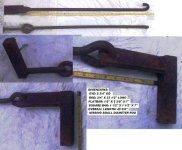
YesCSA_CUB":3hxry400 said:It would require the short bracket correct?
leerenovations
Well-known member
I made mine from some square tubing I had laying around, a large 3/4 bolt, and a piece of cold rolled rod with a hook and eyelet bent into it. Works like a charm. and cost was about 16 for the rolled rod. The other pieces I had just laying around.
Jim Becker":2dmnb6o8 said:The very early mowers had an asymmetrical bracket at the front of the flywheel shaft tube. The flat part on the left side didn't have a bend. The flywheel shaft wasn't centered under the bell housing. From anything I have been able to find, it appears that the short drag bar support was used with that flywheel shaft tube. The long one was used with all later mowers.
Thanks Jim. Went out to my shed this morning to look at the early mower I bought years ago and it has the asymmetric bracket and came with the short drag bar support as you describe. --Lee