

I came across an interesting barn find yesterday and did a little research. It seems I have found a very early Farmrock F-4 tractor and have added it to my collection.
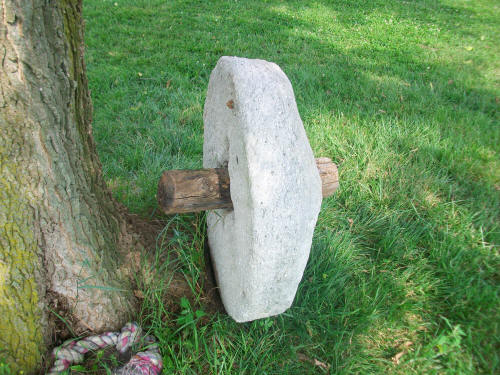
From what I can figure out through extensive internet searching, the F-1 was a cube of stone. When the designers learned that it would not roll they had the corners chipped away and the F-2 was born. The problem with this design was that there was no place for the operator so a hole was knocked out in the center for the operator’s feet. Immediately it was designated the F-3. However, this design proved to be a burden due to the operator having to turn his feet sideways to stick them in the hole and the friction of the turning wheel was a little tough on the old bunions.
After struggling for a new design an engineer quite literally stumbled on a solution. It seems as though he tripped on a log and tossed it aside to get it out of the way. Ironically this log landed right in the middle of the hole of the tractor which had been lying on its side. When the engineer stood the tractor up he discovered fire…no wait a minute that is a different story…he discover he had a comfortable place to put his feet as he rode the tractor, now designated the F-4.
There were many more problems to figure out as the design went forward. It was very hard to plow with since there was nowhere to put the hitch. A seat was needed so the operator would be a bit more comfortable. Then of course there was this little problem with how to power it. It seems it would do nicely going downhill which was great if you had one very looooong row to hoe. The problem was getting it back up the hill. This is where a good herd of wooly mammoths would come in handy.
On level ground it required another person to push the operator to move the tractor. The wooly mammoths were much too cumbersome for this type work. When the operator would try to stop the mammoth would continue on and trample the operator. This tended to eliminate potential buyers of future products so the manufacturer advised against this practice.
There is a long period where there is no info on how the Farmrock progressed until modern times. Some where along the line Farmrock was bought out by Rockford B. McCormick, an early ancestor to Cyrus. The Farmrock later became part of the Farmall group. There is not much available about the F-5, F-6 or any of the others until the F-12 came into being in 1932.
Just thought you’d like to know.


