Knocking sound

Don

New member
I recently bought a 1949 cub with a belly mower for a tinker toy and am discovering that I have joined what is apparently a very large community. This is my first post here.
My cub runs well but has quite a noticeable knocking sound, once per revolution, at low idle that disappears as I increase the revs.
Has anyone encountered this and what is it likely to be?

Don
 
Hi,
A Cub engine doesn't have hydraulic valve lifters, the valve lifters usually make a tapping sound, but it can be more noisy if the clearances are too much.
The clearance is manually adjusted. If nobody checks them, the clearance can be wrong.
The valve cover is on the left side of the engine, it tells how to adjust them in the Cub owner's manual.
Below is a page from the 1949 Cub owner's manual telling how to adjust the valve clearance.
You need 2 open end wrenches, and a .013" flat feeler gauge to check or set the valve clearance.
The valve cover has a gasket, it may need replacing if you remove the cover.
TM Tractor Parts, near the bottom of the Forums page sells them, you can look at the picture of it there.

If the Cub has had lots of use, and never had the engine rebuilt, it could be the crankshaft bearings are worn, and there is too much clearance, making the knocking sound.
If the engine oil pressure is low when the engine is running, the crankshaft bearings could be worn.
Listen when the engine is running, and try to hear where the noise is coming from, the left side, or the bottom area of the engine. It may be hard to tell.
If the crankshaft bearings are worn, and too much clearance in them, using the Cub that way can damage the crankshaft. :)
 
Last edited:
Thanks Glen for your comprehensive reply. I'll do just as you suggest and set the valve clearance. If that doesn't work I'll pull the pan and see if there's anything flopping around in there.
 
.........but has quite a noticeable knocking sound, once per revolution, at low idle that disappears as I increase the revs.
Don
Your description of the "knock" is commonly referred to as a "rod knock" and is usually caused by worn C/S bearings and low oil pressure. Increasing the rpms raises the oil pressure a bit so that might be another clue. If this is the case, repairing involves replacing the bearings (sometimes called a "low end" rebuild) but a best fix will probably require an engine rebuild. JMHO Stan
 
Your description of the "knock" is commonly referred to as a "rod knock" and is usually caused by worn C/S bearings and low oil pressure. Increasing the rpms raises the oil pressure a bit so that might be another clue. If this is the case, repairing involves replacing the bearings (sometimes called a "low end" rebuild) but a best fix will probably require an engine rebuild. JMHO Stan
Boy I love this site. My 57 knocks so now will try and figure out from where.
 
Boy I love this site. My 57 knocks so now will try and figure out from where.
Hi,
Dennis, I sent you a message, you get to it near the top right of the page.
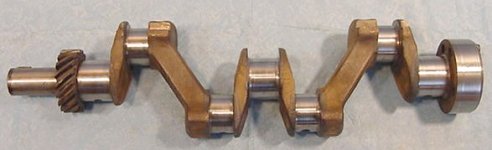
If you need to look at the crankshaft bearings, the surfaces where the bearing run on are called journals.
The crankshaft bearings and journals should be smooth, with no grooves. If any of them look bad, the bearings need replacing, and the crankshaft needs improving, at an engine rebuilding shop.
Below are pictures of journals from TM Tractor Parts. These journals are fair, but smoother is better. They look smoother after being resurfaced at a shop.
 

Attachments

  • Cub crankshaft.jpg
    Cub crankshaft.jpg
    26.9 KB · Views: 10
  • Cub crankshaft 3.jpg
    Cub crankshaft 3.jpg
    55.6 KB · Views: 10
Last edited:
does the engine noise get louder as the engine gets hotter, how low is the oil pressure reading hot ?
 
rebuild means a trip to the machine shop to be boiled out, rebored, crankshaft reground, head and block surfaced AND deep pockets!!
 
Or you could get a fitted block from JP Tractor salvage that has the work done. But you will still need to have your crankshaft ground if needed.
 
Pull the oil pan and see if anything is loose, I had to rebuild mine because a connecting rod cap had become loose. I f on nothing is obvious remove the rod caps one at a time and inspect the crank journal and bearings on each one, they should be smooth. If they look good then do the same thing with the crankshaft journals. If they all look good then it could be a wrist pin, but that is less likely.
 
His Cub is a 49 so it may have a magneto on it. I don't have any Cubs here with a magneto on it so I've got to ask the question, could what he's hearing be the impulse making a noise that he's mistaking for knocking?
 
Good thinking Rick, If the Cub has a magneto, you should hear the impulse coupling click or snap when the engine is being turned by the starter, as it was originally made, using 6 volts.
If the Cub has been changed to 12 volts, I'm not sure if the snapping will happen, the 6 volt starter runs faster on 12 volts.
When the engine is running, the slow idle speed should be about 500 RPM, if the slow idle speed is less than that, the impulse coupling can engage some, and make a clattering sound, or snapping sound, as it goes on and off.
Set the slow idle speed to 500 RPM, and the snapping sound should stop.
 
Back
Top