
You are using an out of date browser. It may not display this or other websites correctly.
You should upgrade or use an alternative browser.
You should upgrade or use an alternative browser.
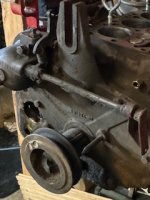
Just bought a new block from JP salvage
- Thread starter tgrist
- Start date


Check to see if the pipe plug in the oil gallery under the cam shaft timing gear has been installed.
If not provided, measure the cylinder bores. You will need that information for ordering pistons and rings.
The pictured block appears to have been bored and honed. Can't tell much else from the photos.
If not provided, measure the cylinder bores. You will need that information for ordering pistons and rings.
The pictured block appears to have been bored and honed. Can't tell much else from the photos.
Hi,
Below is the Cub and LoBoy service manual, it has lots of info.
I would read the engine section, section 1, before working on the engine.
There is a contents beginning on page 1 of most sections, that makes it easier to use online.
http://farmallcub.com/rudi_cub/www.clea ... index.html
You didn't say the year of the Cub. This manual was made in the 1970's so it has newer, 12 volt electrical system info.
I don't know what you meant by drive shaft. The crankshaft goes in the lower part of the engine.
You didn't say if the crankshaft you are using is in good condition, the bearing surfaces should be measured with precision tools, that an engine repair shop probably has, to check it for wear.
The bearing surfaces should be smooth.
Each of its bearings has to be fitted right, and their clearances checked using Plastigauge.
It explains how to use Plastigauge in the manual. It is sold at auto parts stores, like NAPA. It is like a small string.
The clearances all have to be .002" to .003"
The crankshaft info begins on page 1-47, info about Plastigauge is on page 1-50.
If the crankshaft journals, they are called, are worn too much, or out of round, it needs regrinding at an engine shop. Then it would use undersize bearings.
Below is a pic from TM Tractor Parts of crankshaft journals, they are in good condition, new ones look better.
Remove any paint from the engine where the front end, and clutch housing bolt to it, so the electrical system can ground through the tractor.
Remove the paint where the generator bracket goes, so that can ground.
Below is the Cub and LoBoy service manual, it has lots of info.
I would read the engine section, section 1, before working on the engine.
There is a contents beginning on page 1 of most sections, that makes it easier to use online.
http://farmallcub.com/rudi_cub/www.clea ... index.html
You didn't say the year of the Cub. This manual was made in the 1970's so it has newer, 12 volt electrical system info.
I don't know what you meant by drive shaft. The crankshaft goes in the lower part of the engine.
You didn't say if the crankshaft you are using is in good condition, the bearing surfaces should be measured with precision tools, that an engine repair shop probably has, to check it for wear.
The bearing surfaces should be smooth.
Each of its bearings has to be fitted right, and their clearances checked using Plastigauge.
It explains how to use Plastigauge in the manual. It is sold at auto parts stores, like NAPA. It is like a small string.
The clearances all have to be .002" to .003"
The crankshaft info begins on page 1-47, info about Plastigauge is on page 1-50.
If the crankshaft journals, they are called, are worn too much, or out of round, it needs regrinding at an engine shop. Then it would use undersize bearings.
Below is a pic from TM Tractor Parts of crankshaft journals, they are in good condition, new ones look better.
Remove any paint from the engine where the front end, and clutch housing bolt to it, so the electrical system can ground through the tractor.
Remove the paint where the generator bracket goes, so that can ground.
Attachments

I guess the block has a camshaft, be sure to check the valve clearance adjustments. Be sure each valve lifter is fully down before setting the clearance. You will need to turn the camshaft to close some of the valves. The clearance should be .013", at the lower end of the valve stems.
You need a flat feeler gauge to check the clearance, and 2 open end wrenches to change the clearances.
Below is a picture from TM Tractor Parts of the place one of the oil passage plugs goes, that Eugene said above. It is to the upper left of the camshaft hole. Upper left in the picture.
I can sort of see the year letter in the date code on the side of the block. It is maybe C or G.
C is 1957, G is 1961.
You need a flat feeler gauge to check the clearance, and 2 open end wrenches to change the clearances.
Below is a picture from TM Tractor Parts of the place one of the oil passage plugs goes, that Eugene said above. It is to the upper left of the camshaft hole. Upper left in the picture.
I can sort of see the year letter in the date code on the side of the block. It is maybe C or G.
C is 1957, G is 1961.
Attachments

Gary Dotson
501 Club
Was this their “fitted block” package which includes a machined block with appropriate pistons and rings? I’ve always thought that was a good deal and a good way to go. You’ll need to dig into the blue ribbon service manual for all the assembly specs and clearances. All you will need to check is “everything”.
Ken (48 Cub)
501 Club
I have personally done 3 short blocks from JP. All were bored 40 over and worked perfectly with cam and valves already installed. Just check the valve clearance like Glenn said.
You should have purchased the piston and rings from him as well...maybe you did.
Have fun building it. Just take your time. Hearing it run for the first time will be great!
You should have purchased the piston and rings from him as well...maybe you did.
Have fun building it. Just take your time. Hearing it run for the first time will be great!
Workinprogress
Well-known member
Very interested to see how this all comes together!
If the plug isn't there, you won't have any oil pressure. Easy to check with the front cover off.
Yes, the plug has to be there. All the oil passage plugs on the engine screw in. Check them and be sure they are tight.tgrist":3e46n3sf said:Does that plug stay in?
Yes, like Gary said above, check everything and be sure things are right, so the engine works right.
Before putting the pistons and rings in, put just the rings into the cylinders, and check their end gaps.
The rings have to have end gaps, measured where the ends come together. A flat feeler gauge is used to measure the gaps. The clearance is in the manual.
If they are the flat top pistons, use a piston upside down, and push one ring at a time down into the cylinder, that makes the ring straight in the cylinder. Have only 1 ring at a time in the cylinder. Measure the gaps pushing the rings to different places in the cylinder.
You should check the piston clearance in each cylinder also.
I sent you a PM.

Gary Dotson
501 Club
No need to remove the pointer, it’s press fit and has to be driven out from the inside.
The orange paint may be faded original paint that was painted over in the past. I can't see it well in a picture. Try to see which paint is the upper or lower layer, if there are 2 layers.
If there are 2 layers, and the orange is the 2nd layer, someone might have used an orange paint, or if it was red, it may have faded to orange.
I sent you a PM with info.
If there are 2 layers, and the orange is the 2nd layer, someone might have used an orange paint, or if it was red, it may have faded to orange.
I sent you a PM with info.
Bob Allard
New member
The orange “paint” would be the Glyptol, that was used as a coating on all cast parts. Keep it on.
To me, the orange looks more like actual orange paint than cheap red that is faded. Some is showing on the rockshaft which is not a cast part. Maybe it was a highway mower or something else that called for orange paint. The relevant question is the color of the bottom layer.