John Deere Model A.. stuck, rusted starter, etc.

MikeEyre74

Well-known member
So this is weird, writing about JD's.. for me at least! :D

I have a friend of mine that wants to gift me a rather nice JD Model A, 1946 Vintage... he invited me down to try it out, drive it around and see what it was all about, but when I go there, it wouldn't turn over. Its been sitting for years after a full restoration, and after digging into it, and pulling the flywheel cover off, it drained out about a gallon or more of water. All of this water gathered in the cover and into the starter and totally rusted the thing out. I can understand the starter not working then, but shouldn't the flywheel turn by hand? Well, it wouldn't. I don't know a thing about these to start to know what to do next.. and didn't much have any interested until he said "want to come back and just take it home? It's a gift.. I have no time for this anymore", so now I'm sorta curious. I don't really need a two ton lawn ornament, but.. for the price of gas, I'm tempted. Any ideas?
 
Earlier this year I began volunteering at an educational farm. They have a B that had been sitting for several years they asked me to try and put back into service. The flywheel on that one wouldn't turn either. After several weeks sitting with penetrating oil in the cylinders we broke it loose by putting a pair of bolts into the flywheel and using a piece of pipe to turn it.

Those horizontal twin engines have a long stroke and generate a lot of torque at low RPM. That long stroke will make it hard to turn if the pistons are stuck at all.

In the case of the B one cylinder had very low compression before I got it running. I haven't re-checked compression since it's spent some time running but based on the amount of oil it burns it's still probably an issue.

They are neat tractors though and free is free. Worst case you can probably sell parts to cover the cost of picking it up.
 
Pull the spark plugs and look in the cylinders for rust. With that much water in the starter, wonder how much got in other areas. I rebuilt a 1950 John Deere A that was a several year project. It was stuck among other things. If you have the time they are an interesting project.

Rodney 8)
 
So it sounds like any other old iron project. It’ll probably fire up with a little tinkering. I’m a little worried about the size of the pieces involved but I guess I could break out the cherry picker and extra floor jack again... ok, I’ll keep ya posted!
 
MikeEyre74":edimb20j said:
So it sounds like any other old iron project. It’ll probably fire up with a little tinkering. I’m a little worried about the size of the pieces involved but I guess I could break out the cherry picker and extra floor jack again... ok, I’ll keep ya posted!

Even if you haul it home and absolutely cannot get it started, it's worth more than "free" to any local JD collector. Worse case, after fiddling with it to no avail, donate it to a local FFA group as a project. They'll fix it up, show it in a fair, then sell it to raise money for their group.
 
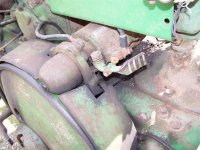
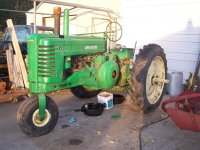
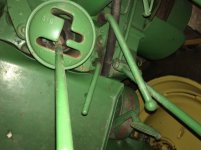
By your description of the starter and cover it sounds like this tractor is later than 1946. The 1946 JD A would have the starter located up on top of the crankcase with a narrow guard around the flywheel ring gear.(first 2 pics) The '46 will also have a angle Iron frame. By the way you describe it, It sounds more like the "late styled" A which began production in 1947 at serial number 584000. and had the full flywheel cover, starter mounted underneath the crankcase, and a stamped steel frame.(last pic)

100_9104 (Medium).JPG100_9092 (Medium).JPG100_8207 (Medium).JPG
 
I was doing some reading and actually just stumbled across some information very much like you just mentioned. The tractor certainly is not in 1946, by the description you gave. It definitely has a fully enclosed fly wheel with the starter on the bottom, like in your last picture. it also has the bench seat with the battery underneath, which isn’t nearly as cool as the big pan spring seat of the earlier models. rats! The one part that is mystifying is the shifter. All of the early 1950 model A machines have a shifter that does not look like the one that is on this tractor. This has a Hi/low range lever, off to the side, but it does not have independent gates on two sides of the main shift lever like some of the other machines I have seen in pictures. I am still trying to figure out how the transmissions differ between John Deere machinery… Unless I am confused, there are several six speed transmissions available?
 
This is a picture of our A, it’s a 1949. Has high/low. The later ones did not have high/low but had a full 6 speed with a different cast piece around the gear stick, like the John Deere model 60 which was the A’s replacement.

If your wondering what the black is beside the high/low stick, it’s a hydraulic line. This one has a pump behind the magneto to give it live lift.
 

Attachments

  • A34E074D-0BE1-4DED-A9D9-5D9F9AEF5F3F.jpeg
    A34E074D-0BE1-4DED-A9D9-5D9F9AEF5F3F.jpeg
    111.9 KB · Views: 1,360
Looks like the shifter change to the late type(pictured) was made at serial #648000 according to the parts book which would be early 1950 model.

100_8196 (Medium).JPG
 
2cubs":37sahkor said:
Looks like the shifter change to the late type(pictured) was made at serial #648000 according to the parts book which would be early 1950 model.

100_8196 (Medium).JPG100_8196 (Medium).JPG
Makes sense, ours is 637xxx
 
Yes, the one on this machine looks like the one that Shane posted a picture of in his 1949 model. So that narrows this one down to somewhere between 1947 and 1949 I guess?

The gearshift is curious, with the automatic bump of the Hi/low shifter when you select reverse. I don’t recall which one it was, but if it’s in hi or low, and you try to put it in reverse, it automatically shifts it into ONE of those selections, and one of those ONLY. Essentially, you only have one reverse speed instead of two reverse speeds. Wonder why they would do that?
 
MikeEyre74":2sg0w3wq said:
Yes, the one on this machine looks like the one that Shane posted a picture of in his 1949 model. So that narrows this one down to somewhere between 1947 and 1949 I guess?

The gearshift is curious, with the automatic bump of the Hi/low shifter when you select reverse. I don’t recall which one it was, but if it’s in hi or low, and you try to put it in reverse, it automatically shifts it into ONE of those selections, and one of those ONLY. Essentially, you only have one reverse speed instead of two reverse speeds. Wonder why they would do that?

Yep, when you shift to reverse they automatically go into low range. The reason is a lot of these old JD's have a very fast reverse in them and that is in low range. If you had a high range reverse they would be down right dangerous. Our 1945 JD B has a really fast reverse and I always idle it way down before backing up.
 
Do you have any insight on the transmissions for these things? Just as in a cage occasional thing I’m trying to figure out the difference between the transmission on this machine with the high low range versus the transmission that has a straight six speed gear set in it versus whatever else might be out there. But it’s hard to get a good search results if you don’t know what you’re searching for?
 
MikeEyre74":soafm6i4 said:
Do you have any insight on the transmissions for these things? Just as in a cage occasional thing I’m trying to figure out the difference between the transmission on this machine with the high low range versus the transmission that has a straight six speed gear set in it versus whatever else might be out there. But it’s hard to get a good search results if you don’t know what you’re searching for?

Probably the best thing is to get a parts book. It will tell you the serial number range that each part was used on and also show any changes made along the way.
 
Back
Top