Installing pistons

Hockeygoon

Active member
I have one of the "basic" ring compressors that will work on cylinders from 2.125 inches to 7" - it worked to install a piston on cylinder that was "C" sized but I cannot get it to work on an "A" sized cylinder. The overlapping of the metal bands prevent it from seating in the top of the cylinder hole and spread out slightly as the rings push out on the lower part of the tool just as the oil rings are about to enter the cylinder hole.


https://www.ebay.com/itm/166250215410

Do you think one of these would work better?

https://www.ebay.com/itm/387649550485


1739198862147.png
 
I have one of the ratchet type that is Hastings brand I bought nearly 50 years ago. Still works great. I've used it to install pistons in a truck engine, several tractor engines and just used it last week on the Kohler K361. It won't go into the cylinder, just flush on top. Hold it tight, and take a hammer with wood handle, or my dead blow hammer and they tap right in.

Gave it a light coat of oil, and put it back in the special tool cabinet for the next time.
 
I have one of the ratchet type DJ54 mentioned. Also had mine many years, although I have others, as well, the old ratchet type will always get the job done. I’ve used the style Hockey Goon posted and they work well, too.
 
You should have gapped them on the lower end since the rings are sacrificial and wear down on every stroke….
Having a ring compressor helps but since the pistons are so small you can use your fingers and light pressure to seat the pistons.

NJ Farmer
 
I don't quite understand the issue you're experiencing. The ring compresser you have should work great on all cylinders. Can you post a picture of the problem?
 
Could you use a screw radiator clamp on your "basic" ring compressor to accomplish your task. Place clamp next to block should keep compressor from belling out at the bottom.
 
If you’re using the compressor in the first eBay link, do you have the narrow end or the wide end next to the block?


I have it "upright" as you can only tighten the compressor from the top using the square wrench they include.

The issue is the lower part of the "tube" flexes out as the rings slide down the tube. If you attempt to tighten it even more the top of the tube flexes in while the bottom flexes out. I have used these before on bigger pistons and I would simply slip the compressor inside the cylinder about 1/16" and the rings would slide from the compression tube into the cylinder. With the tiny cylinders in a Cub the metal that makes up the tube is doubled or even tripled up it can't fit inside the engine cylinder and still have room for the piston to slide into the hole. With the compressor sitting on the deck the tube flexes out at the bottom as the rings exert outward force.
 
I see what you mean. Might be time for a different style compressor. Big box auto parts stores usually have tools that you can borrow or rent. You might want to look into that.
 
Can you cut a wood disc to set on top of the piston so the top part of the clamp can’t flex in? Thus preventing the bottom part from flexing out?
 
Can you cut a wood disc to set on top of the piston so the top part of the clamp can’t flex in? Thus preventing the bottom part from flexing out?


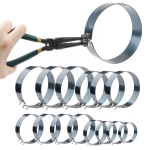
I ordered the ring compressors in the picture above. They might be too small compress all three rings at once - but once the oil rings make it into the cylinder bore I can adjust to the next set of rings.
 
Would it be possible to use the ring compressor "upside down" from the way you usually do? It appears that the locking mechanism does not extend beyond the sleeve so it could be used in either direction. One side of the compressor looks like the bands are closer to the edge than the other, maybe the piston rings won't be able to flare out the sleeve?
 
Would it be possible to use the ring compressor "upside down" from the way you usually do? It appears that the locking mechanism does not extend beyond the sleeve so it could be used in either direction. One side of the compressor looks like the bands are closer to the edge than the other, maybe the piston rings won't be able to flare out the sleeve?


Before I did that I would use my picks to ease it in ring by ring.
 
I have it "upright" as you can only tighten the compressor from the top using the square wrench they include.

The issue is the lower part of the "tube" flexes out as the rings slide down the tube. If you attempt to tighten it even more the top of the tube flexes in while the bottom flexes out. I have used these before on bigger pistons and I would simply slip the compressor inside the cylinder about 1/16" and the rings would slide from the compression tube into the cylinder. With the tiny cylinders in a Cub the metal that makes up the tube is doubled or even tripled up it can't fit inside the engine cylinder and still have room for the piston to slide into the hole. With the compressor sitting on the deck the tube flexes out at the bottom as the rings exert outward force.
I've have never slipped, even just a 16" into a cylinder using mine. I put a little oil on the rings, then position the bands on the compressor just below the bottom ring. Slide the skirt of the piston into the bore, and give it one more snug with the tool. I snug the compressor tight enough, when I bump the top of the piston with dead blow hammer handle it makes the bottom edge of the compressor flush with the top of the block. A few good bumps with the hammer handle, and they go in like they have eyes.

Smallest piston I've ever put in was a 3" in a C-113. Above method worked like a champ. I'd have to check it, but thinking the thickness of the compressor bands have to be around 0.020 just one one side. If it would be just one wrap, that would be 0.040, double 0.080. Sounds like you're pinching the piston, and trying to drive it a hole way smaller than the piston. Even if there is a smidge of a ridge at the top of the bore, even more.

Might try using the above method, and see how that works.
 
No matter which type compressor you use, the compressor must remain on top of the bore, not in the bore. You must also be diligent to keep it against the top of the bore, even tapping gently with a small hammer to keep it there.
 
Back
Top