Increase max rpm to 2000?

Al-turbo

Active member
I would like to join a classic tractor tour in the Netherlands. Minimum speed for participants is 20 kph (= 12.5 mph): I measured 18 kph (= 11 mph).
I believe it is possible to increase the max rpm from 1800 to 2000, assuming the engine is healthy and runs fine, which appears to be the case.
Instructions for making the required changes to the governor settings (spring?) please.

French Cub 1956 with new after market carb.

Sorry if this has been discussed before, have still not figured out how to search this forum.
 
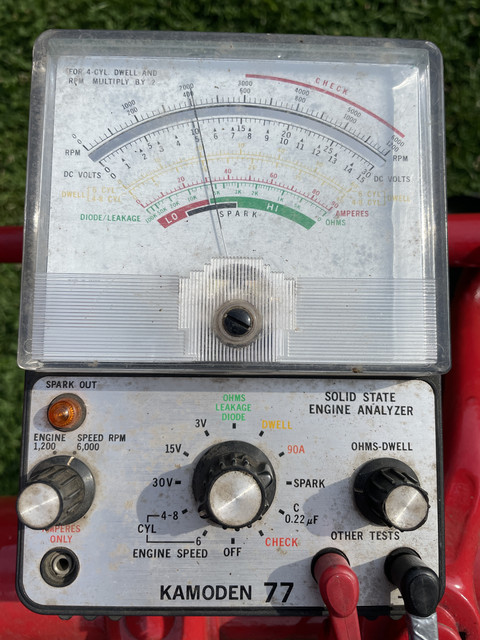
With an engine in good condition, 2,000 rpm isn't a problem. However, you may already be there. I think French Cubs were set up for higher speed than US built Cubs. Have you checked your engine speed with a tachometer? According to the brochure for the long stripe Cubs ('75-'79 model), the ground speed with 9.5-24 tires in 3rd gear is 9.2 mph or 14.8 kph at 2,080 rpm. Based on those numbers and assuming you don't have larger tires, reaching 20 kph requires over 2,800 rpm. There may have been some Power Unit applications that ran that fast. But they may have had counterbalanced crankshafts etc. I wouldn't guarantee a Cub engine staying together at that speed.

To the question about how to change it. The capscrew in the top of the governor adjusts speed. In for slower, out for faster. But 2,800 rpm is probably beyond the range of the adjustment. There may have been Power Unit governors with lighter weights and/or stiffer springs.
 
My Cub spins over 2650 rpm according to Rick Prentice's dynamometer testing at his Cubfest. I let it rip often and after 24 years since the complete restoration, it doesn't mind a bit. Straight exhaust, .020 bore and some porting to help it breathe better. I've never measured it in miles per hour, however.
 
Hi,
Below are the Specifications pages from the 2nd 1955 Cub operator's manual from on here, for USA Cubs.
It seems to have the higher engine RPM spec, the speed was changed during 1955.
It shows the MPH speeds the Cub goes on the 2nd page.
https://farmallcub.club/rudi/farmallcub.com/rudi_cub/www.cleancomputes.com/Cub/Cub Owner's Manuals/McCormick Farmall Cub Operator's Manual 12-20-55/Page 77.jpg

https://farmallcub.club/rudi/farmallcub.com/rudi_cub/www.cleancomputes.com/Cub/Cub Owner's Manuals/McCormick Farmall Cub Operator's Manual 12-20-55/Page 78.jpg

If you have the 1956 French Cub operator's manual, you could look at the specifications in it.
Notice that in the picture above of the Cub with flames, I think he has the rear wheel spacing set as wide as they go.
Be careful and don't flip the Cub over, it's not made to go faster than IH made it, my opinion.

Sorry if this has been discussed before, have still not figured out how to search this forum.
The search is at the upper right of the page.
 
Last edited:
Many of the "stationary" c-60s were set at high RPM I think around 2500. I use most of my cubs for mowing and have them set up at about 2000-2200 to help with that. As long as you do not abuse it I think you will be fine for a few times a year at the high RPM.

Keeping it on the road is an issue as others mentioned. Turf tires may help.
 
Hi,
Below are the Specifications pages from the 2nd 1955 Cub operator's manual from on here, for USA Cubs.
It seems to have the higher engine RPM spec, the speed was changed during 1955.
It shows the MPH speeds the Cub goes on the 2nd page.
https://farmallcub.club/rudi/farmallcub.com/rudi_cub/www.cleancomputes.com/Cub/Cub Owner's Manuals/McCormick Farmall Cub Operator's Manual 12-20-55/Page 77.jpg

https://farmallcub.club/rudi/farmallcub.com/rudi_cub/www.cleancomputes.com/Cub/Cub Owner's Manuals/McCormick Farmall Cub Operator's Manual 12-20-55/Page 78.jpg

If you have the 1956 French Cub operator's manual, you could look at the specifications in it.
Notice that in the picture above of the Cub with flames, I think he has the rear wheel spacing set as wide as they go.
Be careful and don't flip the Cub over, it's not made to go faster than IH made it, my opinion.


The search is at the upper right of the page.
Thanks for this info. Surprising to see that the top speed was just 7.3 mph, where my Cub already reaches 11. Feels like I should not try and go any faster..

On the right upper corner, I only see my own name, an envelope and a bell sign, no search button.
 
Thanks for this info. Surprising to see that the top speed was just 7.3 mph, where my Cub already reaches 11. Feels like I should not try and go any faster..

On the right upper corner, I only see my own name, an envelope and a bell sign, no search button.
Are you accessing the forum on a cell phone?
 
I measured the RPM's to be around 2000 rpm at fast unloaded idle. By changing the governor stop screw a bit, this went up to 2200. This should definitely result in the top speed I was looking for. Thanks for all your replies.
 
I refound this post from 2006 from Jim Becker about 1962 lo boy sales information. Jim is always the authority on specs and part numbers.

"Aug 17, 2006
Edit bookmark
#3
Charts were published with the industrial sales information. This is what was published for a Lo-Boy in '62, stripped engine running on 91 RON gasoline (about 86 or 87 octane on today's gas pumps). (Reading best I can from a chart.)

RPM . Torque . hp
600 -- 32 ----- 3.5
800 -- 34 ----- 5.25
1000 - 36 ----- 7
1200 - 38 ----- 8.75
1400 - 39.5 --- 10.5
1600 - 39.75 - 12
1800 - 39 ----- 13.5
2000 - 37.5 --- 14.5
2200 - 36 ----- 15.25

Looks like the peak torque is at about 1550. Note that governed speed is 1800. Max full load speed is normally about 1600, which is pretty close to the peak torque speed.

Torque curve is pretty flat. Makes horsepower almost a straight line against RPM. Pretty clear where most of the higher power came from in the later engines."


So in 1962 they we ok with the cub at 2200 RPM
 
Original post said 1956 French Cub, the assumption is that all the data previously listed for USA made cubs is close to the same. JMHO Stan
 
Original post said 1956 French Cub, the assumption is that all the data previously listed for USA made cubs is close to the same. JMHO Stan
Valid point. Considering the greater need for street-worthiness in Europe, they could have been geared higher. However, according to the 1956 French Cub Parts Catalog, the gears were the same as the early US Cubs. So, the data presented here should apply. A change could have been made after the Catalog was produced and before this tractor was made.
 
Back
Top