For the retirees ?

Jackman

501 Club
Did you find the answer to retirement living? Things like taxes, climate, affordability, and what ever else a decent retirement requires,

I have some years to go before retirement but I have figured out that NY is not retirement zone for me :( , , cost of living is too high NY State taxes and winter fuel cost are pretty much the main issues here, so where is a good place to retire working man style (no big money) live good be satisfied.

I thinking semi south like Va. or even Pa. , can't do deep south its just too warm down there , west might be doable but where :?: :idea: what works for you :?:
 
Small town, rural areas in south central Missouri. Mild winters, low cost of living, lots of outdoor recreation. Houses are moderately priced compared to other areas of the country.

Taxes. Portion of some pensions are state income tax exempt. Social Security, with some limitations, are state income tax exempt.
 
Travel for a couple of years after retirement and something might appeal to you. As for me I stuck with Michigan's high taxes, high heating costs, but lower somewhat cooling cost. We had to hole up for a few hours Saturday due to snow but it only takes the county 8 hours of plowing to open most roads. Our road is one of the first. I always thought Florida or Texas would be nice for the winter but when you don't have to get out winter isn't so bad. Today I have no desire to move nor leave for the winter. To each his own really. Enjoy yourself whatever you decide and as for retirement :big smile: Vern
 
We live in West Central VA. ( not West Va. ) I think it is one of the better places to liv, taxes are comparably low , crime rate
Is low, heating cooling is as reasonable as can be expected . We are located approx 120 miles south of Wash DC, 120 miles North of Roanoke, VA. And 120 miles West of Richmond, Va. In the Shenandoah Valley. Our area is primarily a farming community. We are in Augusta County

Berlin

We are both retired fron state goverment and so far are very pleased with this area, we both grew up here.

Edited to add retirement info
 
Eugene":guyofyh7 said:
http://www.kiplinger.com/tool/retirement/T055-S001-state-by-state-guide-to-taxes-on-retirees/index.php
This site is interesting but there is so much more to the whole picture that it is borderline misleading. Here in Texas, the state sales tax is 6.25% but almost every local jurisdiction around here has local optioned it up to or close to the 8.25% limit. And it applies to ALMOST EVERYTHING. Another thing left unsaid is that Texas, in pursuit of the holy grail of low taxes, has been adding "user fees" to everything. Virtually all major highway projects are now toll roads. So we not only pay for each road, we also pay for a huge automated toll collection system on each road. We even have one where the toll amount is adjusted as traffic changes. Half the time, when I meet some buddies for lunch I pay more in tolls than I spend on lunch (I am not exaggerating!).

Yesterday, my wife mentioned a story that Texas has the 4th worst drivers in the country. I don't know whose list or what they based it on, but our car insurance rates confirm it belongs high on any similar list. Insurance is cheaper most other places. Add to that the cost of annual safety/emissions tests, and you see Texas isn't all that car friendly.

Don't ignore utility costs. Around here, water can be a rude awakening. My water bill this summer peaked at $342.59 (that is not a typo). The average was something close to $110 per month. This is not the whole utility bill. IT IS JUST WATER. And this is while under watering restrictions. My heating costs aren't bad (cheaper than water!), but brace yourself for the cost of keeping reasonably cool in the summer.

I have tried to find the various state/local government's TOTAL per capita budgets and compare that rather than just tax rates. After all, if they spend it they have to get it somewhere. I never could find the budgets for the various Texas turnpike authorities to add that in. Couldn't get the other "revenue funds" (e.g. where the water bill goes) to add in either. Even so, using this comparison, I didn't find that much difference between Texas and the "not tax friendly" Minnesota at the other end of I-35.

From New York, being a half back may not be a bad idea. (Half back - people that retired to Florida and found it didn't suit them. So they went half way back.) Virginia and the Carolinas have their good points. Just be sure to look at all the factors you can find and not focus on the few things that the politicians like to talk about.
 
Eugene":4necjxed said:
Small town, rural areas in south central Missouri. Mild winters, low cost of living, lots of outdoor recreation. Houses are moderately priced compared to other areas of the country.

Taxes. Portion of some pensions are state income tax exempt. Social Security, with some limitations, are state income tax exempt.

Couldn't have said it any better. We live in south central Missouri close to the Arkansas border and love it. Great country and great independent people. :{_}:
 
VinceD":3ia4p4sn said:
Eugene":3ia4p4sn said:
Small town, rural areas in south central Missouri. Mild winters, low cost of living, lots of outdoor recreation. Houses are moderately priced compared to other areas of the country.

Taxes. Portion of some pensions are state income tax exempt. Social Security, with some limitations, are state income tax exempt.

Couldn't have said it any better. We live in south central Missouri close to the Arkansas border and love it. Great country and great independent people. :{_}:
add me to the list of people who agree with that.
 
Missouri. Utility costs.

My electricity bill for last month, November, was $56-, 20 miles from the nuclear power plant. Water, sewer, garbage pickup and taxes all included in the city "water bIll" runs around $50- a month. Heating and hot water for the house are propane fueled. Prices for propane vary, sometimes greatly.

Previous "water bill" was in the mid $30's. But new septic system system and in the process of installing new wells, water tower, and water mains, bill increased greatly.

Not advocating any particular state or local. Internet search and various magazines. There is a lot of information related to different retirement locations.
 
I think an observation from a vice president of a company where I worked in field service years ago applies here. It was a company that had people scattered all over the US and when we put out a hiring notice we would get applications from all over. People would be willing to move somewhere to take the field sevice job. The people that already lived in the territory would be the ones that ended up staying with the job for the long haul. The people that relocated seldom stayed for more than 18 months before they moved on to another job or wanted to move back where they were from. The observation was; that very few people can and will just pack up and move and be happy with out a support structure of family, friends, and familiarity with an area.
 
Scrivet stated: The observation was; that very few people can and will just pack up and move and be happy without a support structure of family, friends, and familiarity with an area.
I agree with this. My family is scattered throughout this country and I hate it. On top of it of that, I had to make a temporary move far away from my home of 40 years and I miss it.

I agree with the small towns in rural areas for retirement. Keep in mind places for health care when you get older you’ll need it.
 
My wife has been a CCU nurse for 35 years. Every time I fined a place to retire. Her first question is where is the nearest big hospital. After living in the DC area. I want to move so far out that they have to pump sunshine in. I like the northern neck of Va. on the bay.
 
So I die in my bed cause too far away to get to the hospital in time. I figure I am moving on up to the big time!
 
New Brunswick :idea: :!: :D Low cost of living, reasonable taxes, and I do mean reasonable. Compared to NY it is downright cheap. Good medical, cheap insurance .. low property costs. Clean air :D I loves it here :big smile:
 
Eugene":22tyfg92 said:
http://www.kiplinger.com/tool/retirement/T055-S001-state-by-state-guide-to-taxes-on-retirees/index.php


Thanks for the replies :D , I like the kliplinger link , interesting and helpful 8)
 
Jim Becker":2u44moyr said:
Eugene":2u44moyr said:
http://www.kiplinger.com/tool/retirement/T055-S001-state-by-state-guide-to-taxes-on-retirees/index.php
This site is interesting but there is so much more to the whole picture that it is borderline misleading. Here in Texas, the state sales tax is 6.25% but almost every local jurisdiction around here has local optioned it up to or close to the 8.25% limit. And it applies to ALMOST EVERYTHING. Another thing left unsaid is that Texas, in pursuit of the holy grail of low taxes, has been adding "user fees" to everything. Virtually all major highway projects are now toll roads. So we not only pay for each road, we also pay for a huge automated toll collection system on each road. We even have one where the toll amount is adjusted as traffic changes. Half the time, when I meet some buddies for lunch I pay more in tolls than I spend on lunch (I am not exaggerating!).

Yesterday, my wife mentioned a story that Texas has the 4th worst drivers in the country. I don't know whose list or what they based it on, but our car insurance rates confirm it belongs high on any similar list. Insurance is cheaper most other places. Add to that the cost of annual safety/emissions tests, and you see Texas isn't all that car friendly.

Don't ignore utility costs. Around here, water can be a rude awakening. My water bill this summer peaked at $342.59 (that is not a typo). The average was something close to $110 per month. This is not the whole utility bill. IT IS JUST WATER. And this is while under watering restrictions. My heating costs aren't bad (cheaper than water!), but brace yourself for the cost of keeping reasonably cool in the summer.

I have tried to find the various state/local government's TOTAL per capita budgets and compare that rather than just tax rates. After all, if they spend it they have to get it somewhere. I never could find the budgets for the various Texas turnpike authorities to add that in. Couldn't get the other "revenue funds" (e.g. where the water bill goes) to add in either. Even so, using this comparison, I didn't find that much difference between Texas and the "not tax friendly" Minnesota at the other end of I-35.

From New York, being a half back may not be a bad idea. (Half back - people that retired to Florida and found it didn't suit them. So they went half way back.) Virginia and the Carolinas have their good points. Just be sure to look at all the factors you can find and not focus on the few things that the politicians like to talk about.


Good read thanks :D , I have a friend that moved to Houston 30 years ago he speaks highly of Texas and it does sound good , especially no state income tax :o , how does Texas raise enough money with out income tax :?
 
Rudi":24y329l9 said:
New Brunswick :idea: :!: :D Low cost of living, reasonable taxes, and I do mean reasonable. Compared to NY it is downright cheap. Good medical, cheap insurance .. low property costs. Clean air :D I loves it here :big smile:


Wife and I love Canada :D , we did a really nice vacation to Nova Scotia , wow what a nice place the scenery and coast line top shelf , I think Canada is colder than NY so well just vacation there in the summer months 8)
 
Jackman":1r51hxia said:
how does Texas raise enough money with out income tax :?
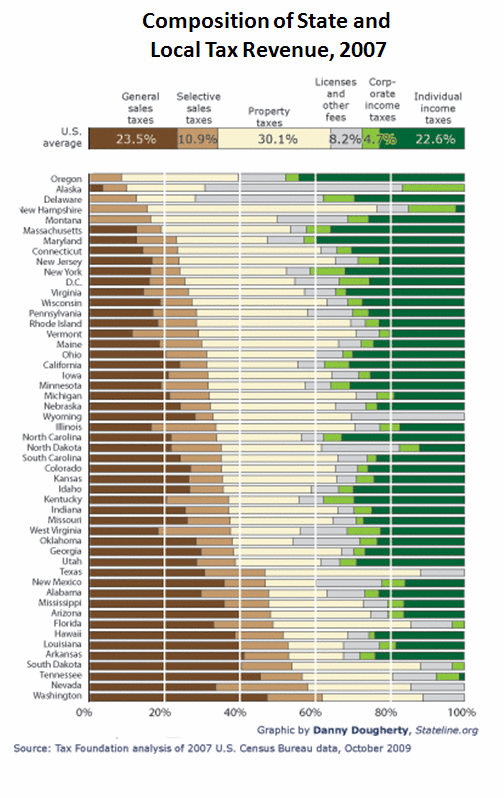
I partly covered that in my original post. Adding much detail would quickly get longer than I have the ambition to post. The very short answer is that instead of having revenue from one big visible source (like income tax), they have revenue from a lot of user fees and little sources that people don't notice (tolls, fees added to vehicle registrations, very broad based sales tax, etc.). Surcharges on utilities are a favorite. My phone bill is nearly incomprehensible (8 line items per cell phone, others on the land line).

Here is an interesting chart (from Wikimedia, one based on per capita $$$ might be more revealing). Look at the lengths of the property tax bars. Just eyeballing them, the only ones longer than Texas are in New England (and maybe NJ). The only one much longer is New Hampshire, where there is no sales tax. Since the property tax is collected by local governments, it isn't included in all the state tax ranking tables that commonly float around. Same with a lot of the user fees, many collected by a special agency or district.

19237_TaxFoundation_v2.gif


Look at how wide the property tax bar is for Texas. Texas doesn't have state property taxes. But state law forces local entities into high rates and redistributes it. Go to Wikipedia and look up "Robin Hood Plan". Read that article and try to decide what that takes out of your pocket. But it isn't a state tax, so the legislature is proud of their work and most people seem to be happy with it. By the way, Robin Hood includes a state "business tax", which some people argue is a state income tax on business. Again, the average person doesn't see it first hand.


Jackman":1r51hxia said:
. . . speaks highly of Texas . . . :o

This seems to be common and the only explanation I can think of is the old adage "ignorance is bliss".
 
Back
Top