Cub Cadet with an alternator

Old Coastie

New member
Took on a 1953 Cub to repair for a friend. It was given to him and sat for 3 years. While repairing some broken wires to the fuse I was tracing the coil wire and saw an alternator had been installed. No I’m trying to figure out whether it’s a 12 volt starting system with a 6 volt coil, or if the ignition system is 12 volts too. It needed a battery so I got a 6 volt but now I’m unsure if it should be positive ground.
What should I be looking for or testing so I don’t screw up the electrical system?
 
To clarify, your post title says “Cub Cadet,” but you mention a 1953 Cub. Cadets were garden tractors that started production in 1961. Sounds like you’re referring to a Farmall Cub (small tractor) and not a Cub Cadet (riding mower/garden tractor).

Correct?
 
That's my assumption as well, Stanton. The presence of an alternator, almost certainly, tells you that it is now 12v. Neg. ground. Look at the coil, is it a 12v. or does it have a ballast resistor connected in series?
 
You are correct, it’s a Farmall Cub. Not a cadet. It does have what looks like a resistor in the circuit before the coil. This is my first Cub to work on. I have a 59 MF-65 diesel, a 59 Ford 641 and a 58 MF 202. They are all original. The alternator on the Cub is hard to get to without removing the hood.
This tractor is owned by a Community Farm (under new management) along with a newer JD 900HC. Nobody there has any mechanical skill or knows the history of either tractor.
 
From your description I'm inclined to think the generator and regulator have been removed and an alternator has been installed along with a resistor added to the 6 volt coil. First question, was there a 12 volt battery on the tractor and how was it connected to the system. Was the negative post fastened to the chassy and the positive post connected to the starter? ( most of the 12 volt conversions I see use the 6 volt starter with no problem ) The resistor connected to the coil indicates a 6 volt coil. Depending on who performed the conversion, you could check the light bulbs to see if they have been changed from 6 volt to 12 volt. Since conversion to a 12 volt system ( usually the battery, resistor and light bulbs ) is usually cheaper than replacing a 6 volt battery, generator and voltage regulator I would guess you have a 12 volt negative ground conversion. I'm sure others will provide a trouble shooting guide to help resolve the charging issues. Luck, Tom.
 
If it has a 12-v Alternator, then it probably has an internal regulator section, which goes bad if sitting outside. The brushes wear down in the holders, AND the real big problem is the armature gets tarnish on it and brushes can't get contact. --They are not hard to take apart and clean up. I have 4 tractors that have this problem. The alternator is NOT a good thing on these older tractors. I did find a couple of good old Generators and regulators to fix a couple of mine.
 
Both my Cub and 300 are converted to 12volt. The previous owner was actually using the old 8 volt trick on the 300. Kept the 6volt starter on both. So doesn't matter on the starter. With an alternator I would be shocked if it is a 6 volt (no pun intended). You may have mentioned it but what was the old battery?
 
Hi,
Welcome to the website.
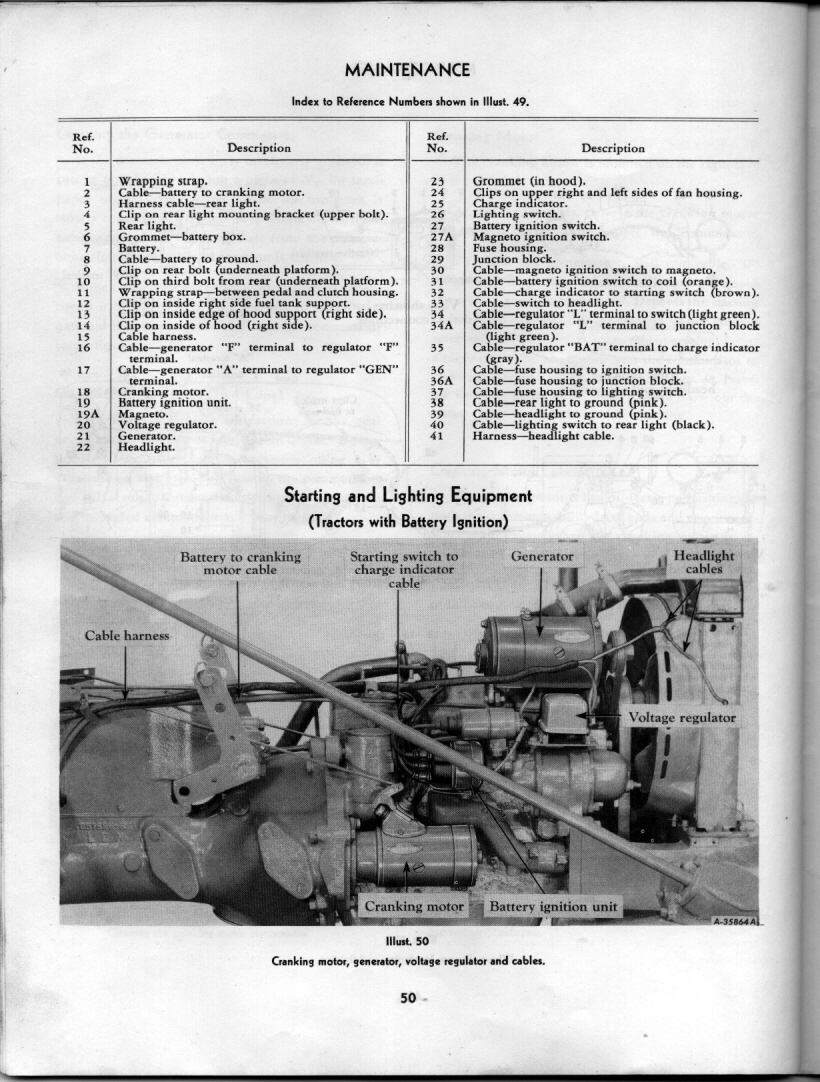
Below are pages from the 1955 Cub owner's manual, showing the original electrical system. This system is the same as a 1953 Cub came with. They are 6 volts, positive ground systems, up until 1964, when IH changed the Cub to 12 volts.
The 1st page shows wiring connections, and routing. The numbers on the 1st page are explained on the 2nd page.
There is a pic of the system on the 2nd page. You can see the 6 volt starter, it has a switch on top of it, and a rod to pull.

http://farmallcub.com/rudi_cub/www.clea ... e%2049.jpg

http://farmallcub.com/rudi_cub/www.clea ... e%2050.jpg

Like they said above, it would be good to know what voltage battery was in it before.
It could have been changed to 12 volts, for the alternator, but there are 6 volt alternators also.
See if it says the voltage on the coil, if it is a newer than original coil.
It could be 12 volt negative ground, for the alt.
If it has no battery, look at the 2 battery cable ends, and see what sizes they are where they go on the battery posts.
The positive post is slightly bigger than the negative post, try the cables on a battery, and see which way they fit.
If the end on the cable going to the starter is bigger ID than the other cable end, it was probably connected negative ground.
If the end on the cable going to the starter is smaller ID than the other cable end, it was probably connected positive ground.
But it could be 6 or 12 volts, unless the coil or alt says. Good Luck. :)
 
There was no battery when I started working on this Cub so I “assumed” stock. But who ever had this and donated to the Community Farrah intended for it to be a working tractor. I did find an excellent wiring diagram on this forum and corrected several jury rigged things to make it right.
Now I’m getting ready to split it to fix the clutch. It runs well but dies when the clutch is depressed. The TO bearing is greased and adjusted. I already have the tank and cover off so splitting it seems the smartest thing to do at this point.It seems the inspection port is good for only so much.
Thanks to those who responded and gave advice. I can see how these tractors have a strong following!
 
Hi,
There might be nothing wrong with the clutch, if it works right, and no need to split the Cub.
People have had the problem with the engine stopping when pushing the clutch pedal down before, not often that I have read though.

It sounds like the power is low. The timing needs setting, so it will have good power. If the power is low, the engine could stop when you push the clutch pedal down.
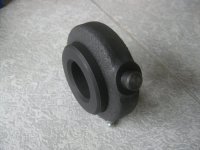
The original style throwout bearing does not turn, so it makes a little drag on the engine when you push the clutch pedal down.
Besides greasing the grease fitting, I put a thin layer of grease on the front of the throwout bearing, part way around, the fingers will spread it around. That reduces friction some.

Do a compression test on the engine, and see if it is good, or wornout.
The Cub service manual says a Cub engine should have 120 lbs of compression, that is probably for a new engine. Some less is ok, 90, 100, 110 lbs. Open the throttle when doing the compression test, so the engine can get air.

You can look in the inspection hole under the clutch housing, the graphite sticks out of a new throwout bearing 5/16". They can wear down from use. If it is not worn down lots, it is still good.
Below is a pic of a new throwout bearing. :)
 

Attachments

  • Cub.jpg
    Cub.jpg
    65.4 KB · Views: 362
Hi,
After doing the compression test, if it has good enough compression, the Cub probably needs a good tune up, they need tune ups, like cars in the past with distributors.
There are ignition points and a condenser in the magneto, or Battery Ignition unit, either system was available.
Below is the 1955 Cub owner's manual. The experts on here recommend that people read it. It has lots of info about operation, maintenance, and lubrication. There is a table of contents on page 1.
The magneto info begins on page 38. The Battery Ignition unit info begins on page 41. It shows how to get to the points on both systems, and set the point gap correctly. You can identify which system it has using the pics. They don't run good with old, burned points.

http://farmallcub.com/rudi_cub/www.clea ... index.html

The spark plugs need removing, cleaning, or replacing.
The spark plug wires have to be in good condition.
The distributor cap contacts, inside the cap, need checking, and the contacts sanded and cleaned if burned, or the cap replaced.
The rotor need checking, sanded and cleaned if the contacts are burned, or the rotor replaced.
Then after doing those items, the ignition timing needs setting. IH recommended using a timing light for the Battery Ignition unit.
It tells how to time the magneto in the owner's manual, in the magneto section.

Below is a listing for new points and condenser at TM Tractor, you can look at the pics. :)

http://www.tmtractor.com/new/el/367fp.htm
 
Back
Top