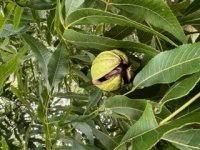
Carpathian Walnut

lyle11

501 Club
I scaled back 4 years ago to a smaller house and the only thing I miss are my nut trees. I was getting pecans and walnuts most years. I planted this grafted Carpathian walnut at my new place 3 years ago. It was about 3’ tall. Sparse nuts on it his year that will probably drop off but I should have a small crop by next year. This is a self pollinating Hanson cultivar but I planted another tree for pollination. If you like “California” walnuts these cold hardy Carpathian trees do well in NE Ohio or warmer climate and aren’t prone to disease like fruit trees. Also, the husk splits open and the nut drops out so they don’t have the mess of a black walnut. You just have to get them before the squirrels.

I also planted 4 cold hardy trees (Northern Prize cultivar) in NW Wisconsin and they survive but get a lot of tip and branch dieback after even a moderately cold winter and end up looking pretty ugly so I wouldn’t recommend them for the far north, despite what the nursery catalogs say.

77652462-BA89-4455-A46B-71A084853BDB.jpeg

3E0A91FE-BC2F-4708-9B11-D277F7251ECA.jpeg

9AB6AD29-7858-4E2F-B71C-9E566F3CA4EE.jpeg
 
Very interesting. Although I am not much of a walnut aficionado for eating, I enjoy hunting and identifying tree species. No substitute for a fine piece of walnut for a rifle stock either.
 
Years back, central Iowa, a neighbor had a very large English walnut tree. I asked how many nuts the owner harvested. Answer, none. Squirrels took the nuts off the tree limbs.
 
I had good luck getting my share of nuts before the squirrels. The husks develop cracks before they split wide open and drop the nuts. I would remove my share of nuts from the cracked husk right on the tree. The squirrels seem to wait for the nuts to drop or the husk to open more. The nuts I removed from the husk were not harvested prematurely and fine after drying them. Eventually you climb the tree or put a ladder up to shake a branch and pick them up off the ground. My tree was only about 25’ tall which made the nuts accessible. Most of the grafted Carpathian trees top out around 30’ tall.

These trees don’t have the straight central leader like a black walnut or a pecan tree. But, if I can train them to be more upright, I should be able to put a metal squirrel guard like a stove pipe around the trunk.

The Carpathian walnut is from the Carpathian Mountains in Poland. The trees were brought to North America by a priest in the 1930s and first planted in S. Ontario.
 
I have 2 trees here 11 years old, no nuts, trees now have canker disease on the branches so they will probably die out by next year.----so much for nut trees here.
 
I harvested my crop today. 1 nut. I planted the tree 3 years ago. Should have more than I can eat in 2-3 years.

The husks open up and you pull the nut out or wait for them to drop.

81368662-A2C3-4458-8517-7FF4325500FC.jpeg

88C2C1C5-ADAF-4B22-87E7-72E71B6E6F4A.jpeg
 
This is a fine discussion about walnuts and the trees. Walnuts are my favorite nut and there is a tree around here. Squirrels are always breaking the husks on my brick porch. They carry them from somewhere else to break them here.
 
lyle11, any chance you'd consider letting me collect some scion wood from those trees later in the winter/spring? Northern Prize is no longer being offered for sale and I've been working with Iowa State to try to track down material to conserve it in my private collection on our farm.
 
nbenjam2":2gscy8jx said:
lyle11, any chance you'd consider letting me collect some scion wood from those trees later in the winter/spring? Northern Prize is no longer being offered for sale and I've been working with Iowa State to try to track down material to conserve it in my private collection on our farm.


I do not have a Northern Prize cultivar. I live in NE Ohio but also have 80 acres in NW Wisconsin. I planted five N. Prize at my farm in Wisconsin (zip code 54757). They lived a few years but eventually we had a cold winter (but nothing we don’t see every few years with temps -25°or lower for a few days) and they all died back. What is generally referred to as “tip dieback” which means the last few inches of a branch die and have to be pruned off. This was very extensive and put the trees into a downward spiral and all were dead within another 1-2 years. Northern Prize may very well survive in Iowa but didn’t survive in NW Wisconsin. That might be why it’s no longer offered for sale. To me it would only be appealing in northern states since there are plenty of well established cultivars that do fine further south and most likely produce bigger crops of bigger nuts. The frustrating thing about planting the N. Prize Carpathian was that they survived about 4-5 winters and looked good. I had a nice row of 12’ trees. Seems like what I read about them was that they were supposed to survive -32° or I wouldn’t have planted them. Of course we all know it’s chancy in areas with cold weather and a short growing season.

In Ohio (zip code 44236) I have 2 Carpathian walnuts on my 1/2 acre lot. One is a Hanson Cultivar and the other a Stark Champion cultivar. To be honest, both have been a disappointment here for 2 reasons. They tend to grow tender shoots with an early spring warm up then the new growth gets froze off and the result is no nuts. The second issue is rust or anthracnose of the leaves which makes the tree truly ugly by August and mostly leafless by September. I tried ortho Fruit Tree Spray but it didn’t prevent the rust despite 3 applications in late spring and early summer.

Unlike at my previous house only 5 miles from here my Carpathian experience has been disappointing at best. By the way, the Carpathian is a hardy English or Persian walnut that was brought to the USA from Poland by a Catholic priest many years ago.

On the other hand, my favorite nut trees that I’ve had success with are pecans. There are cultivars that ripen nuts in NE Ohio and I’m about one year away from my first crop at my new location. Trees are much larger than Carpathian walnuts but much prettier (in my opinion) and easy to grow and buds are much hardier and slower to open in the spring. Trees are disease free here but do have problems with branches breaking due to narrow angles to the trunk referred to as “weak crotches”. But, my experience is the trees quickly grow new branches and it results in what growers call “self pruning”.

My Campbell NC-4 pecan has 2 nuts in it. My other pecan didn’t have any catkins yet so it must have gotten pollinated by hickory trees about 400’ away. Not as big as southern pecans but in this climate with a roughly 160-170 day growing season we can get decent sized nuts.

IMG_1665.jpeg
 
@lyle11 thanks for the feedback. I've got some pecans planted and am excited for them to start producing. I've got a few possible "northern prize" trees located in Iowa but no one can remember for certain which is which at this point.
 
nbenjam2":2j2n20an said:
@lyle11 thanks for the feedback. I've got some pecans planted and am excited for them to start producing. I've got a few possible "northern prize" trees located in Iowa but no one can remember for certain which is which at this point.

I am curious where you live and what pecan cultivars you planted. What is nice in recent years is that they have identified pecan cultivars that can ripen nuts in shorter growing seasons. My farm in Wisconsin only has about a 125 day growing season so all my experimental trees were a failure. The only trees I can get to survive and ripen nuts are black walnuts and a Butternut/Heartnut cross called a Buartnut. Butternut trees are dying off thus the reason for the cross with Heartnut which is native to Japan. I also have 2 American Chestnut trees that just started producing small crops (maybe 50 nuts on each) but it was so dry this year the husks didn’t fill.

Here in Ohio I only had room for 2 pecan trees. Typically the shorter season cultivars are referred to as Ultra Northern pecans. The earliest producing cultivar for sale by a long shot is the Warren 346. I think it originated in Missouri. I have a Warren 346 and a Campbell NC-4 which originated in S. Canada just north of Buffalo NY. I have heard the Warren described as “an unruly grower” and if I was doing it over I’d probably plant a different cultivar since the tree is really unruly with regard to its branches. I have grown the Campbell NC-4 previously and it is a good solid tree and a good annual producer. My young tree here produced 2 nuts this year but the Warren didn’t have catkins to pollinate it or it probably would have produced heavily based on this summer.

I have also success grown and produced nuts on Lucas (small nuts but lots of them. Origin Lucas County Ohio) and Stark Hardy Giant (nuts every year but never a heavy crop). Here is my Campbell pecan and a nut that just popped out.
IMG_1888.jpeg
IMG_1887.jpeg
IMG_1883.jpeg
 
@lyle11 I have one Stark Hardy Giant pecan that I ordered before I had done much research. I'm hopeful that it will produce but I don't know anyone in my area with direct experience. I've also got two each of Kanza and Hark which are supposed to fill nuts well in my area (zone 5b, Central IL). From my understanding these ultra northern pecans are a bit smaller than other varieties but still flavorful. I'm also planning to buy to Mullahy pecans in the spring to round out my collection. I've got a few non-grafted seedlings that I will eventually graft onto also. For anyone looking to get pecans I highly recommend Rock Bridge Trees. I've always gotten healthy, well packed trees and they have great customer service. I also have two improved hickories which are supposed to be even more flavorful than pecans and would probably grow even further north.
 
My zone is 6A but I’m sure you have much hotter summers. Most any pecan tree will survive and grow here but we don’t typically have the summer heat needed to produce nuts except for the ultra north cultivars. My Stark Hardy Giant tree was somewhat isolated from the other 2 trees so maybe it’ll be more productive for you. Stark Bros sells it as self pollinating but most pecan experts will tell you there is no such thing.

I am too old and don’t have room for any more trees but I still like looking at online blogs and reading about other pecan grower’s experiences. Seems like Hark is a good choice based on what I read. I checked out Rock Bridge Trees and I was impressed. Most pecans are now pot grown which really helps with success growing them the first year. Although I’ve had great success with bare root trees.

Good luck with your trees.
 
Nuts. Interesting topic.

Zone 6B. Planted Elliot and Pawnee pecans two years ago to pollinate the 3 mature native pecans. The Elliots are doing great, the Pawnees not so good. The Pawnees have died back to the graft. Planted in the same area and watered this summer.

Ordered for next spring Sumner and Desirable pecan, also Jefferson and Yamhill hazel nut.

Two different English walnut trees planted this spring appear to be doing Ok.

I purchase smaller bare root plants from Willis Orchards. Reason, less expensive because some just die and some get eaten by deer.
 
If anybody plants pecan trees, especially grafted trees that are prone to “narrow branch angles”, it’s very important that early pruning (training) of the central leader is done to eliminate two branches that have this narrow configuration. What frequently happens is that you get two buds at the top of a young tree and one grows into a nice strong leader while the other emerges at the same point on the trunk and becomes a branch. If the branch is at narrow angle, you will usually get what is referred to as “trapped bark” between the new central leader and the branch. It’ll look fine until you get a storm or, if that doesn’t break it, a heavy crop of nuts and this weak connection will split and break off the tree. Sometimes the weaker branch splits off and other times you lose both and your nice pecan tree is ruined.

On a young tree, in spring before it grows, it is best to prune the tree a few inches back to one strong isolated bud and remove any other secondary shoots at the point of the central leader once growth starts.

Here is a photo of what I am talking about on my Warren pecan tree. These are two lower branches that will be pruned off next spring. You can’t see it in the photo but I can take the branch on each side and push it outward and the crack between the 2 branches will open up just a little bit. There is obviously trapped bark between these branches. It’s not a big deal on branches in the upper tree. One may crack off in a wind storm. But it won’t typically hurt the tree since they tend to grow replacement branches quickly.

Just passing this on because not doing this set my one tree back a couple years. Pecan trees that I can grow here and ripen nuts are limited, but in better pecan growing areas, I’d pay as much attention to planting cultivars that have a strong branch structure as much a nut size and production. You can have a tree that supposed to produce large quantities of big nuts, but if you’re just growing them for your own use, you’ll most likely have more than you can eat. So, it’s probably more important to have a tree that is structurally sound even if the nuts are smaller. So research pecan cultivars before you buy them and avoid trees prone to narrow branch angle and ice damage, especially if they are in a yard and you only have room for 2-3 trees. Pecans are a very nice shade tree but I’ve seen pictures where 1/3 of a mature tree breaks off after an ice storm. Best to get cultivars that are more structurally stable.

I was shocked to see the price of pecan trees for sale at Stark Bros and other online nurseries.

IMG_2016.jpeg
 
lyle11":35dhfali said:
I was shocked to see the price of pecan trees for sale as Stark Bros and other online nurseries.
As mentioned before I use Willis Orchards. 2-3' grafted pecan trees, $18.95 each, plus shipping. This years order, $134.75 for 4 trees and shipping.

Previous year's order was close to $200- for nut trees. And then I had to purchase a 250 gallon tote, plus 12 volt water pumps to water the trees because of the severe drought.
 
walnut and pecan trees here are 15+ years old and have NEVER produced 1 nut. Both walnut trees have big lumps on the branches and the trees keep getting bigger every year. Same with the 2 pecan trees and the butternut down by the road. Chesnuts started producing nuts at 3 years old and make a mess on the ground when the sticker pods fall off. cant walk near the trees. Mice/voles devour the nuts as they fall to the ground.
 
Back
Top