
John *.?-!.* cub owner
501 Club
I have wanted one of these for years, but the price was always more than I could justify for my needs.

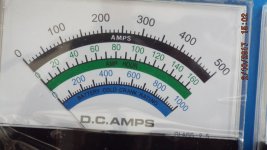
They have a stack of carbon disks and you vary the current by turning the knob to clamp them together tighter or looser depending on the battery. It is calibrated for 12 volts, and the amp meter has various scales you use to set the current, the basic formula is the current draw should me adjusted for 1/2 the CCA, or 3 times the AH, depending on whether starting type or deep cycle, and it should stay above 8 volts for 15 seconds.
The voltmeter is even calibrated to allow for temperature.

To use it on 6 volts, it is necessary to disregard the 2 bottom scales and adjust the amp meter according to the formula above. Unfortunately 200 amps was the highest I could get it on any of my 6 volt batteries, but still it is a much better test than the load testers we normally use. They are not adjustable, and are normally a 100 amp load at 12 volts, but that is only 50 amps at 6 volts. For the voltage readings on 6 volt, the pass fail is 1/2 the volt readings for 12 volts.
Friday I tested 4 tractor batteries (6 volt), and the 2 batteries in my scooter, my ZTR, 8500 watt generator Escort, and Escape, Ranger, plus one under my bench that provides power for my Sirius radio, and anything else I need to run. Some of them were over 5 years old, but all passed with flying colors except for the ones in the golf cart and Escort. The Escort battery was so weak I put my jump starter pack in the trunk just in case, but there was no need, it failed to start today before I left home. The battery in my ranger was original (6 years old), but tested good, so it is now in my 18 year old Escort, and the Ranger has a new Battery. The golf cart requires such a small amount of current to crank the little 2 cycle engine, and never gets far from home, so I will just run it till it finally dies.
The local Harbor Freight had the tester on sale for $50 during it's grand opening.
They have a stack of carbon disks and you vary the current by turning the knob to clamp them together tighter or looser depending on the battery. It is calibrated for 12 volts, and the amp meter has various scales you use to set the current, the basic formula is the current draw should me adjusted for 1/2 the CCA, or 3 times the AH, depending on whether starting type or deep cycle, and it should stay above 8 volts for 15 seconds.
The voltmeter is even calibrated to allow for temperature.
To use it on 6 volts, it is necessary to disregard the 2 bottom scales and adjust the amp meter according to the formula above. Unfortunately 200 amps was the highest I could get it on any of my 6 volt batteries, but still it is a much better test than the load testers we normally use. They are not adjustable, and are normally a 100 amp load at 12 volts, but that is only 50 amps at 6 volts. For the voltage readings on 6 volt, the pass fail is 1/2 the volt readings for 12 volts.
Friday I tested 4 tractor batteries (6 volt), and the 2 batteries in my scooter, my ZTR, 8500 watt generator Escort, and Escape, Ranger, plus one under my bench that provides power for my Sirius radio, and anything else I need to run. Some of them were over 5 years old, but all passed with flying colors except for the ones in the golf cart and Escort. The Escort battery was so weak I put my jump starter pack in the trunk just in case, but there was no need, it failed to start today before I left home. The battery in my ranger was original (6 years old), but tested good, so it is now in my 18 year old Escort, and the Ranger has a new Battery. The golf cart requires such a small amount of current to crank the little 2 cycle engine, and never gets far from home, so I will just run it till it finally dies.
The local Harbor Freight had the tester on sale for $50 during it's grand opening.
