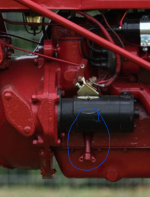
Another Farmall Cub Oil Question

RunningRed

Well-known member
I have read almost every post on this site about which oil to use. Here is my predicament, I live in an climate that's 85-90 degrees in the summer down to -20 below with wind chill factored in in the winter. I have no idea what oil was used in it before nor does the seller cause he is selling it for his elderly grandfather (85+) whom doesn't remember. Now I'm gunna drain the oil and clean the oil pan before I put new oil in however is there anywhere else I should clean to reduce issues? I was going to use Rotella T4 10w30 year around. My manual says 30w for temps above 80+ is 30w and below 32 degrees is 10w.
 
JMHO, You will be fine with the 10w-30 oil. The oil available today is far superior to what was available in 1950. If the oil pressure is low in summer you could switch to a 30wt or 10w-40. That being said and if you remove the oil pan, be sure to flatten the flange surface where the bolt holes are, use a new gasket and sealer and you should be good. If you want to clean the places that you cannot reach or access, run some SEAFOAM in the oil per label instructions and change the oil. If I did it, I would change the oil and clean the pan of sludge and sediment and call it good. I think that perhaps you are overthinking this part of the maintenance. All this is said on the assumption that you are not going to disassemble the engine for a rebuild. If that is the case, a rebuilder shop will clean the block during the process. Stan
 
JMHO, You will be fine with the 10w-30 oil. The oil available today is far superior to what was available in 1950. If the oil pressure is low in summer you could switch to a 30wt or 10w-40. That being said and if you remove the oil pan, be sure to flatten the flange surface where the bolt holes are, use a new gasket and sealer and you should be good. If you want to clean the places that you cannot reach or access, run some SEAFOAM in the oil per label instructions and change the oil. If I did it, I would change the oil and clean the pan of sludge and sediment and call it good. I think that perhaps you are overthinking this part of the maintenance. All this is said on the assumption that you are not going to disassemble the engine for a rebuild. If that is the case, a rebuilder shop will clean the block during the process. Stan
No rebuild needed not yet anyway and I guarantee I'm overthinking it. I'm always accused of being over analytical however I don't know if that's a good thing or bad, I guess it depends on the situation.
 
I agree with Stan. My '48 has had nothing but 10w30 in it for the past 60 yrs and have no issues. I too live in an area with similar temp swings. Keep it tuned up well and replenish/replace fluids as needed and you shouldn't have any issues starting, even in the cold weather.
 
I have read almost every post on this site about which oil to use. Here is my predicament, I live in an climate that's 85-90 degrees in the summer down to -20 below with wind chill factored in in the winter. I have no idea what oil was used in it before nor does the seller cause he is selling it for his elderly grandfather (85+) whom doesn't remember. Now I'm gunna drain the oil and clean the oil pan before I put new oil in however is there anywhere else I should clean to reduce issues? I was going to use Rotella T4 10w30 year around. My manual says 30w for temps above 80+ is 30w and below 32 degrees is 10w.
As far as engine oil goes, I take into consideration how much wear is on the engine. My 1937 Cletrac, 1950 Cub and 1957 Ford 640 all have considerable wear on the engines but not enough to warrant rebuilds and they all call for 20 or 30 weight or 10w20 or 10w30 oils in average climates. Years ago I've heard from a couple mechanics that I trusted that straight weight oils will hold up better than multi-viscosity oils, and with the wear on the engines considered, I run straight 40 wt in all of them. I don't use my tractors much in the winter and they're kept in an unheated barn and I start and run them all at least once a month and have no issues at all with sluggish starting (the Cletrac is hand cranked and at 10-15 degrees out, it will start on the third or fourth crank, every time).

Just like you, when I bought back my Grandpa's Cub last summer, I had no idea what engine oil was in it, but I knew it hadn't been run in a long time. I changed the oil and ran the tractor for a half hour so the engine was good and warm and then changed the oil again with straight 40 and replaced the oil filter and the oil pressure went up noticeably.
 
In my area it is not as cold in the winter and warmer in the summer. My cubs run 15-40 detergent oil.

Personally I would not remove the oil pain to clean unless you have a leak and are replacing the gasket. there are a few bolts that are hard to get at and you do not want to break them. I would do a few oil changes with a detergent oil and a filter change, maybe add some seafoam or other oil additive to help flush the system if you are concerned. You do not need to go looking for or making problems.
 
I am the opposite - I would removed the pan - unless you have a bore scope to send down the oil filler. If there's sludge I would remove the pan and not attempt to "flush" it out while on the tractor. The sludge that was in my pan had to scraped out then flushed clean with gas.

Oil pan 2.jpg
 
I agree, run the tractor for some time to get it warmed up, drain the oil, drain the filter canister, pull the filter, pull the pan off , flush out the filter canister , clean out the pan, straighten out the pan flange if necessary, replace gasket, I use aviation gasket sealer , reinstall ,tighten the pan bolts evenly , don't over tighten . Replace filter, (I prime the oil pump) at this time, don't over tighten bolt. Add your oil 3 quarts, I use 10- 30 . Start the tractor up ,check oil pressure, and for leaks. Should be good to go for routine oil changes, 120 hours, or once a year.
 
Would full synthetics be better for a cub?
On a fresh rebuild, it may be worth using, or if that's all you have on the shelf.
C60's are a low compression engine and have much looser tolerances on rings, bearings, etc. than modern automobile engines.
I only had Mobil 1 5W-30 on the shelf a couple of years ago, so that's what went in my Cub. Original engine as far as I can tell, not sure what the compression is, but it works fine for me. Summertime it smoked pretty bad, winter just fine, so I have to keep an eye on the oil level. Typically I would just use 10W-30.
 
Next to the filter housing is a piece of pipe (about 3/4" x 6") that has a winged cap on the end. Remove the cap and make sure the pipe isn't full of sludge.
 
I may order an inspection camera to send down into the crankcase for inspection. I wonder if I can squeeze it down through the radiator, maybe even up into the water jacket.
 
I may order an inspection camera to send down into the crankcase for inspection. I wonder if I can squeeze it down through the radiator, maybe even up into the water jacket.
if you remove the lower water pipe you can get a camera in the water jacket that way.
 
Last edited:
I may order an inspection camera to send down into the crankcase for inspection. I wonder if I can squeeze it down through the radiator, maybe even up into the water jacket.


I bought one at Habor freight for not a lot of money. All it needs to find is one problem and it's paid for itself.
 
Back
Top