A h/p confusing topic, for me

I just finished reading a post about the cub having enough h/p to run a generator. This is a topic of confusion for me, mainly because way back when I mounted a Woods 7500 backhoe on my cub, the Woods specs required a 35 h/p tractor. After brainstorming some common math, I decided that if the cub's pto developed a ballpark 9-10 h/p, if I used a 12 tooth sprocket to drive a 36 tooth sprocket, technically it would be equivalent to 1/3 or 27 to 30 h/p. At that time a bunch of the engineering brains quickly corrected my thinking and said it wouldn't work that way. My brain told me it should work. After everything was finished and after years of digging holes and trenches, the cub absolutely loves that setup. Normally I only throttle up the cub to 1/2 speed and it's done everything I've asked it to do. It runs the backhoe pump just fine.
This makes me wonder how important the h/p numbers are if technically I'm running a 35h/p setup on 10 h/p and 1/2 throttle at that.

I need some h/p brains to explain this to me in simple terms.
http://photos.cubfest.com/albums/userpics/10025/DSC00001~8.jpg
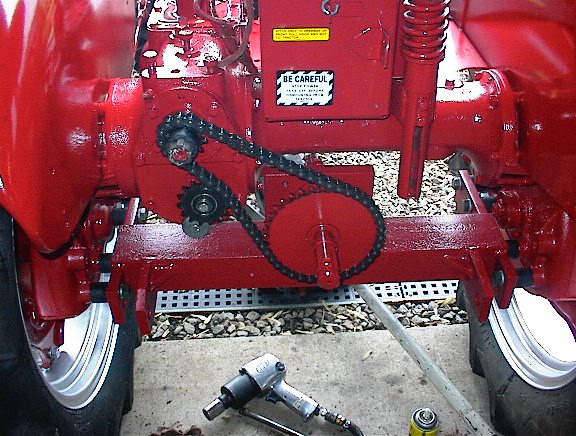
DSC00001~8.jpg

DSC00003~6.jpg

DSC00001~9.jpg


I mounted things underneath the foot platform to get the correct rotation of the pump.

Rick
 
What you need to understand is torque is the ability to do work. Horsepower is how fast the work can be done. The result with your backhoe is it likely won't pull as hard, and definitely not as fast as it would on a 35 HP tractor.

By comparison consider that you could dig a trench by hand. Since you generate only a fraction of an HP it will take a lot longer than if you used a backhoe, even at 9HP.

Your sprocket set up accomplishes 2 things: 1) It triples the torque which makes it easier for the tractor to handle the pump load without slowing or stalling. 2) It cuts the shaft rpm by 1/3 which puts you where most PTO driven equipment is designed for (540 RPM rather than 1,600 RPM).

What your sprocket arrangement doesn't do is boost your HP, it's still 9 ish, or less at a lower engine speed.

An AC generator needs to be run at a pretty constant speed (generally 540RPM on a tractor driven one) to put out the proper AC frequency. You need enough power to maintain that with the electrical load on the generator.
 
Horsepower is simply torque applied at a certain speed. Think of a single horse attached to a turnstyle. The horse produces output torque at a certain speed. Add a 2nd horse. You've effectively doubled the torque at the same speed. But you can now 'gear up' the output 2:1, and maintain the same torque as one horse but at double the speed.

What you have done is to reduce your RPM by 1/3, but increase your torque by 3X into the pump. Horsepower is calculated by multiplying torque (lb-ft) by rpm and dividing by 5252. The gearing affects both torque and rpm by the same factor, so the horsepower driving the pump remains the same regardless of how you gear it (minus any tiny frictional losses in the chain drive an bearings). Think of an extreme case: If you put a 1000:1 gear reducer on your Cub's PTO, you wouldn't end up with an 8-9000 HP setup.

That said, I have no idea how a Cub is able to run this unless the required HP rating of the loader is set artificially high.
 
Carl provide a pretty good explanation.

The generator set. Maximum rated KWs, unknown. Guessing 20 KW or larger. It's not that the C60, Cub engine, wouldn't be able to turn the generator set over. The generator set's KW output would be limited by the torque/HP applied.

From Jim Becker's earlier post on horse power and torque. At 540 engine RPM's you would have about 3.25 HP on the PTO. Math, that comes out to about 2.4 KW.

Jim Becker":4bi3zhyh said:
Charts were published with the industrial sales information. This is what was published for a Lo-Boy in '62, stripped engine running on 91 RON gasoline (about 86 or 87 octane on today's gas pumps). (Reading best I can from a chart.)

RPM . Torque . hp
600 -- 32 ----- 3.5
800 -- 34 ----- 5.25
1000 - 36 ----- 7
1200 - 38 ----- 8.75
1400 - 39.5 --- 10.5
1600 - 39.75 - 12
1800 - 39 ----- 13.5
2000 - 37.5 --- 14.5
2200 - 36 ----- 15.25
 
I'll take a shot at an explanation. It will be about the same as MiCarl said but using different words. My explanation may be easier or harder to follow. Take your pick.

Horsepower is a specific unit or measure for power.

Power is the rate of doing work.

Work is a force through a distance.

For example:
Lifting a 1 pound weight (force) 1 foot up from the ground is 1 foot-pound of work.
If you lift the same weight 2 feet, you have done 2 foot-pounds of work.

If you add a time element to lifting the weight, you are then dealing with power.

Lifting 1 pound weight 1 foot in one second represents 1 foot-pound per second of power
Likewise, 1 pound weight for 1 foot in one half of a second would be 2 foot-pounds per second, twice the power to do it in half the time.

Whatever power you put into a machine will be the power you get out of it. You can make changes to the force, distance, or time but one of the others will have to change to keep power the same.

One horsepower is 550 foot-pounds per second.

Torque is not power, Torque is a specific kind of force. To be work it has to be applied through a distance (revolutions). To be power it needs to be with a specific time (pounds-foot times RPM).
 
Eugene":267rgz0j said:
From Jim Becker's earlier post on horse power and torque. At 540 engine RPM's you would have about 3.25 HP on the PTO.

Except his sprockets give him a 1:3 reduction. With that set up he gets 12HP @ 1600 tractor RPM but his PTO is @ 533 RPM. He still gets 12HP at the PTO (ignoring losses) but his speed reduction triples his torque to 119.25 ft-lb.
 
Can she run a bigger two stage snowblower? Mechanical or hydraulic?

Interesting ratio, she didn’t over heat? If I run my ‘52 fcub powering this kind of stuff I need to completely rebuild everything. I mean all new parts perfect so nothing goes wrong.

New paint isn’t a restoration as some think. The tractors are old and stood the test of time.
Fifty years ago I raced using used short blocks, I had big cam, big valve heads with a 780cfm Holley carb. As the used short blocks blew up in time I got another one, swapped them out and stayed racing. Add new paint and raced. I beat a 400 firebird with a 283 cab Chevy v8 in my 57 chevy. Of course it bit me top end when she spun a bearing. But used engines ran awesome just before they blow.
 
I believe that it was LURKER CARL who had a great explanation of the difference between HP and torque. Anyone know where that link is?
 
ricky racer":1qbaakb2 said:
You guys are making my brain hurt... :lol:

Bill Hudson":1qbaakb2 said:
...My thought, as well. :) Bill

And especially today! My stomach is supposed to hurt, not my head!!

Seriously though, thank you for such explanations of power, torque and work. :hattip:
 
Yep, pretty much the same answers back when I was doing the project. Had I focused on the replies I probably would've scrapped the idea. I have to say the power and speed of the backhoe is way more than needed. I'd bounce all over the place if the throttle was full speed and I worked the controls faster.
Gary, I argued with George on the dyno project, along with others. Everyone said things would get way too hot using the formulas. Things turned out fine in reality.

Rick
 
good morning all from the deep south . happy thanksgiving ! just one of the things i love about the cub , just when you think she can't , she can :lol: coppersmythe...................................PS: A BIG HELLO RICK !!
 
HP is a calculated term invented by James Watt to compare different engines. HP is a concept, not a real thing that can be measured directly like torque or RPM- it has to be calculated.

It may be easier to understand if you break it down into its components: torque and RPM.

If the engine has to overcome too much load ( or the torque needed to rotate the load) RPM will fall. If it is really too much load the engine will stall.

The 10 HP C60 engine is equivalent to 7.5 kw. All things being equal if you work out RPM difference between the C60 and the 3600 need by the generator you should be able to run a 5 KW generator at full specs off of the C60. You may be able to run a larger generator at less than full specs.

When you did your great backhoe project for the cub the Woods backhoe did work but my guess is it does not have the same performance as if it has a 35 hp tractor.

Now a hydraulic pump is different than a generator. A pump, by and large, will start pumping right away at low RPM. A generator is more sensitive to a specific RPM range. In other words, the hydraulic pump is less sensitive to operating off-spec. The generator may not be as forgiving. I did a quick search and it looks like portable generators at 7.5 KW are getting 13 hp engines. Theoretically, they only need 10 hp to run a 7.5kw generator but add in 3hp more as safety so they can maintain the more import 3600 rpm needed by the generator at full load.
 
That backhoe on the cub is way cool, now I have somthing else to be jealous of and want.

Trying to find enough excuse to justify buying a 100 to go with the Cub abd 300. Maybe if I do the loader/backhoe thing with the 100 that would be enough reason for my wife to go along with it.......
 
Back
Top