A

You are using an out of date browser. It may not display this or other websites correctly.
You should upgrade or use an alternative browser.
You should upgrade or use an alternative browser.


A
Anonymous
Guest
No, it is the other end, the end that the pitman arm attaches to.
Yes, it should be welded. Also, if your coupling bar has the big bend that it appears to have in the first picture, you need to fix that too. Based on what it would take to bend the coupling bar, you should check the cutter bar for bends too.
A
Anonymous
Guest
Thanks, I could not tell from the manual, it shows the plate attached in one view and not in another. yes I do plan on fixing the coupling bar too. Dad hit a rock with the mower and said it stopped him dead, you can't tell in the picture of the un-attached plate but that it was bent too. The cutter bar is OK, he hit right in the center of the tractor. I have all the new teeth, rivots and wear plates just need to find some of that International Blue paint. anyone have on online source, or know where i can find it here in Taxachusetts
I've used Van Sickle 460 International Blue and been happy with it. You can get it from Ken Updike at Carter & Gruenewald.
http://www.cngco.com/
Kenneth Updike Parts /Internet/ Toy Sales 608.455.2411 Brooklyn kenu@cngco.com
Here is a recent thread on paint:
http://www.farmallcub.com/phpBB2/viewtopic.php?f=1&t=64132
http://www.cngco.com/
Kenneth Updike Parts /Internet/ Toy Sales 608.455.2411 Brooklyn kenu@cngco.com
Here is a recent thread on paint:
http://www.farmallcub.com/phpBB2/viewtopic.php?f=1&t=64132
A
Anonymous
Guest
Thanks Jim, Paint is on the way, I will post some more pictures as I progress on this restore/repair...
Pretty hard to weld the tube to the hanger because of the bronze bushing inside the tube. The heat will melt the expensive bushing. What I did was make a set screw with a jamb nut on the belt adjuster to hold the tube tight to the pulley shield. This keeps it in place and also keeps the tube from rotating. It is working well for me.
Good point. Another option is to pull the bushing while welding then reinstall it. It would be a good idea to look at the wear on the bushing before starting. There may be some benefit to turning it 90 degrees when reinstalling it.BIGHOSS":20xsoezr said:Pretty hard to weld the tube to the hanger because of the bronze bushing inside the tube. The heat will melt the expensive bushing.
A
Anonymous
Guest
I am going to replace that bushing mine is worn down, problem is the shaft is worn on that end also. I am going to make a up a split bushing out of oil-lite bronze as the pully end of the shaft is larger than the pitman end. I will need to slide the shaft in almost all the way then push in the split bushing in the tube.

Don McCombs
501 Club
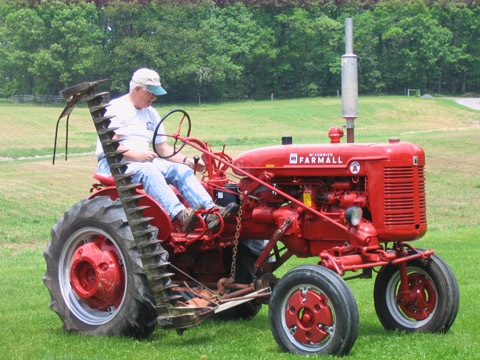
Original paint and decals on mine. All red, except for the pitman and grass rod assembly. Those are cream.
Bus Driver
501 Club
I suggest disassembling the mower for inspection and repair/replacement of every damaged part. Welding is easier when access is better and positioning is possible. For that weld, I doubt that the bushing will be damaged. Copper plates are used to back up the weld area on sheet metal repairs when MIG welding rust perforated areas. Copper and it's alloys wick heat away rapidly. I would weld the broken part with 7018 electrodes, not MIG. Contrary to conventional practice, I would consider leaving all the existing weld to aid in proper alignment, tack the parts thoroughly (6011 electrode is good for this) , and then grind limited portions and weld there before grinding the opposite area and welding it .
I built up the badly worn pulley end of the mower tube with MIG and ground it back to shape with no damage to the bushing.
I built up the badly worn pulley end of the mower tube with MIG and ground it back to shape with no damage to the bushing.
I used to prefer 6011's because that is what I learned on with Dad. Now after my course I have become a little wiser/accustomed to different rods and different types of welding. 7014's are now my rod of choice. Lots of metal gets laid on rather quick and good flow. I keep my rods in the plastic sealed rod keepers. My
A
Anonymous
Guest
What type of wood do you make a new pitman arm out of ?

I think hickory is common but I have also seen oak and ash. If you have a Case/IH dealer nearby you would be better off getting a new one.oneofthesedays":1jja8odk said:What type of wood do you make a new pitman arm out of ?