From time to time questions have been asked about valve seat replacement, doing an engine rebuild right now that was a mess, it needed 8 new seats, if I had thought about it would have take pics from the start so here we go
To replace valve seats in a cub is a pita as the original seats are part of the block, so that means the block has to be counterbored to the correct size for the replacement seat, this job has to be done carefully as the water jacket run very close to the seats and if bored to deep you now have more problems
To counter bore the block requires a special size counter bore for the replacement seat size, normally it is set 3/16" deep and a .005 press fit, 1st the valve guides should be replaced because the pilot tool that centers the counterbore tool is held by the valve guide so that needs to be nice and tight for the pilot tool, worn guides may push the tool off center and make more mess to deal with on the block, then the counterbore chews out the metal on the block for the new seat, when installing the new seat it is referred to as a press fit but never try and press it in, the new ring will crack, leave the new seats in the freezer overnight and use a heat gun to warm up the block and the new seat will drop in to place
once the new seat is installed it can now be cut for the valve
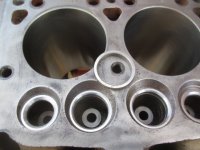
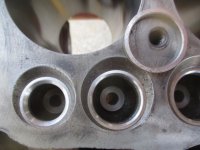
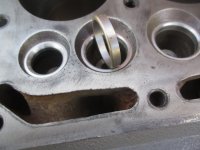
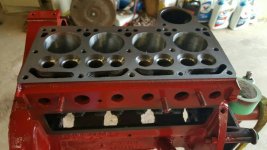
few pics of the new seats installed, and you can see a replacement ring in them
this is not a job 99% of us cannot do at home, takes practice and expensive tooling, machine shops that do this are getting harder to find, the cub exhaust valve seat is only a 1" , smaller tan average cars so many will not have the tooling to do the job, motorcycle/lawn mower shops who do machining would be helpful with this small size, and the old small time machine shops and old timers who do this are disappearing now making it harder to get the job dun, here in the north, cost runs between $60 to $100 a seat for labor, probably less in the south and west , the replacement rings are nothing at about $5 each
Just posted this so you can see what it takes to deal with this job if needed
Tim
To replace valve seats in a cub is a pita as the original seats are part of the block, so that means the block has to be counterbored to the correct size for the replacement seat, this job has to be done carefully as the water jacket run very close to the seats and if bored to deep you now have more problems
To counter bore the block requires a special size counter bore for the replacement seat size, normally it is set 3/16" deep and a .005 press fit, 1st the valve guides should be replaced because the pilot tool that centers the counterbore tool is held by the valve guide so that needs to be nice and tight for the pilot tool, worn guides may push the tool off center and make more mess to deal with on the block, then the counterbore chews out the metal on the block for the new seat, when installing the new seat it is referred to as a press fit but never try and press it in, the new ring will crack, leave the new seats in the freezer overnight and use a heat gun to warm up the block and the new seat will drop in to place
once the new seat is installed it can now be cut for the valve
few pics of the new seats installed, and you can see a replacement ring in them
this is not a job 99% of us cannot do at home, takes practice and expensive tooling, machine shops that do this are getting harder to find, the cub exhaust valve seat is only a 1" , smaller tan average cars so many will not have the tooling to do the job, motorcycle/lawn mower shops who do machining would be helpful with this small size, and the old small time machine shops and old timers who do this are disappearing now making it harder to get the job dun, here in the north, cost runs between $60 to $100 a seat for labor, probably less in the south and west , the replacement rings are nothing at about $5 each
Just posted this so you can see what it takes to deal with this job if needed
Tim