Super M engine rpm's going ballistic

R Hulen

Member
I have an International Power Unit which has the same motor as a Farmall Super M. Whenever I need parts, I can only find parts for a Super M, the U6 is almost never listed. So far, this has worked find. I use the U6 to power a sawmill I bought and restored on my property about 20 years ago.

The problem I am having now is controlling the engine rpms. The engine, frequently, will run the rpm’s up to an extremely high rate where the engine, if left alone, would undoubtedly do serious damage to itself. I initially thought it was the governor. However, as I was investigating the governor/governor linkage and had the governor linkage disconnected from the carburetor, I started the engine to see if the throttle valve was functioning properly. The engine rpms immediately went ballistic. The engine did not respond to the throttle valve. Moving the throttle valve back and force between its end of travel had no impact on the engine. I could not maintain the engine rpms at a safe level and had to stop it almost immediately. This repeated several times. It appeared that my trouble was with the carburetor as opposed to the governor.

I use a low-pressure electric fuel pump that has performed the job adequately for years. I removed the air intake hose from the carburetor and ran the pump with the engine off and there was no gas flowing out of the air intake, so it appears that the float valve is working. I still removed and disassembled the carburetor and did a visual inspection. Everything appeared as it should.

Anybody have an idea or suggestion? Any help would be appreciated. Thanks
 
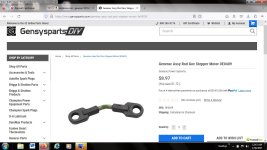
Does the power unit supply electrical power for the sawmill or does it run on mechanical power connection like a belt? The reason for the question is I have a 20 y/o 17.5kw Generac portable power unit that was giving me the same conditions that you are experiencing--uncontrollable rpm over-speeding. When I finally got the answer it was that the engine speed is not determined by a mechanical governor but by the electrical output of the generator through an electrical control module that links to the throttle via a "stepper motor" control device. In my case the "stepper motor" can go bad or the electrical control module can go bad, it happens that my problem was the module was not sending the electrical signal to the "stepper motor" so it was trying to increase the engine rpm because there was no electrical signal being received. This caused an immediate max out rpm condition which like you said would do catastrophic damage to the engine if allowed to continue.
The control module was replaced and the problem was solved immediately. I know nothing about the U6 power unit but this was my experience. The pics show the stepper motor and leads that go to the control module and the other pic shows the link device from the stepper motor to the throttle. Good Luck, My search for info was very difficult and I finally found the correct info by getting a service manual from the internet. Stan
 

Attachments

  • Stepper speed Sw2.jpg
    Stepper speed Sw2.jpg
    221.8 KB · Views: 2
  • Stepper speed Sw5.jpg
    Stepper speed Sw5.jpg
    179.4 KB · Views: 2
Does the power unit supply electrical power for the sawmill or does it run on mechanical power connection like a belt? The reason for the question is I have a 20 y/o 17.5kw Generac portable power unit that was giving me the same conditions that you are experiencing--uncontrollable rpm over-speeding. When I finally got the answer it was that the engine speed is not determined by a mechanical governor but by the electrical output of the generator through an electrical control module that links to the throttle via a "stepper motor" control device. In my case the "stepper motor" can go bad or the electrical control module can go bad, it happens that my problem was the module was not sending the electrical signal to the "stepper motor" so it was trying to increase the engine rpm because there was no electrical signal being received. This caused an immediate max out rpm condition which like you said would do catastrophic damage to the engine if allowed to continue.
The control module was replaced and the problem was solved immediately. I know nothing about the U6 power unit but this was my experience. The pics show the stepper motor and leads that go to the control module and the other pic shows the link device from the stepper motor to the throttle. Good Luck, My search for info was very difficult and I finally found the correct info by getting a service manual from the internet. Stan
The U6 pre-dates the technologies you mentioned in your response. The connection to the sawmill is via a PTO shaft to an 8" pulley which connects to an 18" pulley on the saw arbor via 4 V belts. Congratulations on finding the cause to your issue. My issue is not near as complicated as yours but may prove equally as difficult in finding a solution. Thank for the response.
 
Oh, I should have said, "welcome to the forum." It's amazing what you will find on this Forum. Stan
Thanks Stan. I've seen other post that talk about issues with engine rpms and the responses are directed towards the governor, which is entirely logical. I would still be working to fix the problem with doing something to the governor except for the impulse I had to start the engine with the governor disconnected to check the throttle valve. While the engine was building the rpms, I was manipulating the throttle by hand to no effect. The carburetor was rebuilt about 10 years ago and the engine has only had about 50 hours run time since then. I don't mind rebuilding the carburetor again, but the engine run outstandingly well other than the rpm control problem. I have all the manuals and I have been on the Steiner and "Yesterday's Tractors" and a few other website for the last couple of days. Thanks for the response.
 
The U6 pre-dates the technologies you mentioned in your response. The connection to the sawmill is via a PTO shaft to an 8" pulley which connects to an 18" pulley on the saw arbor via 4 V belts. Congratulations on finding the cause to your issue. My issue is not near as complicated as yours but may prove equally as difficult in finding a solution. Thank for the response.
Sorry my experience was not helpful. When you get the problem resolved please post the details, that's the best way for all to profit from your experiences. The fact that you said the manual control of the carb butterfly did not have any effect on the engine rpm is hard to understand. I hope you keep posting on this problem. Stan
 
Since your throttle is not responding have you made sure it hasn’t come apart inside the carb making it wide open all the time? With that lo pressure fuel pump it probably can’t run itself out of gas.
 
Sorry my experience was not helpful. When you get the problem resolved please post the details, that's the best way for all to profit from your experiences. The fact that you said the manual control of the carb butterfly did not have any effect on the engine rpm is hard to understand. I hope you keep posting on this problem. Stan
I will most certainly do that.
 
Since your throttle is not responding have you made sure it hasn’t come apart inside the carb making it wide open all the time? With that lo pressure fuel pump it probably can’t run itself out of gas.
Yes. I actually loosened the butterfly attempting to get it to fit tighter in the throat. I don't think I did. I reassembled it and tried it again and got the results describe above. Thanks for the response.
 
. . . However, as I was investigating the governor/governor linkage and had the governor linkage disconnected from the carburetor, I started the engine to see if the throttle valve was functioning properly. The engine rpms immediately went ballistic. The engine did not respond to the throttle valve. Moving the throttle valve back and force between its end of travel had no impact on the engine. . . .
Did this problem start by itself after things had been running properly? Or did it crop up right after some other event, repair work, etc?

It seems improbable that the engine would continue to build speed with the throttle plate closed. The linkage from the governor to the carburetor includes one connection that amounts to a tab that fits between the two ends of a fork shaped part. If the tab is not in the proper place, the governor may be able to push the throttle one way but not the other. This is probably the most common source of a run-away engine problem on an M. I wonder if you are manually duplicating the same problem. So, how EXACTLY were you manually moving the throttle plate back and forth?
 
Did this problem start by itself after things had been running properly? Or did it crop up right after some other event, repair work, etc?

It seems improbable that the engine would continue to build speed with the throttle plate closed. The linkage from the governor to the carburetor includes one connection that amounts to a tab that fits between the two ends of a fork shaped part. If the tab is not in the proper place, the governor may be able to push the throttle one way but not the other. This is probably the most common source of a run-away engine problem on an M. I wonder if you are manually duplicating the same problem. So, how EXACTLY were you manually moving the throttle plate back and forth?
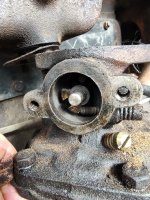
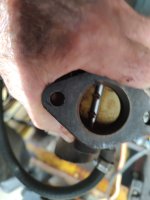
Had I not personally experiencing this, I would have thought it impossible. The image to the left is the throttle shaft where it connects to the governor. I manipulated the throttle using a small set of vise grips clamped on the shaft. My engine controls are on a panel about five feet away and I needed to be where I could instantly kill the engine if needed. I wasn't able to rotate the shaft more than a couple of turns until I had to kill the engine. Next, I held the shaft against the stop in the clockwise direction and started the engine and it went ballistic. I then held the shaft against the stop in the counterclockwise direction and, again, the engine went ballistic. You can see the butterfly valve in the right-hand image, and it operates freely without any resistance.

To answer your first question. There is rarely a time that there is not some kind of repair or modification work going on. That is where the fun of having this old equipment comes from. However none of that work was on the engine. My son and I had been cutting an ash log and was about to shut down when he commented that the governor didn't seem to have the control of the engine that it had previously. He operated the governor control lever several times and that was the first time it ran away. Up until that time and for the past 20 years, the engine has performed exceptionally well. It was a fluke that I tried to run the engine with the governor disconnected. I just wanted to hear the engine run where I could throttle it up and down unencumbered by the governor. Had I not done that, I would still be looking at rebuilding the governor. Thanks for the response.
 

Attachments

  • IMG_20251013_103757587.jpg
    IMG_20251013_103757587.jpg
    1.8 MB · Views: 7
  • IMG_20251013_103842364.jpg
    IMG_20251013_103842364.jpg
    740.4 KB · Views: 7
It doesn't make sense to me either. With the shaft fully to the left, against the adjustment screw, the throttle plate should be very close to completely shut. You might try backing the screw out so the plate is completely shut. Verify it is completely shut and try it again. By the way, you can usually kill an engine by fully closing the choke, which should be within reach while manipulating the throttle.

There must be some other factor that we are all missing. The only other things I can think of are bad manifold gaskets or a rusted through manifold. It doesn't seem like either of those would cause a full out run-away.
 
It doesn't make sense to me either. With the shaft fully to the left, against the adjustment screw, the throttle plate should be very close to completely shut. You might try backing the screw out so the plate is completely shut. Verify it is completely shut and try it again. By the way, you can usually kill an engine by fully closing the choke, which should be within reach while manipulating the throttle.

There must be some other factor that we are all missing. The only other things I can think of are bad manifold gaskets or a rusted through manifold. It doesn't seem like either of those would cause a full out run-away.
 
I tried to attach a video, but this site does not allow that file type. All these comments are "spot on" and I would investigate each and every one except that I had already done that before I resorted to the forum.

The only thing left for me to pursue is elevating the gas tank to the same level, relative to the engine, that the tank is on the Super M and removing the electric fuel pump. It currently is a little lower than waist high. It may be that the updraft suction of the carburetor and the pressure of the electric fuel pump is sufficient to overcome the pressure of the float on the needle valve. By elevating it, I can use gravity (of which there is a plentiful supply) to deliver the gas to the carburetor. It's a long shot, but it is the only thing left. It will take a day or two, but I will get back and let everyone know if it worked. Any thoughts on this before I get out the cutting torch?

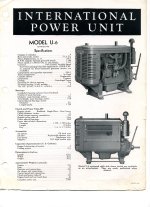
The power units did not have a built-in gas tank. I've attached a motor data sheet so you can see what it looks like.
 

Attachments

  • U6 mtr data sheet pg 01.jpg
    U6 mtr data sheet pg 01.jpg
    1.3 MB · Views: 3
Fuel tanks were an option on many (usually smaller) IH power units, not sure if available for the U-6. In any case, when there was one it mounted over the clutch with the top even with the hood. So there wasn't much drop to the carburetor. Electric fuel pumps are available in high and low pressure ranges, and there are also some that are adjustable. You would only need a low pressure, or an adjustable set very low. In any case, if it had been working before it seems unlikely that a malfunction of the fuel pump would suddenly increase the pressure. To test your fuel pressure theory without a lot of heavy-duty reconstruction, get a small tank that you can temporarily attach somewhere near hood level and run a gas hose straight to the carburetor. A tank from a lawn mower or whatever will work. You can probably do all the testing you need on a half gallon of gas.

I still think trying with the idle speed screw turned way out is worth doing.
 
Fuel tanks were an option on many (usually smaller) IH power units, not sure if available for the U-6. In any case, when there was one it mounted over the clutch with the top even with the hood. So there wasn't much drop to the carburetor. Electric fuel pumps are available in high and low pressure ranges, and there are also some that are adjustable. You would only need a low pressure, or an adjustable set very low. In any case, if it had been working before it seems unlikely that a malfunction of the fuel pump would suddenly increase the pressure. To test your fuel pressure theory without a lot of heavy-duty reconstruction, get a small tank that you can temporarily attach somewhere near hood level and run a gas hose straight to the carburetor. A tank from a lawn mower or whatever will work. You can probably do all the testing you need on a half gallon of gas.

I still think trying with the idle speed screw turned way out is worth doing.
Excellent suggestion, I will try a small tank positioned at the appropriate level before I change the existing setup. Also, I will change the idle screw to where the throttle valve completely closes. I will do these separately so, if the nature of the problem changes, we will know which change is responsible.
 
Last edited:
Excellent suggestion, I will try a small tank positioned at the appropriate level before I change the existing setup. Also, I will change the idle screw to where the throttle valve completely closes. I will do these separately so, if the nature of the problem changes, we will know which change is responsible.
I disconnected the governor and the electric fuel pump from the carburetor and temporarily rigged an elevated fuel source. With this modification I was able to fully control the rpm’s by manually manipulating the throttle shaft.

I should have changed the idle adjustment first just to see if the throttle valve would completely stop the gas. I cut the idle speed down while it was running and the engine responded as it should but it may not have if it was still using the electric fuel pump.

I believe the operating specs changed on the fuel pump as it aged and was causing the problem. I believe my problem is solved. Thanks for all the help.

The lesson learned here is: “be wary of cheap, low pressure, electric fuel pumps”.
 
I disconnected the governor and the electric fuel pump from the carburetor and temporarily rigged an elevated fuel source. With this modification I was able to fully control the rpm’s by manually manipulating the throttle shaft....... I believe my problem is solved. Thanks for all the help.

The lesson learned here is: “be wary of cheap, low pressure, electric fuel pumps”.
Hey...........that's great news to hear, and the lesson about electric fuel pumps as well. I know of situations on lawn mowers, (other small engines too) where the diaphragm type fuel pump has failed and a low pressure electric fuel pump was added to replace it. I can see where this might create a problem if conditions were right? Thanks for solving the problem and sharing it on the forum. Great lesson learned. JMHO Stan
 
Last edited:
Back
Top