Stuck valve?

lyle11

501 Club
A couple of weeks ago I posted about my tractor that won't start after a few hours of use after an upgrade to a mini alternator from a generator.

This tractor is remote from where I live, but I'm back here now and going through troubleshooting steps. Can't even get so much as pop, but I was reading about stuck valves. This is new territory for me. I've never messed with even taken the valve cover off.

It does seem like cranking the tractor compared to my other cub has less resistance but it's not that dramatically different.

My main reason this post is just my understanding is that if I have a stuck valve, I would see a gap between the adjustment nut and the valve bottom. So based on what I'm looking at in these photos, I would say this does not show any indication of a stuck valve. Is that correct?

As soon as my helper gets here, I'm gonna have her crank it and kind of watch the workings of it.
Thanks
 

Attachments

  • IMG_5348.jpeg
    IMG_5348.jpeg
    1.5 MB · Views: 26
  • IMG_5347.jpeg
    IMG_5347.jpeg
    1.4 MB · Views: 25
If a valve is sticking, not moving down to the closed position, there is nothing to push the tappet back down to the closed position. So, it could remain up and there be no obvious gap between it and the bottom of the valve stem. Nothing would be obvious from a static inspection. You need to turn the crank to a couple different positions to see that each valve closes. (At TDC 4 valves should be verifiably closed. One revolution later the other 4 should be.)
 
simple compression test will tell you if you have a problem
Thanks for the information. This 'no start" issue that has been covered probably more than any other topic. Since I have spark and swapped in another running carburetor, I read about stuck valves so I figured I'd check it out. Also couldn't get it to pop with starting fluid spray. Usually, based on what I've read, the stuck valve issue occurs after the Cub isn't run for an extended period of time and that is not the case here.

After my helper arrived, I watched as she cranked the engine over numerous times and, everything was moving up and down and making that little air exhaust noise. Cranking resistance increased when I covered the hole in the manifold (carb is off).

So, I'm reasonably confident the problem isn't a stuck valve. It just made sense to check it out.

I have plenty of past threads to refer to for further troubleshooting.

Thanks
 
Check for spark (1) at the points, if good then (2) at the plug wires to ground. I fought that battle once and found that the coil was bad on the high voltage (tower) side. JMHO Stan
 
Hi,
I would check the valve clearance, and adjust them if needed, while you have the valve cover off the engine.
The valve clearance is manually adjusted, if nobody checks it, as the valves wear, the clearance can get to be wrong. You need 2 open end wrenches, and a flat feeler gauge to check and set the clearance.
People on here have said that their engines ran better after setting the valve clearance. :)
 
Still no start. Did the following:
Bent a spare spark plug out about 1/4". Attached to coil and got spark across about 3/16" gap. Took that test spark plug to each cylinder and got spark at all cylinders.

On cylinder #1 the spark occurred every other revolution with timing pointer very close to the notch in the pulley. Distributer hasn't been moved in years and is bolted solidly.

Even put my fingers in the exhaust when she cranked and felt air flow.

Next I had her crank with the starter while i sprayed fresh starter fluid into the carburetor air hole with the choke open. Got not even so much as a pop. Lots of fluid ran out the carburetor but I sprayed a lot. Doesn't have a "straw" attachment to spray right up into the manifold but felt good suction at the manifold opening.

Also pulled all plugs. Just removed and cleaned them after alternator conversion. They had about 5 hours run time on them. Looked dry.

I just get the impression that no gasoline or starter fluid is getting to the plugs. But like I said, I feel good suction on the manifold so that doesn't really make any sense.

Also tried it reconnecting the gas with two different carburetors, including the one off the other Cub that runs but there was no difference.

Had to charge the battery now on my slow charger, so I'm not sure what to try next. This has been a very good runner and quite powerful. Nothing around the tractor indicating any kind of catastrophic problem. Oil normal everything clean looking.

I did plug each spark plug hole with my finger and felt suction. Was hand cranking and did didn't really feel anything near as powerful as at the manifold but like I said, I was hand cranking.
 

Attachments

  • IMG_5349.jpeg
    IMG_5349.jpeg
    730.7 KB · Views: 7
simple compression test will tell you if you have a problem
In your first post you said it didn't want to start after getting hot. Feeling airflow does not necessarily mean that you don't have sticking valves. Like tst said a compression test on each cylinder wet and dry will tell you a lot. The compression might be too low to start. You could try a pull start, sometimes that will get a stubborn engine to kick off. Just don't pull from the front axle/bolster!! JMHO Stan
 
In your first post you said it didn't want to start after getting hot. Feeling airflow does not necessarily mean that you don't have sticking valves. Like tst said a compression test on each cylinder wet and dry will tell you a lot. The compression might be too low to start. You could try a pull start, sometimes that will get a stubborn engine to kick off. Just don't pull from the front axle/bolster!! JMHO Stan

Thanks, Stan. Just to clarify if I said anything about it not starting when hot, that was never the issue and I misspoke. Tractor worked fine and was run for about five hours then shut down for about two weeks.

That was the point where the tractor has never started again after sitting idle for 2 weeks. So at this point, my plan is to get a compression tester and test the compression.

I'm at somewhat of a disadvantage here because I live 700 miles away. My wife and I go here on vacation on a 80 acre farm that I inherited. So I have limited time when I'm here. I'll get a tester before I return unless I get one locally this week.

I had a couple questions:

Since I won't be back for 3-4 weeks, would it make any sense to squirt Seafoam into the spark plug holes just in case that would free things up over the next 3-4 weeks?

I'm thinking a compression tester has an attachment which I thread into the spark plug hole. So I'm hoping to have some kind of flexible hose to get into tight spaces so I don't have to remove the hood.

The good news is my FCub is working great. I put a Clancy radiator on it about two years ago. Had to do some cutting of the radiator supports to get it to fit but so far it's working great after two years. No leaks Cub running cool in our July like September weather. Not recommending Clancy just giving feedback on a two year-old install.

I've had the FCub for about 21 years. Finally put a set of new blades on the Woods 59 mower. Got Woods 6950KT which consists of three blades at a dealer about 40 miles away. Based on the looks of the box, he's had it for awhile. Paid the high woods price of $87 but figured since this may become my primary mower again for whatever time is left to mow here in Wisconsin, I might as well have it look good because the old blades were really doing a substandard job. I didn't have time to shop online for a bargain. These are actual Woods brand blades, although aftermarket might be fine.
 
I don't think Seafoam in the cylinders will do any harm, it might help if your rings are not free on the pistons. It's doubtful that you can get enough on the valves to help there without removing the head. As for sticking valves, it's hard to see if the valve stems are all moving up and down since the vision is limited by the carb but a tester will tell you if they are sealing or not. The test numbers should be greater than 85-90. Some auto parts sellers have tools for loan, that might be an option. Also be careful when removing and reinstalling the plug wires, It's very easy to get them mixed up. Firing order is 1-3-4-2. Good Luck. Stan
 
I don't think Seafoam in the cylinders will do any harm, it might help if your rings are not free on the pistons. It's doubtful that you can get enough on the valves to help there without removing the head. As for sticking valves, it's hard to see if the valve stems are all moving up and down since the vision is limited by the carb but a tester will tell you if they are sealing or not. The test numbers should be greater than 85-90. Some auto parts sellers have tools for loan, that might be an option. Also be careful when removing and reinstalling the plug wires, It's very easy to get them mixed up. Firing order is 1-3-4-2. Good Luck. Stan

Went to Harbor freight and got a compression tester and did a wet and dry compression test. Based on the results, I can see why it won't start.

Cylinder 1 - 80 Dry 110 Wet
Cylinder 2 - 15 Dry 75 Wet
Cylinder 3 - 10 Dry 105 Wet
Cylinder 4 - 50 Dry 90 Wet

I haven't really done any further looking on this site for next steps. I am just reporting what I found out. I would think this means I have badly worn rings and need to rebuild. What I find so surprising is tractor mowing with good power and then two weeks later won't start. Worn rings seems like it would be more of a gradual thing. Didn't overheat or anything indicating a problem.

Like I said, I don't live here. Might be a winter project I would like to try, but I don't live here and it would be something I would do very slowly taking my time if I was able to do it. Rebuilding an engine in limited time is not something I want to try.

Wisconsin is definitely not an area with a lot of Cubs. I have read some threads on this forum about people having their Cub engine rebuilt by a shop and it didn't turn out so great.

I could also look into other tractors, but Cub has been ideal here. Can't mow near as frequently as needed, but with the hydraulics, lifting the deck allows me to do a sloppy high cut, followed by the normal shortcut a couple days later. Plus easy on gas.

I still do have one working Cub so, being an old guy, that might be all I need for the rest of my life or the rest of my time cutting here. But I hate to see this one just sit here since it's such a good tractor and all the other major components, like the transmission are working really good. I like to have two Cubs around just for this very reason.

If it's rebuild time, the best thing for me to do is find a good used engine and have it shipped to this location via something like Fastenall to arrive when I'm here. I have replaced a couple of cub engines, so that's something I can do. Not really interested in buying something off eBay. I'd rather get something from Tim or a knowledgeable forum member if that's the route I go.
 
Hi,
I guess I didn't post this here before you did the compression test.

Here is info for doing a compression test, if you need it.
Open the throttle fully to do the compression test, so the engine can get air. If the throttle is closed, it could show less compression on the gauge.
Have all 4 spark plugs out of the engine at the same time.
Charge the battery fully before the test, and use the starter.
Charge a new battery also, they are not always fully charged, a low output charger is better, 6 amps or so, that automatically goes down as the battery charges. It may take several hours to charge.
The Cub service manual says a Cub engine before Cub serial number 192113 has 107 lbs of compression, when turning at 240 RPM. That is probably for a new engine.
Some less is ok, they have said on here 90 lbs or above is ok.

The piston rings may be stuck, and not wornout. It is common for them to get stuck when sitting.
They say on here if the engine is smoking, or the compression is low, if you can get it to run, to put Seafoam oil additive in the engine oil.
They sell it at auto parts stores.
Piston rings commonly get stuck, and then the engine will smoke, or have low compression.
It could help the compression, if the rings are stuck, and the Seafoam loosens them.
Make the engine work doing something when using the additive, so it warms up.
I have read on here of people having good results after using the oil additive.
It is easier to try the oil additive, than rebuild, or replace the engine.

One of the experts on here said to use the additive for 2 oil change periods.
The 1955 Cub operator's manual says to change the oil every 150 hours of use.
If the piston rings are wornout, the seafoam won't help much.

I have used Rislone, and had good results with that brand, it is an oil additive also.
I haven't used the Seafoam, but have read people's posts about it on here.
If you need to replace the engine, J P Tractor Salvage, near the bottom of the Forums page on here, may sell a complete, or mostly complete, used engine, I'm not sure. :)
 
Last edited:
Hi,
I guess I didn't post this here before you did the compression test.

Here is info for doing a compression test, if you need it.
Open the throttle fully to do the compression test, so the engine can get air. If the throttle is closed, it could show less compression on the gauge.
Have all 4 spark plugs out of the engine at the same time.
Charge the battery fully before the test, and use the starter.
Charge a new battery also, they are not always fully charged, a low output charger is better, 6 amps or so, that automatically goes down as the battery charges. It may take several hours to charge.
The Cub service manual says a Cub engine before Cub serial number 192113 has 107 lbs of compression, when turning at 240 RPM. That is probably for a new engine.
Some less is ok, they have said on here 90 lbs or above is ok.

The piston rings may be stuck, and not wornout. It is common for them to get stuck when sitting.
They say on here if the engine is smoking, or the compression is low, if you can get it to run, to put Seafoam oil additive in the engine oil.
They sell it at auto parts stores.
Piston rings commonly get stuck, and then the engine will smoke, or have low compression.
It could help the compression, if the rings are stuck, and the Seafoam loosens them.
Make the engine work doing something when using the additive, so it warms up.
I have read on here of people having good results after using the oil additive.
It is easier to try the oil additive, than rebuild, or replace the engine.

One of the experts on here said to use the additive for 2 oil change periods.
The 1955 Cub operator's manual says to change the oil every 150 hours of use.
If the piston rings are wornout, the seafoam won't help much.

I have used Rislone, and had good results with that brand, it is an oil additive also.
I haven't used the Seafoam, but have read people's posts about it on here.
If you need to replace the engine, J P Tractor Salvage, near the bottom of the Forums page on here, may sell a complete, or mostly complete, used engine, I'm not sure. :)

Thanks Glen.
Yeah, that's how I did the compression test. Looked here before I started it to make sure I was doing it right. The Harbor Freight instructions say start with a warm engine, but that's certainly not something I can do when I can't start the engine to get it warm.

Obviously, I'm gonna try something before I buy a replacement engine just thinking worst case scenario. Just from looking at a few past threads, it seems like you'd be expecting one cylinder to have some kind of result way out of line with the other three. I have 2 that read extremely low. Seems like it would be more likely that there would be one problematic cylinder in such a short time rather than two. This Cub was running fine about a month ago and run 5 hours mowing And then wouldn't start two weeks after that. So sitting only two weeks idle

Not sure about the wet or dry I haven't really read that much about it. My understanding is that the oil coats from the top and then you get much better compression. So I don't know if my very low dry readings are due to It not being started for a month. It's been cranked with the starter a lot so I I think that would be enough pumping of oil.

I have Seafoam on hand. I'll definitely put Seafoam in the cylinders and check it again when I come back here in about a month. I'm still here for a few more days, but the Seafoam will have a month to work before I return in October.

Also wondered if I should squirt oil in the problem cylinders and then start it right after that and see if it'll start with the higher compression and may be running it loosens something up.

Got a lot of other stuff I gotta do here so I haven't really had much chance to search past threads for ideas.
 
.....................If it's rebuild time, the best thing for me to do is find a good used engine and have it shipped to this location via something like Fastenall to arrive when I'm here. I have replaced a couple of cub engines, so that's something I can do........
If you decide to replace the engine, you might consider a short block that's been tested and rebuilt. I think someone recently posted that a forum sponsor sells one for about $500. JMHO Stan
EDIT: Just looked at JP TRACTOR website, he has a cleaned and checked block listed including new pistons for $475
 
Last edited:
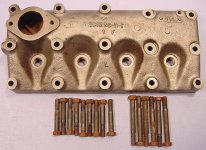
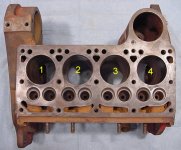
If you put Seafoam in the cylinders, be sure that it gets into the cylinders. The cylinders are mostly to the right side of the engine from where the spark plug holes are in the head.
You need a small oil bottle, with a long plastic tube, so you can put the tube into the spark plug holes, and angle it to the right side.
A pump oil can might work, if you can squirt it to the right, with the end in the holes. I don't know how well that would work with the hood on.
If you put Seafoam straight down from the holes, it will mostly run out the valves, which are mostly below the holes.
Below are pictures from TM Tractor Parts of the engine block, and the head.
You can see the 3 rows of head bolt holes forward to back, the cylinders are mostly to the right side of the center row of bolt holes.
You can sit down on a chair on the left side of the Cub to remove the spark plugs. Be sure the base areas of them are clean, so dirt doesn't fall into the engine. A light is helpful for working under the hood.
 

Attachments

  • Cub head .jpg
    Cub head .jpg
    78.3 KB · Views: 7
  • Cub Block 3.jpg
    Cub Block 3.jpg
    67.4 KB · Views: 7
Last edited:
Looking at the dry numbers, my first thought was a head gasket blown between cylinders 2 and 3. But that doesn't track with the cylinder 3 wet number. I think letting Seafoam soak in for a month then redoing the dry/wet test is a good next step. Maybe the numbers from a redo will show something more useful.
 
Hi,
I guess I didn't post this here before you did the compression test.

Here is info for doing a compression test, if you need it.
Open the throttle fully to do the compression test, so the engine can get air. If the throttle is closed, it could show less compression on the gauge.
Have all 4 spark plugs out of the engine at the same time.
Charge the battery fully before the test, and use the starter.
Charge a new battery also, they are not always fully charged, a low output charger is better, 6 amps or so, that automatically goes down as the battery charges. It may take several hours to charge.
The Cub service manual says a Cub engine before Cub serial number 192113 has 107 lbs of compression, when turning at 240 RPM. That is probably for a new engine.
Some less is ok, they have said on here 90 lbs or above is ok.

The piston rings may be stuck, and not wornout. It is common for them to get stuck when sitting.
They say on here if the engine is smoking, or the compression is low, if you can get it to run, to put Seafoam oil additive in the engine oil.
They sell it at auto parts stores.
Piston rings commonly get stuck, and then the engine will smoke, or have low compression.
It could help the compression, if the rings are stuck, and the Seafoam loosens them.
Make the engine work doing something when using the additive, so it warms up.
I have read on here of people having good results after using the oil additive.
It is easier to try the oil additive, than rebuild, or replace the engine.

One of the experts on here said to use the additive for 2 oil change periods.
The 1955 Cub operator's manual says to change the oil every 150 hours of use.
If the piston rings are wornout, the seafoam won't help much.

I have used Rislone, and had good results with that brand, it is an oil additive also.
I haven't used the Seafoam, but have read people's posts about it on here.
If you need to replace the engine, J P Tractor Salvage, near the bottom of the Forums page on here, may sell a complete, or mostly complete, used engine, I'm not sure. :)
Thanks Glen for the reminder about the Pistons being off to the right from the spark plug hole. One advantage of inheriting a an old farm is that there's always a lot of junk laying around. Seems like for years after my father's death I would find something I needed in his toolbox or laying around somewhere.

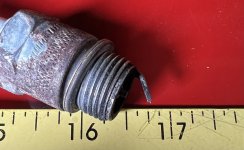
In this case, I found an old automobile antenna. Telescoping hollow type. Broke off a chunk and then bent almost a right angle and made sure I could blow through it. Certainly doesn't look pretty, but I was able to set it in the spark plug hole and then use my flexible oiler can filled with sea foam to pump it down the middle of the bent tube. I put a little dimple in it so I could see that I had it oriented correctly.

Now I'll give it a month or so to work.
IMG_5392.jpeg
 
Looking at the dry numbers, my first thought was a head gasket blown between cylinders 2 and 3. But that doesn't track with the cylinder 3 wet number. I think letting Seafoam soak in for a month then redoing the dry/wet test is a good next step. Maybe the numbers from a redo will show something more useful.
Thanks, Jim. If a 30 day Seafoam soak doesnt work, I'm kind of hoping it is the head gasket because that's the kind of repair I can do. I know breaking off bolts can be a problem. I feel confident that I got the sea foam in over the pistons.
 
Back
Top