
You are using an out of date browser. It may not display this or other websites correctly.
You should upgrade or use an alternative browser.
You should upgrade or use an alternative browser.
rejuvenate pasture
- Thread starter Jack
- Start date
Most garden shops have the kits, flebay, amazon, etc.---Not hard to find and they also have refill kits after you buy the starter kit.
The fertilizer company here says that you can send the same soil sample to 100 different labs AND get 100 different answers!!!!--- Thats why I do my own for N-P-K tests. Micro nutrient testing is VERY costly around here, so that part is to observe the plants, do research and you can come close to getting micro needs in order. thanks; sonny
The fertilizer company here says that you can send the same soil sample to 100 different labs AND get 100 different answers!!!!--- Thats why I do my own for N-P-K tests. Micro nutrient testing is VERY costly around here, so that part is to observe the plants, do research and you can come close to getting micro needs in order. thanks; sonny
ScottyD'sdad
501 Club
I've "frost seeded" pastures, a few times. Overseed it, in late winter, and the freezing and thawing of the surface, opens cracks and allows the seed to drop in.
Of the soil test results, pH is very important, as that determines if the nutrients will be absorbed by the plant. Plenty of a nutrient can be in the soil, but at the wrong pH level, it becomes unavailable to the plant.
Ed
Of the soil test results, pH is very important, as that determines if the nutrients will be absorbed by the plant. Plenty of a nutrient can be in the soil, but at the wrong pH level, it becomes unavailable to the plant.
Ed
Several PMs from Jack, the original poster of this topic. From the PMs, I gather that Jack is a novice farmer and had moved onto the property last June.
Knowing nothing about Jack's property, most of my advice was, where to get assistance from the various county, state, federal agencies, and neighboring farmers.
Growing up and farming in the rolling hills of west central Iowa and then moving to the Ozarks, I thought I knew about farming. Wrong. Farming in the Ozarks is totally different. Anyway, I purchased Iowa farm equipment, didn't work in the Ozark's clay and rocky soil. Literally destroyed some of my Iowa based farm machinery.
Over the 20 years on the acreage, found out that some of the bottoms are decent for row crops. Hill side, trees and rocks. Top of the ridges, clay, rocks, and pasture. Also found out that adjacent properties have a different soil structure.
I did get quite a bit of assistance from the local, state, and federal agencies as what to do with the property. Frequently, the agencies would schedule a "walk through" of the acreage. They would offer their opinions, suggestions, and what type(s) of assistance grants to apply for.
While on the topic of acreages and farms, while waiting for the glue to dry on my wife's winter project. When we purchased the acreage, it had been over grown for many years. Spent several years clearing brush, cleaning up the pasture, cleaning up junk deposited on the property, building fences, just maintaining the property. Felt like pioneers. Acreage was purchased at a reduce value because of the condition.
What I know, I'm working for the current and future family generations. Everything on the acreage is fully paid for. Depending on the black walnut harvest, annual taxes are paid with a tiny bit of profit. And then there is the fire wood harvested to heat son's house.
Knowing nothing about Jack's property, most of my advice was, where to get assistance from the various county, state, federal agencies, and neighboring farmers.
Growing up and farming in the rolling hills of west central Iowa and then moving to the Ozarks, I thought I knew about farming. Wrong. Farming in the Ozarks is totally different. Anyway, I purchased Iowa farm equipment, didn't work in the Ozark's clay and rocky soil. Literally destroyed some of my Iowa based farm machinery.
Over the 20 years on the acreage, found out that some of the bottoms are decent for row crops. Hill side, trees and rocks. Top of the ridges, clay, rocks, and pasture. Also found out that adjacent properties have a different soil structure.
I did get quite a bit of assistance from the local, state, and federal agencies as what to do with the property. Frequently, the agencies would schedule a "walk through" of the acreage. They would offer their opinions, suggestions, and what type(s) of assistance grants to apply for.
While on the topic of acreages and farms, while waiting for the glue to dry on my wife's winter project. When we purchased the acreage, it had been over grown for many years. Spent several years clearing brush, cleaning up the pasture, cleaning up junk deposited on the property, building fences, just maintaining the property. Felt like pioneers. Acreage was purchased at a reduce value because of the condition.
What I know, I'm working for the current and future family generations. Everything on the acreage is fully paid for. Depending on the black walnut harvest, annual taxes are paid with a tiny bit of profit. And then there is the fire wood harvested to heat son's house.
Farm Number. Jack, check with your local Dept. of Agriculture to see if you have a farm number. Easy to apply for if you need one.
The Farm Number is needed if you apply for any USDA assistance.
If there is a Farm Number, check for the agricultural base, such as corn, tobacco, etc. on the property. For some crops there are acreage limitations.
The Farm Number is needed if you apply for any USDA assistance.
If there is a Farm Number, check for the agricultural base, such as corn, tobacco, etc. on the property. For some crops there are acreage limitations.
BIGHOSS":7mhjm9h7 said:spike 1.JPG
Fall is the best time here in TN to seed lawns, pastures and hay fields. Spring time not so good. Easy to establish a good stand of grass in spring but hot weather will kill new grass before the roots can take hold, so I prefer fall. But the seeding process is the same for fall or spring.
My method is to run over the ground one or two times with my shop fabricated aerator, then scatter the seeds fairly thick and then use the aerator again hooked in tandem with a cultipacker to push the seeds into the sod.
Works well with lots of rainfall, but a dry fall it's not so good.
Just my 2 cents.
Could we see a few more pictures of the aerator ,,,wondering how long the spikes are and instalation pattern.
Mike
Jack":5f8o1k34 said:hello, I would like to get some input on rejuvenating my goat pasture this spring,The pasture is pretty old, I need your expert experience. I was thinking of hooking my 28a disc to the cub and angle the disc all the way, and just disc the pasture, then over seed with either orchard grass seed or get a goat formula seed mix? or do you think I should just rototill the pasture and seed then roll it?
thank you in advance for your help.
Jack
:tractor:
this site may help you out [it has been valueable information for me]
https://www.greencoverseed.com/about/
Mike
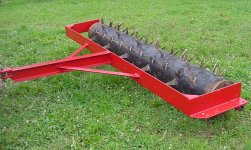

Mike H":3e6oapfe said:BIGHOSS":3e6oapfe said:spike 1.JPG
Fall is the best time here in TN to seed lawns, pastures and hay fields. Spring time not so good. Easy to establish a good stand of grass in spring but hot weather will kill new grass before the roots can take hold, so I prefer fall. But the seeding process is the same for fall or spring.
My method is to run over the ground one or two times with my shop fabricated aerator, then scatter the seeds fairly thick and then use the aerator again hooked in tandem with a cultipacker to push the seeds into the sod.
Works well with lots of rainfall, but a dry fall it's not so good.
Just my 2 cents.
Could we see a few more pictures of the aerator ,,,wondering how long the spikes are and instalation pattern.
Mike
Field Aerator
Material List
10” x 84” natural gas pipe (used and available)
¼” x 4” bar stock
3/8” x 4” x 4” angle (freeby)
Roller was made by enclosing each end with ¼” plate and 1” round stock for axle stub and welding the spikes to pipe. Drain pipe plug on one end to fill with water for extra weight.
Spikes were sheared from bar stock with a 2” base and sharp point on other end. This is very important! Don’t weld the spikes in a straight row on roller. This will cause the roller to run rough and beat up your towing vehicle. (Don't ask how I know this)The best location for the spikes is in a spiral pattern which makes more points in contact with ground at any given time. I welded this with a 7014 rod. Be prepared to burn lots of rod while welding spikes to roller.
Frame was made using the 3” angle.
Added later, after pic was made, was a tow bar to hitch a cultipacker behind aerator.
These are all pics that I have now.
Broomsedge bluestem, I have a problem with Broom Sedge on several sections of the pasture, side hills. The soil is mostly clay and rocks. Lacking nutrients.
The plan to help eliminate the sedge grass, fertilize with spreader and have the tenant spread turkey residue/crap/feces on the broom sedge areas
The process will take several year to bring the soil up to snuff.
The plan to help eliminate the sedge grass, fertilize with spreader and have the tenant spread turkey residue/crap/feces on the broom sedge areas
The process will take several year to bring the soil up to snuff.