Necessary to split my Cub to replace the Throw-Out bearing?

Alec

Active member
I apologize if the answer to this query is somewhere in the 10+ pages of 'clutch' questions.

My '48 Cub Throw-Out makes a bit of noise when the clutch is out (pedal not depressed).
The noise disappears when the clutch is disengaged (pedal depressed).
I'm assuming from my mechanical experience that it's the Throw-Out bearing.
I will grease it first but, if I have to replace it, can that be done without splitting the tractor?

Thanks for your time & patience.
Alec
 
I apologize if the answer to this query is somewhere in the 10+ pages of 'clutch' questions.

My '48 Cub Throw-Out makes a bit of noise when the clutch is out (pedal not depressed).
The noise disappears when the clutch is disengaged (pedal depressed).
I'm assuming from my mechanical experience that it's the Throw-Out bearing.
I will grease it first but, if I have to replace it, can that be done without splitting the tractor?

Thanks for your time & patience.
Alec
No, you have to split the tractor. You can look through the inspection opening and see how much graphite remains around the bearing. When it gets close to the bearing housing, it is time to replace.
 
The noise is not necessarily the TOB (Throw-out Bearing).
As suggested, check through the inspection opening to see if the clutch fingers appear to be at even heights and intact, as well as the condition of the TOB, itself. Grease the TOB if it looks OK, using really "cheap" grease. Check that the gap between the TOB & the fingers is about 1/8".

I have a tractor that "rattles" a bit when the clutch peddle is NOT depressed and is quiet when it IS depressed. I am pretty sure, in my case, that the transmission bearings are actually making my noise.
 
To replace the Throw Out Bearing (TOB), you have to split the Cub. I have a '48 Cub and had a lot of trouble adjusting the clutch free travel since you have to do it through the inspection hole in the housing. If you really want to fix your TOB bearing/clutch problems, also get a new (used) long tube between the rear axle and the Cub engine "bell housing. You all ready have the tractor split -- just do a little "extra" work to make it better. See the following description of my fix:.

On the 1948 Cub, those long "swing bars" that hold the TOB are no longer available. The holes in my "swing bars" were worn. I tried to put shim washers in to make the bars have a tighter grip on the TOB. That didn't work. The TOB was so loose that it would always rattle when the clutch was out as it bounced back & forth on the clutch fingers.
The "swing bars" on the later Cubs are of a different design. They are shorter and you can adjust the clutch "free travel" externally. On my Cub, that long tube between the rear axle and the Cub engine "bell housing" had a small crack in the casting. I was afraid the housing would break in two pieces. So I bought a "new" used housing that was from a later model Cub. I bought new "swing bars" for this later design and am very happy. I have no more TOB rattling when the clutch is released. If I have to adjust the clutch free travel, the external adjustment is very easy.

If I knew how much better this later Cub clutch design was, I would have replaced the long tube between the rear axle and the Cub engine a long time ago. Fortunately, I "stumbled" on it because my tube had a crack in the casting.
 
Alec,
Face of graphite puck to the cast holder on a new throwout bearing is approximately 5/16".
If the throwout bearing is not greased at least 2 times per year, using cheap grease, allowing it to ooze out the small hole on the top of the bearing, you could break off chunks of the bearing or the fingers can wear the dry graphite away. The chattering would only happen with the fingers against the uneven face of the graphite puck.
Splitting the tractor is necessary and is somewhat involved. You need to use some form of splitting stands that move with each half of the tractor as well as some wedges in the front axle so the engine doesn't tip over the front half. I just split mine at Cecil's CubFest Northeast last weekend. I needed to replace the rear main seal (from Tim Talleur - tst), so while everything was apart, we installed a reman clutch & pressure plate. I had a new throwout bearing with me, but there was plenty of life left in the existing one.
 
I not only use the grease zerk, but I also put some grease on the end of a flat blade screwdriver, and smear some grease on face of the graphite bearing also...
 
Check and make sure you have about 3/4"-1" of free travel in the pedal before the TOB makes contact with the clutch fingers. The pedal should always return to its hard stop when it's released. Sometimes lack of lubrication on the pivot or a missing return spring won't allow the pedal to fully return. That can leave the TOB in contact with the clutch fingers which can cause some noise.
 
My '48 Cub Throw-Out makes a bit of noise when the clutch is out (pedal not depressed).
The noise disappears when the clutch is disengaged (pedal depressed).
I'm assuming from my mechanical experience that it's the Throw-Out bearing.
Hi,
The throwout bearing doesn't touch anything when the clutch pedal is fully up.
The original style throwout bearing doesn't turn, so it has no turning bearing making noise.
It could make rattling sounds if the mounting holes in the throwout bearing holder are worn.
The clutch pedal should have either 1 3/16" or 1" of free play at the top of it's travel, at the surface where you put your foot, depending on the age of the Cub.
You said before that the serial number plate is gone from your Cub.
I guess we figured out the serial number of your Cub is around 53000.
IH changed the free play adjustment method, and the amount of free play at Cub serial number 32229, which was during 1948.
There should be return springs on all 3 pedals, under the platform, to hold the pedals up against the edge of the platform. If the spring on the clutch pedal is broken or gone, the pedal would always go ahead, and there would be no free play. The throwout bearing would always touch on the turning pressure plate fingers.
I agree with Dale above, if something is making noise, and the noise stops when you push the clutch pedal down, it is probably 1 or both of the bearings on the long shaft in the transmission.
The shaft goes from the clutch, to about 6 inches to the rear of the gear shift lever.
It stops turning when you push the clutch pedal down.
It is common on Cubs for the 2 bearings to make noise after lots of use.
It is a job to replace the bearings, the Cub has to be split at the transmission, the clutch housing has to be removed from the trans. That is about 6" ahead of the gearshift.
The Cub service manual tells about splitting the Cub.
You need to know exactly what is making the noise before taking anything apart.
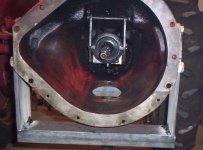
Below is a picture of the Cub split, and the throwout bearing in it's holder.
The 2nd picture is a new throwout bearing, the graphite material sticks out of it 5/16". The material can wear down from use.
 

Attachments

  • Cub clutch housing 3.JPG
    Cub clutch housing 3.JPG
    90.2 KB · Views: 7
  • Cub.jpg
    Cub.jpg
    65.4 KB · Views: 4
Last edited:
The Cub owner's and operator's manuals tell about adjusting the clutch pedal free play.
Below are pages telling about it.
The 1st page is from the 1947 Cub owner's manual.
The 1st style of adjustment is inside the housing, you turn the yoke on the rod.
There is a picture of the clutch on the page.
When the free play is set to the right amount, it automatically sets the distance between the bearing and the pressure plate fingers.
https://farmallcub.club/rudi/farmallcub.com/rudi_cub/www.cleancomputes.com/Cub/Cub Owner's Manuals/McCormick-Deering Farmall Cub Owner's Manual 5-23-47/Page-40.jpg

The page below, from the 1950 Cub owner's manual, shows the 2nd style of adjustment, it is external, at the pedal base.
 
Back
Top