Exhaust question

Jim in SC

Well-known member
Slowly working on the refresh on my '51 H and I have a question. As long as I had the carb off, I thought I might as well remove the manifold and get the manifold heat control valve and shaft "unstuck". This is a distillate model tractor. I got the manifold off fine and was able to loosen the control valve by lightly tapping it about a hundred times - it finally came loose and works fine now, although I had to drill out the set screw and replace it. I was also able to remove the nuts holding the exhaust pipe on - amazingly, I did not break the studs, however they could both stand to be replaced. Here's my question: does anyone know the size of the studs? Case/IH lists one for sale without giving the thread size and they want WAY too much $$$ for it. I figure I can get one at Autozone for cheaper, but need the size.

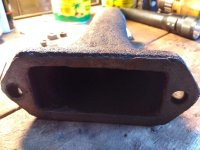
An interesting find when I got the exhaust pipe off - I dug around inside the bottom of the manifold with a long, skinny screwdriver and got probably a pound of dirt out of it. Also, the heat control valve "butterfly" had been stuck almost closed, probably for years. I'm amazed the the engine ran with all that increased back pressure. Pics are attached.
 

Attachments

  • IMG_20190109_113855246.jpg
    IMG_20190109_113855246.jpg
    702.3 KB · Views: 2,100
  • IMG_20190109_115709422.jpg
    IMG_20190109_115709422.jpg
    618 KB · Views: 2,100
  • IMG_20190109_115656355.jpg
    IMG_20190109_115656355.jpg
    661.4 KB · Views: 2,100
Not sure how the valve was closed, all it should do is redirect flow through the intake or not, depending on the position. Don't know the size of the studs but the book says the nut is 7/16 NC.
 
Jim, the valve was stuck in the bottom notch on the side of the manifold, which is the closed position (I believe that was to aid starting with kerosene - I'll have to check my manual, which is in the barn right now). I agree on the nut size, that should be an easy fix at the hardware store. i'm hesitant on trying to remove the studs though, unless I have a replacement in hand. The old ones will work, but one of them is badly corroded where it enters the manifold. Sure wish I knew the thread of the part that is seized up in the manifold! Another question: would those lower stud threads be left or right threads?

I can't figure how all that dirt got in the manifold unless the exhaust wasn't covered when the engine was off. At any rate, it should breathe a lot better cleaned out!

Thanks for your reply!
 
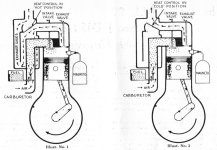
Maybe this diagram will help. It is from some F-20 material, but the idea is the same. Illustration 1 is in the hot position, where yours was evidently left. The valve isn't "closed", the exhaust is redirected through a longer path. If you are familiar with the "heat riser valve" used in carbureted auto engines, this is exactly the same.

The thread in the manifold for your rusted studs is right handed coarse thread.

HotManifoldValveF20.jpg
 
Very interesting, Jim - thank you. I learn something new every day! The updraft carburetor is truly simple and ingenious.

Now the crusted up dirt at the bottom of the manifold - hmmmm - now that couldn't be good!

Jim
 
Wow, I have never seen something like that. I am surprised it was able to stay running. When I restored mine the amount of rust in the manifold and check valve wasn't even worth trying to save and refurbish.
 
Jim, I may be way off base but the manifold studs from the auto parts are usually nc on one end and nf on the other end. One possible approach is to see if the CIH has one on hand that you could look at. Auto parts usually sells them for about 3 or 4 dollars.
 
True, manifold studs are usually NC/NF. Usually the NC end has shorter threads that are screwed into the block/head/whatever and a NF nut is screwed on the longer end to complete the assembly. Studs are also made with a single NC thread the whole length. Some of the automotive studs are NC/NF packaged with a nut for each end. Then you can use them whichever way they fit.
 
staninlowerAL":3vpo8v4l said:
Jim, I may be way off base but the manifold studs from the auto parts are usually nc on one end and nf on the other end. One possible approach is to see if the CIH has one on hand that you could look at. Auto parts usually sells them for about 3 or 4 dollars.


Thanks to you and to Jim. I've been soaking the studs now for over a week in PB Blaster, plus hitting them with heat and then an ice cube, and double nutting them. No movement on the studs. At this point I'm afraid I might crack the cast iron manifold and since it's a distillate manifold, I don't want to chance that, so I've decided to live with the studs as is. They aren't great, but I can still get nuts on them if I use a washer. If they ever strip the threads, I'll drill them out. Not now though.

On to the carb and governor now. :)
 
NavyBM":1mak967a said:
Wow, I have never seen something like that. I am surprised it was able to stay running. When I restored mine the amount of rust in the manifold and check valve wasn't even worth trying to save and refurbish.

Hahahaha! Well, you see, that WAS the problem! It was running, but it started to run pretty rough, so I waded into it and - well - it's like renovating an old building, I'm finding out. That little rotten spot on the old building often turns out, once you get into it, to be not so little.

Same for old tractors. I'm now re-wiring the tractor, rebuilding the carb and distributor, working on the throttle shaft, and probably more as time goes on. But, heck, that's why I got the tractor in the first place! I like doing this stuff! :tractor:
 
Jim in SC":1690fdcf said:
........that's why I got the tractor in the first place! I like doing this stuff! :tractor:
Sure beats sessions with a psychiatrist and a lot less expensive. :surrender: :lol: :hattip: :tractor:
 
staninlowerAL":r4t0y71e said:
Jim in SC":r4t0y71e said:
........that's why I got the tractor in the first place! I like doing this stuff! :tractor:
Sure beats sessions with a psychiatrist and a lot less expensive. :surrender: :lol: :hattip: :tractor:

Very true, but I'm not real sure about the less expensive part!
 
Back
Top