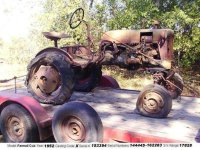
Getting a '51 Cub Running

wslove

New member
Hi all,

New to the forum. I ran across it searching for info on my dad's old 1951 Cub. Sadly, it has sat for 20+ years after he got sick in 2001 and passed in 2010. I'm in the process of "getting it all running" again after so long just as a side hobby/nostalgia thing. Is there a thread on here that is a good starting point for things to watch out for/basic how-to/etc for something that has sat for so long? I'm fairly certain it's still the 6v system, and engine will turn with the crank handle.

Is there any harm in starting with a fresh battery and fluids, and just see what happens? Just don't want to blow something up and do irreparable damage by doing things in the 'wrong' order. I'm mechanically inclined, but the restoration process is a new frontier for me.

Also have a 1942 H and 1970 140 that are on the docket for at least an attempt at restoration if the Cub situation goes well.
 
Just don't want to blow something up and do irreparable damage by doing things in the 'wrong' order.
Hi,
When a Cub has sat for some time, it is sort of common for the oil pump to lose it's prime.
Then if you start the engine, there is no oil pressure, or oil circulation.
The oil pump needs priming if there is no oil pressure showing on the oil gauge.
Do not run the engine with no oil pressure, it will cause engine damage.
It's better to prime the oil pump before running the engine, if it has sat for some time.

To prime the oil pump, remove the oil filter cover bolt, cover, and oil filter.
There is a small hole near the top, inside the chamber. Use a light to see it, if needed, especially if the hood is on the Cub.
It is an engine oil passage.
I use a clean pump oil can to pump clean motor oil into the hole. It might take more than 1 filling of the oil can to fill the passage in the engine.
When the hole is full of oil, put in the oil filter, and put the cover on.
If the chamber is dirty inside, you can wash it with kerosene and a brush. The Cub owner's and operator's manuals say to put the bolt in without the filter or cover, so the kerosene doesn't run down into the engine.
There is a drain for the chamber below the starter.
The pipe may be plugged if nobody has drained it lately. Sometimes if you remove the cap at the bottom of the pipe, and let it sit, the goop will begin moving down and come out of the pipe. Or you may need to push it out.
Watch the oil gauge when the engine is running, it takes 15 or 20 seconds for the gauge to show pressure, the pump has to fill the oil filter chamber before the gauge shows pressure.
Don't run the engine after priming the system without the oil filter, cover, and bolt in place.
Below is a picture of where the oil passage hole is. :)
 

Attachments

  • Cub oil filter.jpg
    Cub oil filter.jpg
    83.8 KB · Views: 6
Welcome to the Forum. You can expect to find one or more stuck valves after sitting for so long. You can remove the rectangle cover on the left side of the block behind the carb and see if the lifters and valves are all moving. Spray the parts liberally with some penetrating lubricant to help get things moving. While you have the cover off is a good time to check the valve clearance with a feeler gauge and set the clearances. If you find any stuck valves, you might be able to remove the hood and spark plugs so you can lube the top of the valves and try to get things moving before resorting to removing the head. Patience is you best tool, use it liberally. The pic attached is one that I brought back after about 30 years of inactivity. JMHO Stan
 

Attachments

  • 1aaOdomCub.JPG
    1aaOdomCub.JPG
    108.6 KB · Views: 7
  • 1abOdomcub.JPG
    1abOdomcub.JPG
    134 KB · Views: 7
I usually start with the basics when getting something running again after sitting a long time.

Check for spark, check compression, check fuel. The tank might need to be cleaned out. The carb may be dirty and need a good cleaning. Fuel line might be rotted out.

As others mentioned, check the valves. Might be sticky and out of tolerance. Set to .015” clearance.

Glen mentioned priming the oil pump. You definitely want to do that before attempting to fire it up.

Changing all the fluids is a good idea. Fresh engine oil, transmission oil, final drive oil, steering gearbox oil, coolant, etc. Grease all fittings.

Sometimes old stuff just fires right up and runs great. Other times it’s a battle. If it ran good years ago it will likely be fine with a little work. Good luck!
 
Cdahl and Stan covered valves and fluids. The next place l'd look at for an inexpensive starting point is points, plugs, condensor, and wires. Sometimes you can get by with just a clean up and checking the gap, but l'd at least check them out before getting frustrated with no spark.
Good luck with your project, and my condolences for your loss.
By the way, we love pictures on projects like this, so if you have time.
 
Back
Top