A baler described with hand tying was made by Case. Luckily I was too young to work on it but my uncle had one. I have no idea if a tool like that was used. I am however going to question it, I feel it would be difficult at best to feed a wire thru the small hole while bouncing across a field but I have been wrong before. Some of the wires had a loop on one end and the other end was twisted to tye the bale. Another design had a loop with a slot formed by the wire the same width as the wire. The other end had a ball which was slipped thru the hole and would pull back into the slot as the bale expanded leaving the chamber, this however did not allow the crew to control the length of the bale unless they were tyed by twisting. I do remember trying to feed these bales, both styles of wire, as they were heavy and I had to break them open in the mow and carry a few slabs at a time. As to auto tye wire, both Moline and JD built them. On a JD the plunger ran sideways and a large 90 degree chute was necessary to turn the bale towards the wagon. This also made the bales look like bananas. Vern

You are using an out of date browser. It may not display this or other websites correctly.
You should upgrade or use an alternative browser.
You should upgrade or use an alternative browser.
Anybody know?
- Thread starter Barnyard
- Start date
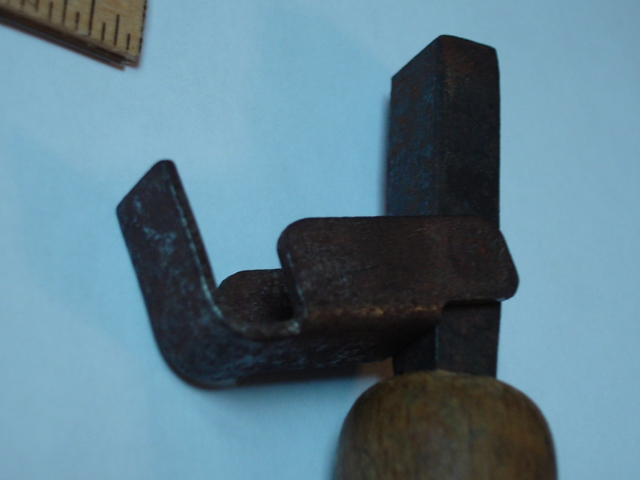
With the hole question settled, I agree with Clint, pan handle. The one in this patent is quite different but the similarities on the "working end" are pretty strong.
http://www.google.com/patents?id=pM...=gbs_selected_pages&cad=2#v=onepage&q&f=false
http://www.google.com/patents?id=pM...=gbs_selected_pages&cad=2#v=onepage&q&f=false

Jim Becker":24jkie9o said:With the hole question settled, I agree with Clint, pan handle. The one in this patent is quite different but the similarities on the "working end" are pretty strong.
http://www.google.com/patents?id=pM...=gbs_selected_pages&cad=2#v=onepage&q&f=false
That makes the most sense to me now.
Also, on the back side of the latch, does it look like some numbers on it... enlarged it looks like a couple 2's, but then again, it is not a clear close up and it could be my minds eye playing tricks on me.

Well, I told my cousin what the possible answer was and recommended she grab a pan and try it. I got this from her a few minutes ago.
She also sent these along;
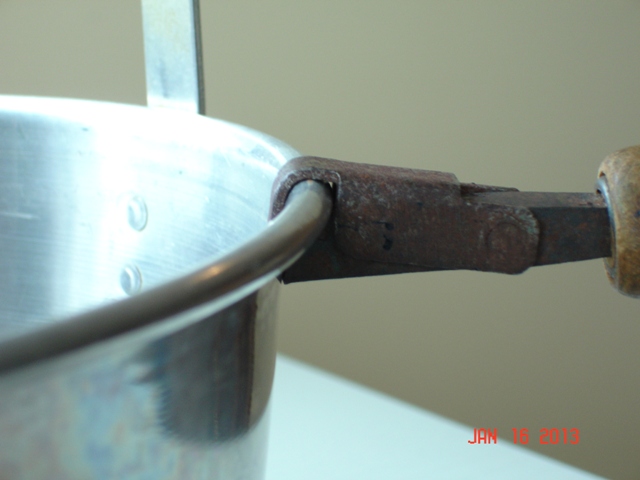
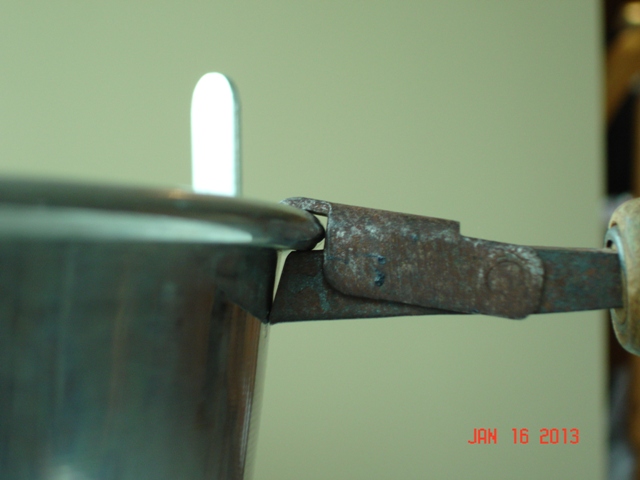
Thanks Clint for the answer. And thanks also to everybody else for your help.
I think she is tickled to know she now has something her grandmother used in the kitchen instead of Uncle Walter using in the field :lol: .Bill,
Let me know what the final consensus is,
but it’s looking like Grandma gets the last laugh...
Angie
She also sent these along;
Thanks Clint for the answer. And thanks also to everybody else for your help.
beaconlight
501 Club
Sure had my imagination run away on me.

John *.?-!.* cub owner
501 Club
microwaves. LOLv w":2o9a1oq4 said:This is the style I remember. What ever happened to it??????????
........
danovercash
501 Club
Corning Ware had removeable handles, but we never used them. They had to be put on and the screw tightened.