
You are using an out of date browser. It may not display this or other websites correctly.
You should upgrade or use an alternative browser.
You should upgrade or use an alternative browser.
Anybody know?
- Thread starter Barnyard
- Start date
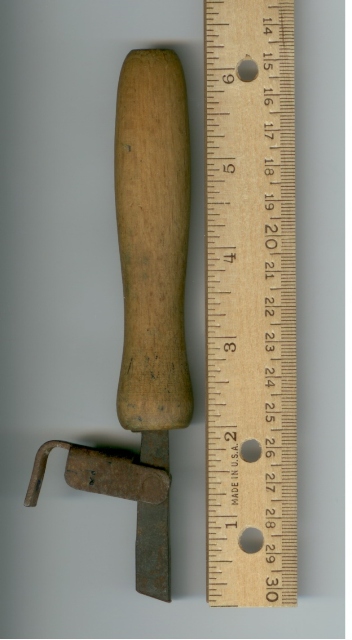
Half of a saw handle???

Clint Carter
501 Club
looks like you would use it to pick up a hot pan with to me. A detachable handle

Don McCombs
501 Club
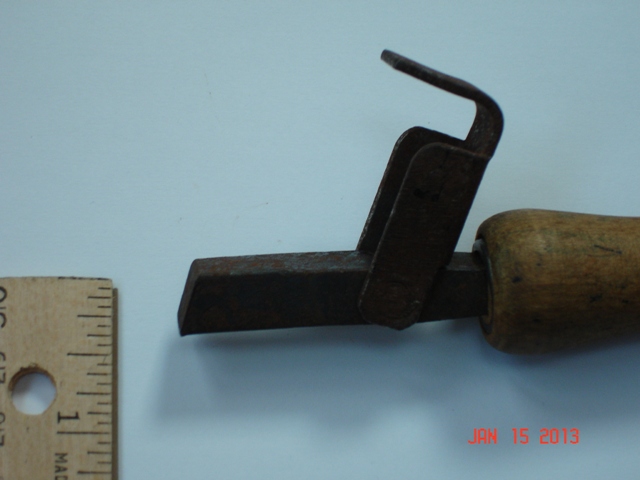
The guard at the business end implies that it is sharp, although it doesn't look that way.
Don McCombs
501 Club
Interesting. Not sharp and doesn't look like it ever was. Wonder what the guard is for?
Bill, With a stationary baler, there is a cut piece of wire with a loop on one end. The unlooped end is fed through slots in vertical blocks that separate the bales. When the wire comes through at the end of bale on the same side it was started, it is passed through the loop and twisted around the wire by hand. I'm not sure what the next version consisted of, but I would assume that when the baler was pulled through the field, the wire "knotting" and cutting would have been done by the machine.
Bob
Bob
farmallcub49
501 Club
I always thought a wire tie baler when pulled through the field, still had the wire tied by hand. I thought I have seen pictures of men sitting on the back tying the bales as it went through the field.

Andy, my cousin said she remembers her uncle telling her how he would ride the baler through the field and had to place a piece of wood between the bales. That wood would have been where the wire was inserted between the bales. I think you have the right idea here when you say the later balers had riders.
I'm just not sure if he may have used this tool as part of the tying process.
I'm just not sure if he may have used this tool as part of the tying process.
In the early days of pick-up balers, they were little more than a stationary baler with wheels and a mechanism to get the hay up off the ground. A worker had to stand up behind the pick-up unit and fork the hay under the wad board. Two more people were required on each side of the chamber to hand tie the bales. Later on, balers with auto-feed and later yet with auto-tie came along. I suppose there were a lot of farmers that started with a roll of wire, cut it to length and twisted a loop into one end prepare for baling. However, there was also wire available that was precut and preshaped. The loop end had a key hole shape to the loop. The other end looked a bit like the head of a nail. Once the wire was fished through the divider board slots, one end was simply hooked into the other. I assume there were multiple designs for the wire ends, as everyone tried to bypass everyone else's patents. Here is one patent to give you an idea what I am trying to describe. This one has multiple knots on the straight end to allow for different bale lengths.
http://www.google.com/patents/US1957676
Back to Barnyard's tool. Does the hinged end have a hole through it? I thought it looked so in the first picture.
http://www.google.com/patents/US1957676
Back to Barnyard's tool. Does the hinged end have a hole through it? I thought it looked so in the first picture.
The first "pickup" baler that I ever saw was as Bob McCarty described. It was a three man operation with one driving the tractor that pulled the baler. The pto was not used. The baler was run by an independant power unit. The other two operators sat on seats on each side near the rear of the baler. The wire was already cut to length with a loop on one end in a bundle. The wooden block divider was slid in place by one operator. The other operator fed the wire through a slot in the wood to the other one. Who then fed it back to the first one through a slot in another block on the other end of the bale. The first man then loosely tied the wire off by hand. The operation was then repeated.
OSHA would have had a field day with this, as the two riders at the end of the day were covered from head to toe with dust. All you could see were their eyeballs.
OSHA would have had a field day with this, as the two riders at the end of the day were covered from head to toe with dust. All you could see were their eyeballs.

Barnyard":1hq0wkm2 said:Jim, from the way I see it I don't believ it has a hole. I don't have access to it. My cousin has been providing the photos.
I enlarged one of your first pictures, and it appears to have a hole in the latch part.
Attachments

Donegal Cub
501 Club
Don't know what that is. I remember as a young boy about 14yrs tying wire at a stationary baler.
Donegal Cub.
Donegal Cub.
beaconlight
501 Club
I can see how it might work. The free end if the wire through the loop and then into the hole of the hinged piece. pivot so the hinge closes to secure the wire. Pull to tighten the wire, then push it backwards against the bail to secure. slip off the wire and slide the wire end under the running part of the wire and bend up to lock in place.
I can visualize it and hope I have described it so others can see what I am thinking. I kind of guess you would want a pair of pliers too, though I can see picking the wire after it is slipped under to grip it to lock the stitch.
This tool would be light yet still grip the wire and fit into a pocket. It would fit into a pocket in a pair of overalls which would be deep enough to hol and not fall out.
I can visualize it and hope I have described it so others can see what I am thinking. I kind of guess you would want a pair of pliers too, though I can see picking the wire after it is slipped under to grip it to lock the stitch.
This tool would be light yet still grip the wire and fit into a pocket. It would fit into a pocket in a pair of overalls which would be deep enough to hol and not fall out.